

7 Benefits of Buying Coffee Beans Directly From Roasters
Quick Summary
Buying coffee beans directly from a roaster gets you fresher, more flavorful coffee because the beans are roasted recently rather than sitting on a shelf for weeks or months. Direct buyers also see the roast date, origin, processing and roast level, and can choose beans to match their brewing method.
- Roasters can ship soon after roasting, so beans arrive fresher than most grocery store coffee.
- Look for a specific roast date on the bag, not just a vague best-by stamp.
- Compare cost per brewed cup, not cost per bag, when weighing direct against grocery coffee.
- A good roaster lists the region, processing method, variety and tasting notes on each bag.
- Plan to finish a bag within about four weeks of its roast date.
Table of Contents
- Why Buying Coffee Beans Directly From Roasters Changes Your Cup
- 7 Benefits of Buying Coffee Beans Directly From a Roaster
- Freshly Roasted Coffee Beans: How to Read the Roast Date
- How to Choose Coffee Beans and Identify a Quality Roaster
- Roaster Direct vs. Grocery Store Coffee: Price, Shipping and Subscriptions
- How to Buy Coffee Beans Online From Roasters Without Overpaying
- Who May Not Benefit and Your Next Bag of Iron Spur Beans
- Frequently Asked Questions
Why Buying Coffee Beans Directly From Roasters Changes Your Cup
Last Updated: November 17, 2026
Buying coffee beans directly from a roaster is the simplest way to get fresher, more flavorful coffee at home. At Iron Spur Coffee, we roast to order in small batches, which means the beans you receive were roasted recently, not sitting on a grocery shelf for months. The gap between a roast date and your first cup is where most of the flavor is won or lost.
Grocery store coffee is often roasted for a distribution schedule rather than for the person who will brew it. Beans can spend weeks or months in transit and storage before they reach you. Direct purchasing shortens that chain, and the benefits show up in the cup.
Below, we cover seven concrete benefits, show you how to read a roast date, explain how to identify a quality roaster, compare direct purchasing with grocery store options, and list who may not benefit from switching.
7 Benefits of Buying Coffee Beans Directly From a Roaster
Buying directly from a roaster gives you more control over freshness, flavor and value. Here are the seven benefits that matter most.
- Fresher beans. Roasters can ship soon after roasting, so your beans arrive fresher.
- Roast dates you can read. A reputable roaster prints the roast date on the bag, so you know exactly how old your coffee is.
- Clear origin information. Our single-origin coffees come with details on region, altitude, variety and processing.
- Control over roast level. You can choose light, medium or dark roasts based on your taste, not the shelf's default.
- Better matching to your brewing method. Many roasters can recommend a bean for pour-over, espresso or French press.
- Access to small-batch coffees. Small lots often showcase flavors that mass-market blends smooth out.
- Convenient reordering. Subscriptions and saved orders keep you stocked without a grocery run.
For example, our Ethiopia Natural is a medium-light roast with milk chocolate, fruity and caramel notes, grown by smallholder farmers in the Sidama Zone.
Freshly Roasted Coffee Beans: How to Read the Roast Date
A roast date tells you how fresh your beans are, and it is the first thing to check on any bag. Look for a specific calendar date rather than a vague "best by" stamp, because the roast date is what matters for flavor. Most roasters who sell direct print it as a day-month-year stamp or a "roasted on" line; if a bag shows only a best-by date, you cannot calculate age, and that is a reason to ask before you buy.
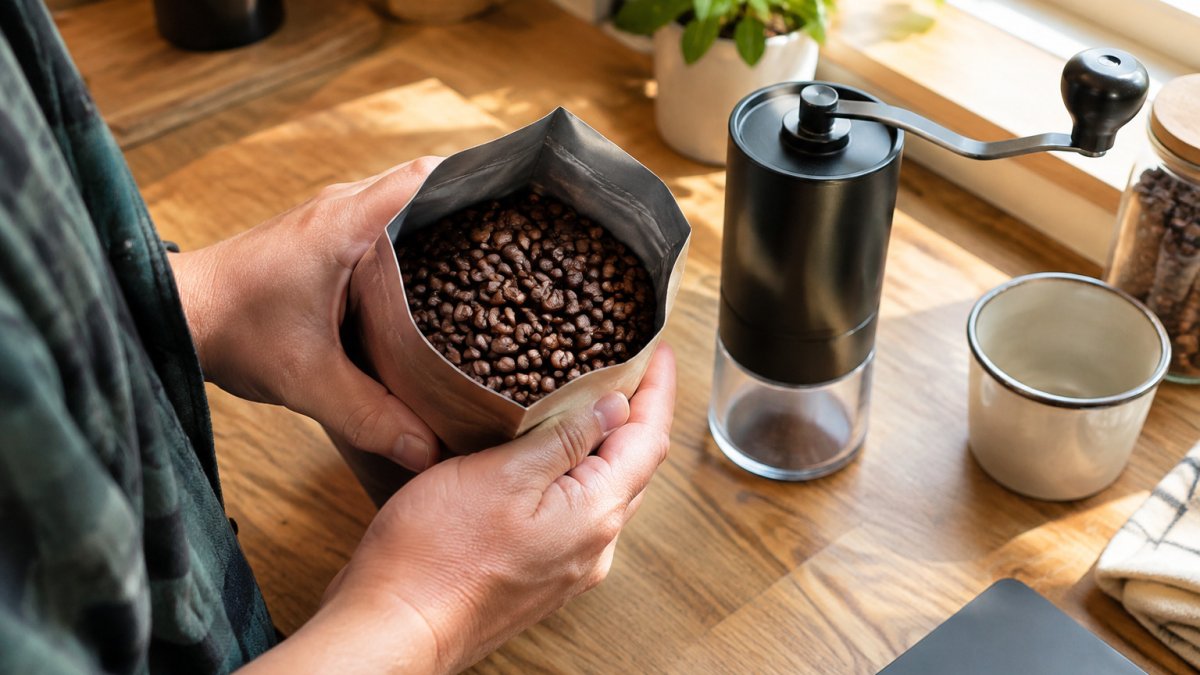
Coffee is at its best in the first few weeks after roasting. Beans release carbon dioxide after roasting, a process called degassing, and the flavor changes as they age. Very fresh beans can taste sharp or gassy in the first few days, especially in espresso, where trapped gas disrupts extraction. These are starting points, not rules; darker roasts degas faster and light roasts slower.
Use this freshness checklist before you buy:
- Find the roast date, not the best-by date. A specific date lets you calculate age; a best-by stamp does not.
- Do the math on arrival. Add shipping time to the roast date. A bag roasted three days before shipping and delivered in four days arrives about a week old, still in its prime window.
- Size the bag to your habit. Plan to finish a bag within a few weeks of the roast date.
- Check the valve and seal. A one-way degassing valve lets carbon dioxide escape without letting oxygen in. A bag with no valve and no seal is a warning sign for a roaster that does not prioritize freshness.
- Ask how the roaster ships. Roast-to-order roasters ship within days of roasting; roasters who batch-roast for wholesale may ship older stock.
Once the bag is open, storage decides how long freshness lasts. Keep beans in an airtight container away from heat, light and moisture, and avoid the refrigerator, where condensation can damage the beans. A cool, dark cabinet is fine. Grind just before brewing.
Watch out: a roast date alone does not guarantee quality. A bag roasted last week but stored in a hot warehouse or a clear bin can taste older than a bag roasted three weeks ago and kept sealed and cool. Treat the date as the starting point and the storage and shipping chain as the rest of the story.
For a fuller guide, see our article on how to store coffee beans after opening. If you want to judge freshness once beans are home, our signs that coffee beans have gone stale explain what to look for.
How to Choose Coffee Beans and Identify a Quality Roaster
Choosing a good roaster starts with transparency. A quality roaster tells you where the coffee grew, who grew it, how it was processed and when it was roasted.
Use this checklist when you evaluate a roaster:
- The roast date is printed on every bag.
- The origin names a region, country and often a farm or cooperative.
- Processing method and variety are listed.
- Tasting notes describe the cup, not just marketing language.
- The roaster explains its roast level and what it means for flavor.
Roast level shapes flavor as much as origin does. Light roasts tend to highlight acidity and origin character, while darker roasts emphasize body and chocolate or caramel notes. If you are unsure which level suits you, our guide to coffee roast types walks through the differences. Origin matters too: altitude, soil and processing all change the cup, and our explanation of why origin affects flavor covers the reasons.
Watch out: many bags use words like "premium" or "artisan" without giving any data behind them. Ask for the roast date, origin and processing before you buy.
Roaster Direct vs. Grocery Store Coffee: Price, Shipping and Subscriptions
Price is the first thing most shoppers compare, and it is where the direct-vs-grocery decision usually gets made, often on the wrong number. A single bag from a roaster often costs more per bag than a supermarket brand, but the cost per cup can be closer than it looks, because fresher beans brew more flavorful coffee and you waste less of a bag that tastes flat. The right comparison is cost per brewed cup, not cost per bag.
Here is how the two channels differ on the factors that actually affect value:
| Factor | Roaster direct | Grocery store coffee |
|---|---|---|
| Roast date | Usually printed on bag | Often missing or vague |
| Freshness | Roasted within days of shipping | Can be weeks or months old |
| Origin detail | Region, farm, processing | Often a blend with little detail |
| Price per bag | Typically higher | Typically lower |
| Shipping | Varies; often free above a threshold or built into subscription | No shipping; bought in person |
| Subscription | Common; frequency and skip options vary | Rare |
| Convenience | Online ordering, delivery | Available on the next shopping trip |
Our single-origin bags are $23.99 each.
To compare fairly, do the per-cup math. A 12-ounce bag holds about 340 grams. At roughly 18 grams per brewed cup, that is about 18 to 19 cups per bag. At $23.99, that works out to roughly $1.25 to $1.35 per cup before shipping.
Shipping costs change the math.
- Delivery frequency. Match it to how fast you finish a bag, usually every two to four weeks for daily drinkers.
- Skip, pause and cancel terms. A good subscription lets you skip a delivery without penalty.
- Price lock. Check whether the subscription price is fixed or can change at renewal.
- Shipping cost and speed. A slow, cheap shipping option can erase the freshness advantage if the bag sits in transit.
Sourcing claims deserve the same scrutiny as price. "Direct trade" and "relationship coffee" are marketing terms, not regulated certifications, so a roaster can use them loosely. To verify what you are buying, look for a named producer, farm or cooperative; a region and altitude; the processing method; and, where applicable, a third-party certification such as Fair Trade or Rainforest Alliance. A roaster that publishes harvest and producer details is giving you something checkable; one that only says "ethically sourced" is not.
Watch out: a low per-bag price can hide a high per-cup cost if the coffee is stale or the bag is oversized for your habit. Compare cost per brewed cup, add shipping, and factor in how much of the bag you will actually finish before it fades.
How to Buy Coffee Beans Online From Roasters Without Overpaying
Buying coffee beans online from roasters can be simple if you plan your purchase. Start by deciding how many cups you drink each week, then choose a bag size you can finish within about four weeks of the roast date.
Follow these steps:
- Pick a roast level and origin that match your brewing method.
- Check the roast date on the product page or label.
- Compare the per-bag price with the amount of coffee you actually brew.
- Read the shipping and subscription terms before checkout.
- Set a reorder schedule so you never run out between roasts.
Do not buy more than you can drink in about a month. Stale beans are a bigger waste of money than a slightly higher price per bag.
Who May Not Benefit and Your Next Bag of Iron Spur Beans
Buying directly from a roaster is not the right choice for everyone. If you drink coffee rarely, or you only use it in strongly flavored drinks where freshness matters less, a grocery store bag may serve you well. If you need the lowest possible price per pound and do not mind a flatter cup, the supermarket aisle makes sense.
For shoppers who want fresh, traceable beans, the case for buying direct is strong. Our single-origin coffees are $23.99 each. Pick the origin that matches your taste, check the roast date, and order a bag you can finish within a month.
Ready to try it? Discover Iron Spur Coffee today and taste the difference that fresh, small-batch roasting makes.
Frequently Asked Questions
Are coffee beans fresher when you buy them from a roaster?
Usually, yes. Roasters that sell directly often ship within days of roasting, and many print the roast date on the bag. Grocery store coffee can sit on shelves for months with no roast date at all. Check the roast date on any bag before you buy, and look for a date within the last few weeks. Beans are at their best roughly two to four weeks after roasting for most brew methods, so a recent roast date matters more than the brand name.
How long do coffee beans stay fresh after roasting?
Whole beans keep their best flavor for roughly two to four weeks after roasting, though they remain drinkable for longer. Ground coffee loses flavor much faster, often within days. Store beans in an airtight container away from heat, light and moisture. Buying in bag sizes you can finish within a few weeks helps you avoid stale coffee. Once you open a bag, use it within a few weeks for the most consistent cup.
Is it better to buy coffee beans online or from a local roaster?
Both can work well. A local roaster lets you ask questions and sometimes pick up the same day. Ordering online from a roaster gives you access to a wider range of single-origin coffees and direct shipping. Whichever you choose, check the roast date, ask where the beans come from, and confirm the roaster sells whole beans so you can grind them fresh at home.
Does buying coffee directly from a roaster support coffee producers?
It can. Some roasters buy directly from farms or cooperatives and publish the producer names, region, altitude and processing method on the product page. That kind of disclosure is a good sign. Ask whether the roaster pays producers directly and whether it works with the same partners over time. Be cautious of vague claims like 'ethically sourced' with no supporting details.
