

How to Store Coffee Beans After Opening: 2026 Guide
Table of Contents
- Why Proper Storage Decides Whether Your Coffee Peaks or Dies
- How to Store Coffee Beans After Opening: A Step-by-Step Method
- Coffee Bean Shelf Life: How Long Beans Stay Fresh After Opening
- Best Coffee Storage Containers: Material Comparison and Picks
- Freezing Coffee Beans: When It Works and How to Avoid Condensation
- How to Store Coffee Beans After Opening for Different Roast Levels
- Common Coffee Storage Myths and Troubleshooting Stale Beans
- Conclusion
- Frequently Asked Questions
Last Updated: October 1, 2026
Why Proper Storage Decides Whether Your Coffee Peaks or Dies
Coffee starts dying the moment you open the bag. That is not drama, it is chemistry: roasted beans begin losing the gases and oils that carry flavor within hours of contact with air. At Iron Spur Coffee, we roast to order for exactly this reason, because a fresh roast gives you a head start that no storage trick can recreate.
The Four Enemies: Oxygen, Moisture, Heat, and Light
Four things wreck coffee, and they work as a team:
- Oxygen: triggers oxidation, which turns bright acids flat and stale
- Moisture: pushes beans toward soggy, dull, lifeless cups
- Heat: speeds up every chemical reaction you are trying to slow
- Light: breaks down the volatile compounds that create aroma
How Degassing and Oxidation Steal Flavor
Degassing is the release of carbon dioxide trapped inside beans during roasting. Fresh beans breathe. That is normal and good, and it is why a one-way valve matters.
How to Store Coffee Beans After Opening: A Step-by-Step Method
This is the method we recommend to every customer who asks how to store coffee beans after opening. It takes about two minutes.
Step 1: Keep the One-Way Valve Bag
Do not toss the original bag. A quality bag is built with a one-way valve that releases carbon dioxide while blocking oxygen. Fold the top down tight and clip it shut between uses. This is the cheapest upgrade most people never make.
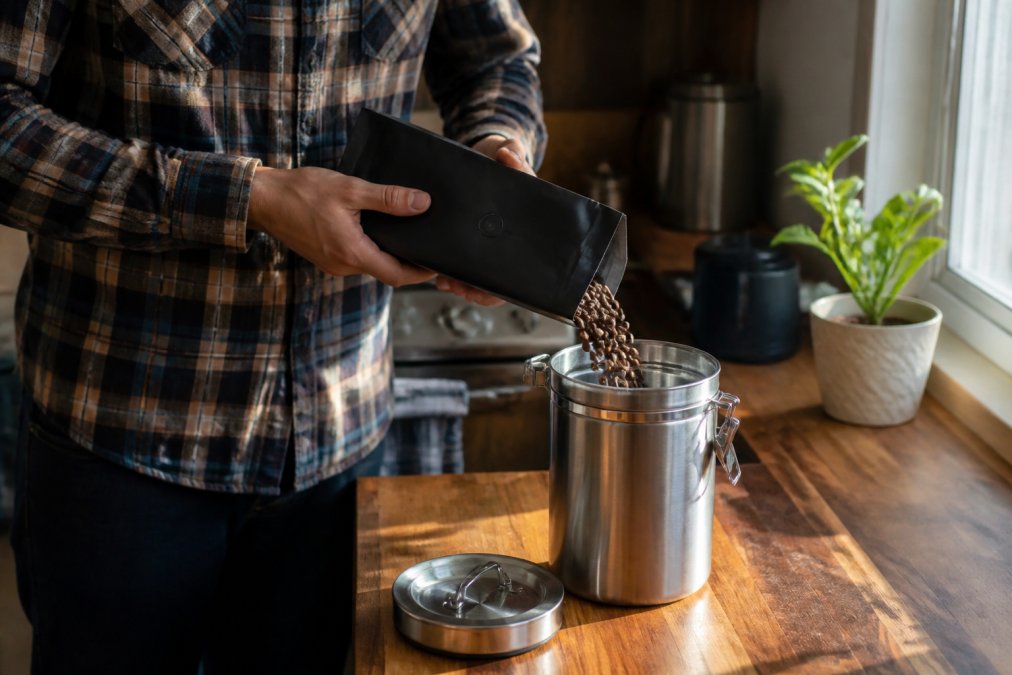
Step 2: Transfer to an Airtight, Opaque Container
If you want better protection, move beans into an airtight container that blocks light. Opaque matters as much as sealed. A clear glass jar on a sunny counter fails at sunlight exposure no matter how tight the lid is.
Step 3: Store at Room Temperature, Away from Sunlight
Keep beans in a cool, dark cabinet at room temperature. Away from the stove, away from the window, away from the top of the fridge. Simple, but it decides how long your beans last.
Coffee Bean Shelf Life: How Long Beans Stay Fresh After Opening
Coffee bean shelf life after opening runs roughly two to four weeks at room temperature in a sealed, dark container. Whole beans hold up far longer than pre-ground coffee because there is less surface exposed to oxygen.
Several things shorten that window:
- Grind size: finer grinds go stale faster, so grind right before brewing
- Roast level: darker roasts tend to fade sooner than lighter ones
- Container quality: a sealed opaque jar outlasts a paper bag by weeks
- Storage spot: heat and moisture cut shelf life fast
Best Coffee Storage Containers: Material Comparison and Picks
The best coffee storage containers share three traits: they seal airtight, block light, and stay easy to clean. Material is where most buyers get stuck, so here is the honest breakdown, including the mechanisms that actually matter.
What Actually Matters in a Container
Three physical properties decide whether a container protects beans:
- Oxygen permeability: how easily oxygen molecules pass through the material or its seal. Metals and glass are essentially impermeable; most plastics are not.
- UV and visible-light transmission: light energy breaks down the volatile compounds that create aroma. Opaque materials block it; clear materials do not, regardless of lid tightness.
- Seal geometry: a gasket, clamp, or threaded lid that stays compressed over hundreds of open-close cycles. A loose press-fit lid fails within weeks.
Material-by-Material Breakdown
| Material | Light Blocking | Oxygen Permeability | Seal Quality | Best For |
|---|---|---|---|---|
| Stainless steel | Excellent | Negligible | Excellent (with gasket) | Daily home use |
| Ceramic (opaque glaze) | Excellent | Negligible | Good (gasket-dependent) | Counter display |
| Opaque plastic (HDPE/PP) | Good | Low but non-zero | Good | Budget setups |
| Clear glass | Poor | Negligible | Varies | Short-term only |
| Original valve bag | Good | Low | Good | Simplest option |
| Vacuum-sealed plastic | Good | Low | Excellent | Freezer portions |
Stainless steel is our top pick for most people. It is opaque, durable, does not hold onto old oils the way plastic can, and its oxygen permeability is effectively zero. Look for a silicone gasket and a clamp or screw lid rather than a press-fit top.
Matching the Container to Your Routine
- Daily drinker, one bag at a time: stainless steel canister with a gasket, kept in a cabinet.
- Two or three bags open at once: one canister per bag, labeled with the roast date.
- Freezer stash: vacuum-sealed portions, one per session.
- Travel or office: the original one-way valve bag, folded and clipped.
Freezing Coffee Beans: When It Works and How to Avoid Condensation
Freezing coffee beans works well for long-term storage, but only if you do it right. The freezer slows oxidation and preserves peak flavor for months instead of weeks. Done wrong, it ruins beans through condensation.
Follow these rules:
- Use a freezer-safe, vacuum-sealed bag or airtight container
- Freeze in small portions you will use in one go
- Do not thaw and refreeze; take out only what you need
- Let sealed beans sit at room temperature before opening
How to Store Coffee Beans After Opening for Different Roast Levels
Roast level changes the storage math, and almost no guide explains why. The mechanism is straightforward once you see it: roasting drives moisture out of the bean and brings oils to the surface. The darker the roast, the more oil sits on the outside of the bean, and the faster those surface oils oxidize when they meet air.
Why Roast Level Changes the Clock
- Light roasts are roasted for less time and to a lower internal temperature. They retain more of their original density, keep more oils inside the bean structure, and finish with a drier surface. That means less exposed oil, slower oxidation, and a longer practical window.
- Medium roasts sit in the middle. Surface oil is present but not dominant, and the bean still has enough structural density to slow gas exchange.
- Dark roasts are roasted longer and hotter. The bean expands, cracks more, and pushes oils to the surface. Those surface oils are directly exposed to oxygen the moment the bag is opened, so dark roasts fade noticeably faster, often within a week to ten days of opening for peak character.
Degassing also differs by roast. Darker roasts degas carbon dioxide faster in the first days after roasting, which is why a one-way valve matters most in that window. Lighter roasts release gas more slowly and over a longer period, so a light roast opened at two weeks may still be actively degassing.
Practical Storage by Roast Profile
| Roast Level | Surface Oil | Degassing Rate | Practical Window After Opening | Storage Priority |
|---|---|---|---|---|
| Light | Low | Slow, extended | 3-4 weeks | Seal and block light |
| Medium | Moderate | Moderate | 2-3 weeks | Airtight and dark |
| Dark | High | Fast, front-loaded | 1-2 weeks | Small batches, freeze extras |
What This Means for Your Buying and Storage Habits
- If you drink dark roasts: buy the smallest bag you will finish in about ten days, keep it in an opaque, airtight container, and freeze any portion you will not reach in that window. Do not buy a two-pound bag of dark roast "to save money" unless you are freezing most of it.
- If you drink light roasts: you have more breathing room, but the rules do not change. Airtight, opaque, room temperature, always. A light roast left in a clear jar on a sunny counter will still go flat.
- If you keep multiple roasts open: store each in its own labeled container with the roast date written on it. Mixing beans from different roast dates in one jar means the oldest beans set the flavor ceiling for every cup.
Common Coffee Storage Myths and Troubleshooting Stale Beans
Most storage advice online repeats the same three words, cool, dark, airtight, and stops there. Here is what actually trips people up.
Conclusion
Keeping coffee at its best comes down to discipline: seal it, shade it, keep it cool, and buy only what you will drink while it is fresh. That is the whole game.
Frequently Asked Questions
How long will coffee beans last once opened?
Opened coffee beans hit peak flavor within 7 to 14 days and start tasting noticeably stale by 3 to 4 weeks when stored at room temperature in an airtight, opaque container. Whole beans outlast pre-ground coffee because less surface area is exposed to oxygen. For longer storage, freezing coffee beans in a vacuum-sealed or freezer-safe bag extends freshness for up to 2 to 3 months. Always check the roast date on the bag, not the best-by date, since that tells you when the clock actually started.
What is the best container to store coffee beans in?
An opaque, airtight container made of ceramic or stainless steel is the best coffee storage container for most kitchens. These materials block sunlight exposure and do not absorb or transfer odors the way plastic can. Look for a container with a one-way valve if you plan to store beans within the first week after roasting, since beans release carbon dioxide during degassing. Vacuum-sealed canisters work well for longer storage. Avoid clear glass jars on open shelves and thin plastic bags that let oxygen and moisture through.
Should you store coffee beans in the refrigerator or freezer?
The refrigerator is the worst option because beans absorb moisture and food odors every time the door opens. The freezer works well for long-term storage of freezing coffee beans when you use a vacuum-sealed or freezer-safe bag and portion out what you need. Let frozen beans thaw completely in the sealed bag before grinding to avoid condensation. For daily use, room temperature in an airtight, opaque container preserves peak flavor without the thawing hassle.
Is it okay to store coffee beans in a Ziploc bag?
A standard Ziploc bag is not airtight enough to protect coffee beans for more than a few days. The plastic is thin, lets oxygen and moisture through, and does not block sunlight exposure. If you must use one, squeeze out as much air as possible, keep it in a dark pantry, and plan to finish the beans within a week. For anything longer, transfer them to an airtight, opaque container or a vacuum-sealed bag. The one-way valve bag your coffee arrived in is a better short-term option than a Ziploc.