

Top 5 Gooseneck Kettles for Pour Over: 2026 Buying Guide
Last Updated: October 23, 2026
Quick Summary
The top 5 gooseneck kettles for pour over are judged on spout control, temperature accuracy, and build quality. Electric models with variable temperature give you repeatable results, while stovetop gooseneck kettles offer durability and simplicity without cords. Match the kettle to your brewing method, batch size, and patience for measuring temperature by hand.
- A narrow, tapered spout produces a thin, steady stream you can aim at the coffee bed.
- Variable temperature settings usually span roughly 104°F to 212°F on electric models.
- Most pour-over recipes call for water in the range of 195°F to 205°F.
- A common starting flow rate is roughly 4 to 6 grams of water per second during the main pour.
- In hard-water areas, descale every two to four weeks using a 1:1 white vinegar and water mix.
Table of Contents
- What Separates the Top 5 Gooseneck Kettles for Pour Over
- Electric Gooseneck Kettle with Temperature Control: The Set-and-Forget Choice
- Stovetop Gooseneck Kettle: Simplicity, Durability, and No Cords
- Gooseneck Kettle Temperature Control: Why Degrees Decide Flavor
- How to Pour Coffee with a Gooseneck Kettle
- Capacity, Heating Speed, and the Specs That Matter
- Durability, Cleaning, and Long-Term Ownership
- Conclusion
- Frequently Asked Questions
What Separates the Top 5 Gooseneck Kettles for Pour Over
A gooseneck kettle is a pouring vessel with a long, narrow, curved spout that gives you control over water flow, and it is the single piece of gear that most changes the quality of pour-over coffee. At Iron Spur Coffee, we care about what happens in the cup, and the kettle is where consistency starts. The top 5 gooseneck kettles for pour over earn their place on three things: spout control, temperature accuracy, and build quality. Below, we break down exactly how to judge each one, so you can pick the right kettle instead of the best-marketed one.
Selection Criteria: Spout, Temperature, and Build
Spout design decides how much control you actually get. A narrow, tapered gooseneck spout produces a thin, steady stream you can aim at the center of the coffee bed. A wide or flared tip dumps water too fast and disturbs the bed, which pushes extraction unevenly.
Temperature control matters just as much. Specialty Coffee Association brewing standards point to water temperature as a primary variable in extraction, and a kettle that cannot hold a steady temperature forces you to guess.
Build quality is the third pillar. Look for stainless steel bodies, a comfortable handle, a secure base connection, and boil-dry protection. Buyers weighing build quality should recognize the signs of high quality specialty coffee their equipment is meant to serve, because a great kettle cannot rescue stale beans.
Electric Gooseneck Kettle with Temperature Control: The Set-and-Forget Choice
An electric gooseneck kettle with temperature control is the easiest path to repeatable coffee. You set a target temperature, the kettle heats and holds it, and you pour without watching a stove. Variable temperature settings usually span roughly 104°F to 212°F, which covers every brewing method from light-roast pour over to French press.
The trade-offs are real. These kettles cost more, they need counter space near an outlet, and the electronics are one more thing that can fail. Look for a keep-warm function, a clear display, and a timer if you want to track bloom time. Wattage affects heating speed: higher-wattage models reach temperature faster, but they also draw more power.
For most people brewing pour-over coffee daily, an electric model with variable temperature is the practical pick.
Stovetop Gooseneck Kettle: Simplicity, Durability, and No Cords
A stovetop gooseneck kettle is the durable, cord-free option. There is no heating element, no display, and no base to fail. A well-made stainless steel stovetop kettle can last for years with basic care, and it works on gas, electric, and induction cooktops if the base is magnetic.
The catch is temperature control. You heat the water, then either use a thermometer or rely on timing and sound. Many people pull the kettle just before a full boil and let it rest briefly, but that is an estimate, not a measurement. If you brew single-cup pour over and want precision, a stovetop model adds a step. If you value simplicity and long-term durability, it is hard to beat.
Gooseneck Kettle Temperature Control: Why Degrees Decide Flavor
Gooseneck kettle temperature control determines whether your coffee tastes balanced or sharp. Water that is too hot over-extracts the grounds and pulls out bitter, harsh compounds. Water that is too cool under-extracts and leaves the cup thin and sour.
Most pour-over recipes call for water in the range of 195°F to 205°F. Darker roasts generally do better at the lower end, while light roasts need more heat to extract fully. A kettle with variable temperature and a hold function removes the guesswork. If your pour over tastes thin or watery, temperature is one of the first variables to check, and our guide to why your pour over tastes thin and watery walks through the diagnosis.
How to Pour Coffee with a Gooseneck Kettle
Learning how to pour coffee with a gooseneck kettle comes down to three habits: a slow bloom, a steady spiral, and a controlled flow rate. The difference between a good pour and a great one is usually measured in grams per second, not in style.
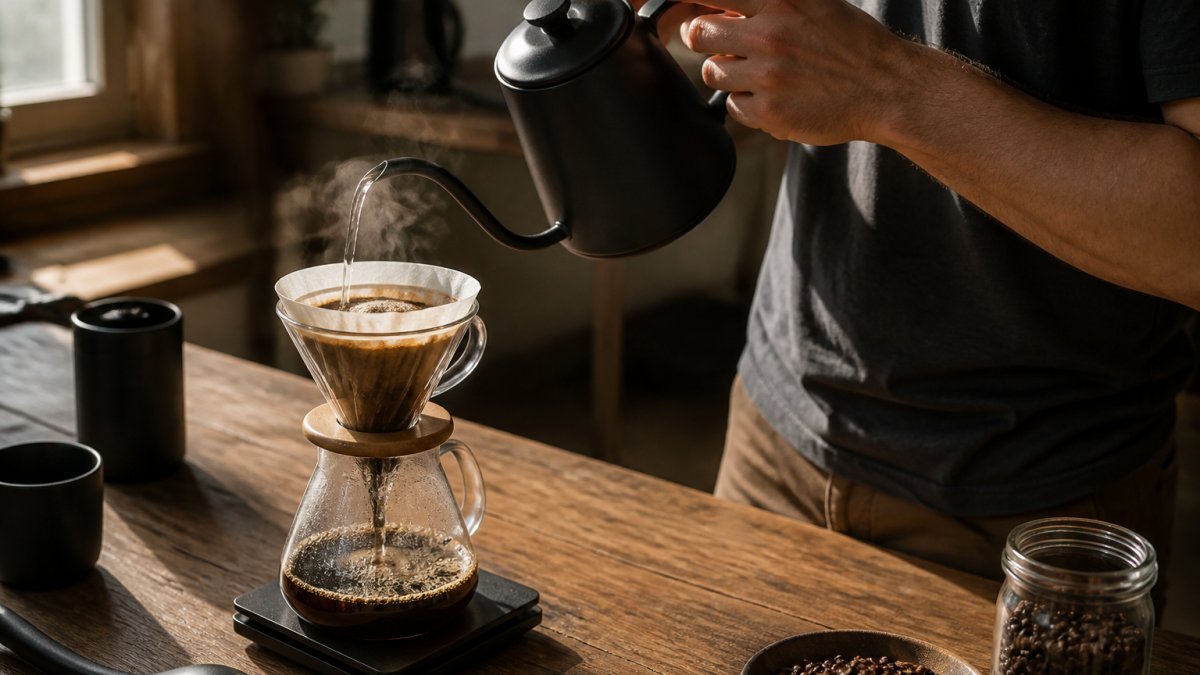
Set a flow-rate target. A common starting point for a single 12- to 16-ounce pour over is roughly 4 to 6 grams of water per second during the main pour, with a slower 2 to 3 grams per second during the bloom. You do not need a lab setup to hit this: put your dripper and mug on a digital scale, tare to zero, and watch the gram readout climb as you pour. If the number jumps faster than about 6 grams per second, you are pouring too hard and the bed is likely channeling.
Bloom with restraint. Start with a medium grind and water at your target temperature.
Pour in slow concentric circles. Work from the center outward, keeping the water level steady and the stream thin. A controlled pour keeps the coffee bed even, which is what produces consistent extraction.
Watch the stream, not just the spiral. A well-formed gooseneck stream should look like a thin, unbroken thread that bends slightly under its own weight.
Match pour height to kettle weight. A full 1-liter kettle weighs about 2.2 pounds of water plus the body, so a full kettle is harder to control than a half-full one. For single-cup brewing, fill to about half capacity; you get finer control and the water stays closer to temperature because there is less thermal mass to reheat.
Discover Iron Spur Coffee Today →
If you want to measure your pour precisely, a scale helps, and our guide on whether a digital coffee scale is worth it covers what to look for.
Capacity, Heating Speed, and the Specs That Matter
Kettle capacity should match your batch size. A 0.8 to 1.0 liter kettle suits single-cup brewing and one or two mugs.
Heating speed depends on the heating element and power rating. Higher wattage heats faster, though the difference between models is often a matter of a minute or two. For stovetop kettles, a flat, wide base heats more evenly than a narrow one.
Other specs worth checking:
- Handle ergonomics: a balanced grip matters when the kettle is full
- Spout design: narrow and tapered beats wide and flared
- Auto shutoff and boil-dry protection: basic safety on electric models
- Cord length: short cords limit where you can brew
Once you have chosen a kettle, matching it with the right beans matters just as much, and our list of the best non-bitter coffee beans for home brewing is a good starting point.
Here are the capacity and spec guidelines the article lays out for matching a kettle to your brewing.
| Spec | Guidance | Note |
|---|---|---|
| Capacity for single-cup brewing | 0.8 to 1.0 liter | Suits one or two mugs |
| Capacity for households | 1.2 liter | Reduces refills without heavy lifting |
| Heating speed | Higher wattage heats faster | Often a minute or two difference |
| Stovetop base | Flat, wide base | Heats more evenly than narrow |
| Spout design | Narrow and tapered | Beats wide and flared |
| Safety features | Auto shutoff and boil-dry protection | Basic safety on electric models |
| Cord length | Short cords limit placement | Check before buying |
Durability, Cleaning, and Long-Term Ownership
Most roundups stop at the unboxing.
What tends to fail, and when. Across electric gooseneck kettles, the common failure points are the heating element, the temperature sensor, the base contact pins, and the lid seal.
Read the warranty, not the badge. Most electric kettles carry a one-year limited warranty, and many exclude the heating element or require you to pay shipping.
Repairability is a real criterion. Stovetop kettles are effectively repairable: a loose handle can be re-tightened, and a worn gasket can be replaced.
Descaling schedule and method. Mineral buildup from tap water dulls heating performance and can affect flavor.
Water quality is the cheapest upgrade. Filtered water reduces scale and keeps the cup clean. Store your beans properly too, because the flavor your kettle and gear deliver depends on it, and our guide to the best temperature for storing coffee beans explains how.
Operating cost, briefly. Heating 1 liter of water from room temperature to 205°F takes roughly 0.1 kWh in an efficient electric kettle, which at typical residential rates costs a few cents per brew.
Conclusion
Choosing among the top 5 gooseneck kettles for pour over is really a question of how much control you want and how much you are willing to pay for it. Electric models with variable temperature give you repeatability; stovetop models give you durability and simplicity. Match the kettle to your brewing method, your batch size, and your patience for measuring temperature by hand.
Great gear only gets you so far without great beans. Iron Spur Coffee roasts specialty-grade, high-elevation beans in disciplined small batches, using precision thermal mapping to eliminate bitter noise, and roasts to order for maximum freshness. The result is complex sweetness and deep flavor notes that reward a careful pour. Discover Iron Spur Coffee today and give your pour over the foundation it deserves.
Frequently Asked Questions
Is a gooseneck kettle better for pour-over?
Yes, for most brewers. The narrow, curved spout on a gooseneck kettle gives you a slow, steady stream instead of a wide gush, so you can control where the water lands and how fast the bed of coffee saturates. That control matters most during the bloom and the spiral pours. A standard kettle works, but you will fight splashing and uneven extraction. If you brew pour-over regularly, a gooseneck kettle is the single upgrade that changes results fastest.
Do I need temperature control for pour-over coffee?
Temperature control helps more than most gear upgrades. Light roasts usually taste best with water between 195°F and 205°F, and dark roasts can turn harsh above 200°F. A variable temperature electric gooseneck kettle lets you set and hold that range instead of guessing. If you use a stovetop gooseneck kettle, a quick-read thermometer covers the same need. Either way, gooseneck kettle temperature control gives you repeatable results, which is what turns a good cup into a consistent one.
Is an electric or stovetop gooseneck kettle better?
It depends on how you brew. An electric gooseneck kettle with temperature control wins on precision: set the target, walk away, and it holds the temperature for you. A stovetop gooseneck kettle wins on durability and simplicity, with no base, cord, or electronics to fail, and it works on gas, electric, and induction cooktops if the base is magnetic. For daily pour-over at home, electric is easier. For camping, travel, or a kettle you want to last a decade, stovetop is the tougher tool.
How much water does a pour-over kettle need to hold?
Most pour-over recipes use 300 to 500 milliliters of water per cup, roughly 10 to 17 ounces. A 1-liter (about 34-ounce) kettle covers two to three cups comfortably and remains easy to handle when full. Larger 1.7-liter kettles suit batch brewing or serving a group but get heavy during a controlled pour. Smaller 0.6 to 0.8-liter kettles are lighter and more precise but limit you to one or two cups. Match capacity to your typical batch size, not the maximum you might brew once a year.
