

Is a Digital Coffee Scale Worth It? A Practical Guide
Table of Contents
- Is a Digital Coffee Scale Worth It? The Honest Answer
- Coffee Scale vs Kitchen Scale: Where the Difference Actually Shows Up
- Accuracy, Resolution, and Calibration: What the Numbers Mean
- Why a Coffee Scale With Timer Changes Your Brew
- Coffee-to-Water Ratio: The Number That Decides Your Flavor
- A Controlled Side-by-Side Brewing Test
- Choosing the Best Coffee Scale for Home Brewing
- The Verdict: Cost, Benefit, and Who Should Buy One
- Frequently Asked Questions
Last Updated: October 21, 2026
Is a Digital Coffee Scale Worth It? The Honest Answer
Yes, a digital coffee scale is worth it for anyone who brews manually and wants the same cup twice. The reason is simple: coffee extraction depends on weight, not volume, and a scoop of ground coffee can vary widely from one day to the next. At Iron Spur Coffee, we roast to order for people who treat their morning brew as fuel, not an afterthought. Below, we'll show you exactly when a scale earns its place on your counter, when a plain kitchen scale is enough, and what a controlled test actually reveals.
Most buying advice treats precision as an end in itself. It isn't. Precision is only worth paying for when it changes what lands in your mug.
Coffee Scale vs Kitchen Scale: Where the Difference Actually Shows Up
A coffee scale and a kitchen scale differ in three practical ways: resolution, response time, and features built for brewing. The useful question is not which is better in the abstract, it's which of those three differences your brewing method actually depends on. Most buyers overpay for resolution they can't taste and underpay attention to response speed, which they can.
Here is the minimum specification that makes a scale genuinely useful for brewing, whether it's a $20 kitchen scale or a $60 coffee scale:
- Resolution: 0.1-gram display increments for espresso and small pour-overs; 1-gram increments are fine for batches of 40 grams or more.
- Response speed: the display should update within about half a second of a change on the platform. A slow scale that lags a full second or more will cause you to overshoot every pour.
- Platform size: wide enough to hold your brewer and mug together, and low-profile enough to slide under an espresso group head. A platform around 4 to 6 inches across covers most brewers; espresso setups usually need a platform under an inch tall.
- Tare function: resets to zero cleanly and repeatedly, so you can zero the cup, then the grounds, then the water without drift.
- Auto-off: long enough to finish a slow pour-over, typically 2 to 3 minutes of inactivity at minimum. A scale that sleeps at 60 seconds will cut out mid-brew.
- Timer: optional for batch brewing, close to essential for pour-over and espresso.
When a Regular Kitchen Scale Is Enough
A kitchen scale is enough if you brew in large batches, weigh beans roughly, and drink your coffee with milk or sugar. If you're dosing 60 grams of coffee for a big French press, one-gram accuracy is fine. You'll taste the difference between a strong and weak batch regardless.
Budget-minded brewers who just want to stop guessing should start here. A kitchen scale you already own costs nothing, and it solves the biggest problem: scoop-based inconsistency. Before buying anything, check your existing scale against the list above. If it reads in 1-gram steps, holds a mug steadily, and doesn't shut off mid-pour, you may already own everything a French press or drip routine needs.
Where a Kitchen Scale Falls Short
Where a kitchen scale falls short is speed and readability. Most kitchen scales update slowly, so by the time the display catches up, you've poured past your target. They also auto-off mid-brew and rarely have a timer.
For espresso, the gap widens. A kitchen scale that reads in whole grams can't reliably hit a target yield on a 30-second shot. If you're dialing in espresso, that limitation gets frustrating fast. The same applies to small pour-overs: when your total brew water is 250 grams, a 1-gram display step is a 0.4% swing per tick, and a slow update turns a 30-gram bloom pour into a guess.
Accuracy, Resolution, and Calibration: What the Numbers Mean
Accuracy is how close a reading is to the true weight. Resolution is the smallest increment the display shows. Calibration is the adjustment that keeps readings honest over time.
These are not the same thing, and marketing copy blurs them. A scale with 0.1-gram resolution can still be inaccurate if it drifts. Look for a scale you can calibrate with a known test weight. Repeatability matters more than absolute precision for brewing, because you're matching your own previous results, not a lab standard.
Why a Coffee Scale With Timer Changes Your Brew
A coffee scale with timer combines weight and time on one display, which removes a step from every brew. Instead of juggling a phone stopwatch and a scale, you watch one screen.
Time matters because extraction is a race. Too fast and the cup tastes thin and sour. Too slow and it turns bitter and harsh. A built-in timer lets you see weight and time together, so you can adjust grind size with real feedback.
What most guides miss is the bloom. During the first pour, coffee releases gas and the bed expands. Watching the weight climb while the timer runs tells you whether your bloom is behaving normally.
Coffee-to-Water Ratio: The Number That Decides Your Flavor
The coffee-to-water ratio is the relationship between the weight of dry grounds and the weight of water, and it decides strength before anything else does. A common starting point is 1:16, meaning one part coffee to sixteen parts water. For a 12-ounce mug, that's roughly 22 grams of coffee to 355 grams of water.
From there, adjust to taste:
- 1:15 for a bolder, heavier cup
- 1:16 as a balanced default
- 1:17 for a lighter, clearer brew
Weigh the water, not just the grounds. Volume markings on kettles and mugs are approximate, and a scale settles the question. This is where a coffee scale earns its keep on every single brew.
Discover Iron Spur Coffee Today →
A Controlled Side-by-Side Brewing Test
Run this test yourself and the answer stops being theoretical. Set up two identical pour-over brewers, same beans, same grind, same water temperature. On one, dose by scoop and eyeball the water.
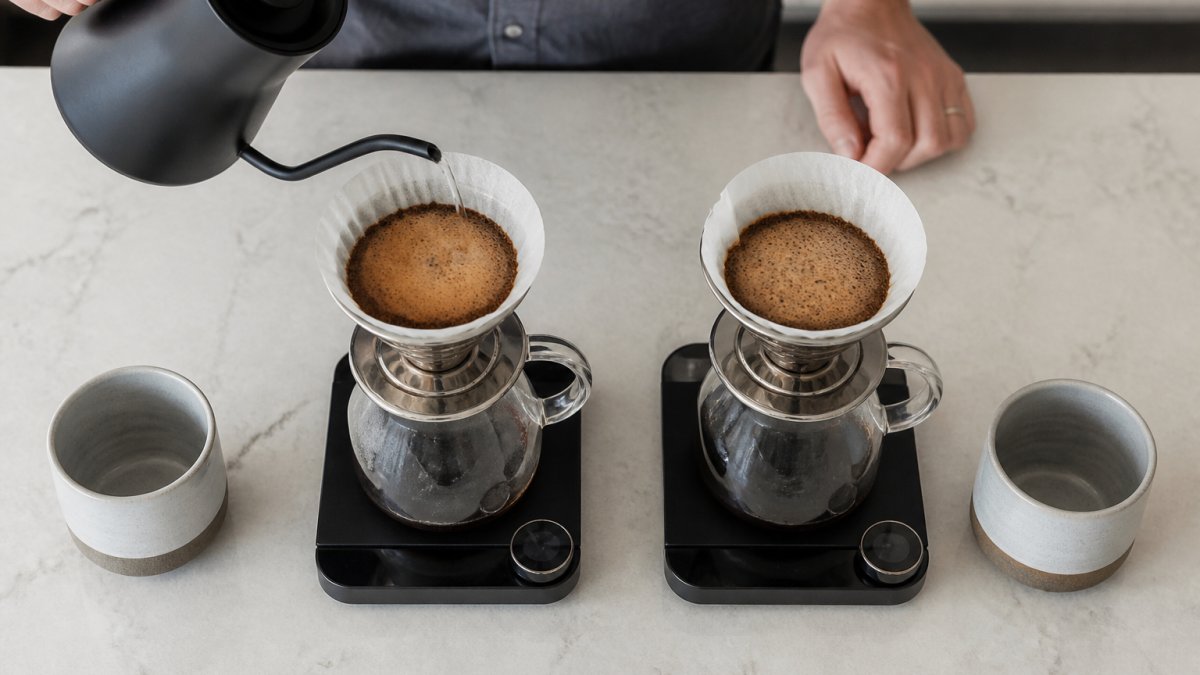
Taste both blind. In our experience, the weighed cup lands more consistent and more balanced, while the scooped cup often runs thin or bitter depending on how the scoop settled. The point isn't that one method is magic.
Do this test once and you'll know whether the difference matters to your palate. For some brewers it's obvious. For others, it's subtle enough that a kitchen scale suffices.
Choosing the Best Coffee Scale for Home Brewing
The best coffee scale for home brewing is one that fits your method, not the one with the longest feature list. Match the scale to how you actually brew:
| Brewing Habit | What to Prioritize | Why It Matters |
|---|---|---|
| Pour-over | 0.1 g resolution, built-in timer | Tracks slow pours and bloom timing |
| Espresso | Fast response, low-profile platform | Fits under the group head, catches quick changes |
| French press | 1 g resolution, wide platform | Large batches, stability over speed |
| AeroPress | Compact size, tare function | Fits the brewer, easy resets between pours |
| Drip coffee | Simple 1 g scale, timer optional | Batch brewing needs less precision |
Check these features before buying:
- Reads in 0.1 g steps if you brew espresso or small pour-overs
- Updates quickly while you pour, without lag
- Has a tare function that resets to zero cleanly
- Includes a timer, ideally on the same screen
- Water-resistant surface for spills
- Auto-off long enough to finish a slow brew
- Platform sized to your brewer and mug
Accessibility matters too. A bright, high-contrast display helps anyone brewing in a dim kitchen at dawn. Large buttons beat tiny touch panels when your hands are cold or wet.
The Verdict: Cost, Benefit, and Who Should Buy One
A dedicated coffee scale pays off for manual brewers who want repeatable results and brew espresso or pour-over regularly.
Option 1, No scale (cost: $0). You dose by scoop and fill by kettle markings. The benefit is zero upfront cost and no counter space.
Option 2, A basic kitchen scale you already own (cost: $0 incremental). The benefit is the single biggest improvement available for free: you stop guessing at dose.
A simple way to decide by habit:
- Occasional drinker, mostly milk drinks: no scale or a kitchen scale. The improvement won't be noticeable enough to justify the spend.
- Daily drip or French press: a kitchen scale is sufficient. Spend the money on fresher beans instead.
- Daily pour-over: a dedicated scale with a timer earns its place. You'll use the timer and the fast response on every brew.
- Espresso: a dedicated low-profile scale is close to essential. Without fast response and 0.1-gram resolution, dialing in becomes guesswork.
- Convenience-first brewer: a scale with a long auto-off and a simple two-button interface beats a feature-heavy model you won't want to fiddle with at dawn.
The throughline here is simple: precision only matters when it changes flavor. For espresso and careful pour-over, it does. For a rough-and-ready camp brew, it doesn't.
Pair a reliable scale with fresh, well-roasted beans and you've controlled the two variables that matter most. That's where Iron Spur Coffee comes in. We source specialty-grade, high-elevation beans and roast in small batches with precision thermal mapping to keep bitterness out of the cup. Every bag is roasted to order for maximum flavor and aroma, and our fast, reliable delivery means your beans arrive ready to brew. Discover Iron Spur Coffee Today and give your scale something worth measuring.
Frequently Asked Questions
Can a food scale work as a coffee scale?
A kitchen scale can weigh coffee and water, but it usually lacks the resolution and speed that brewing demands. Most kitchen scales read in 1-gram increments, so a 0.5-gram difference in your coffee dose goes unnoticed. They also respond slowly, which means the reading lags behind your pour. For French press or drip coffee, a kitchen scale gets you close. For espresso, where a 1-gram shift in yield changes the shot, you need a scale that reads to 0.1 grams and updates quickly.
How accurate should a coffee scale be?
Look for 0.1-gram resolution for espresso and 1-gram resolution at minimum for pour-over, French press, and drip. Accuracy matters as much as resolution: a scale that reads to 0.1 grams but drifts under a hot carafe gives you false precision. Check that the scale handles at least 2 kilograms of capacity so a full brewer and mug fit without maxing it out. A calibration check with a known weight tells you whether the readings hold up over time.
Do you need a scale to make pour-over coffee?
You can brew pour-over without one, but you lose repeatability. A coffee-to-water ratio of 1:16, meaning 1 gram of coffee to 16 grams of water, only works if you can measure both. Without a scale, you are guessing at dose and pour volume, so a good cup becomes hard to reproduce. A coffee scale with timer solves both problems at once: you track the pour weight and the bloom time in the same place, which is why most pour-over recipes assume you have one.
Is a smart coffee scale worth the extra cost?
A smart scale connects to an app that logs brews, guides ratios, and sometimes walks you through a recipe step by step. That helps if you are learning and want structure, or if you brew several methods and want a record of what worked. The trade-off is price and dependence on the app. A basic digital scale with a timer covers the same core job for less. Buy smart only if guided brewing or brew logging is something you will actually use.