

Preventing Coffee Bean Oxidation at Home
Table of Contents
- How Coffee Oxidation Steals Flavor Before You Notice
- How Long Do Coffee Beans Stay Fresh?
- Step 1: Choose the Best Coffee Storage Containers
- Step 2: Control Temperature, Light, and Humidity
- Step 3: Identify the Signs of Stale Coffee Beans Early
- Step 4: Store Different Roast Levels and Green Beans Correctly
- Step 5: Manage Opening Frequency and Daily Handling
- Common Mistakes That Speed Up Oxidation
- Frequently Asked Questions
Last Updated: October 2, 2026
How Coffee Oxidation Steals Flavor Before You Notice
Preventing coffee bean oxidation at home starts with one fact: the moment roasted beans hit open air, they begin losing the flavors you paid for. Oxygen pulls volatile compounds out of the bean, and heat, light, and moisture speed that up. At Iron Spur Coffee, we roast to order because freshness has a short window, and storage decides whether that window stays open or slams shut.
The Four Enemies of Freshness
Four things drive oxidation and staling:
- Oxygen reacts with oils and aromatic compounds inside the bean
- Light breaks down those same compounds, especially in clear containers
- Heat speeds up every chemical reaction, including the ones you don't want
- Moisture gets absorbed by porous beans and dulls the flavor
What Oxidation Actually Does to the Bean
Roasted coffee is porous, why beans smell so good, and why they go stale. Oxygen slips into tiny pockets and reacts with the oils (lipid oxidation), producing a flat, papery, sometimes cardboard-like taste.
Meanwhile, the bean keeps releasing carbon dioxide from roasting, degassing, which is normal. But when oxygen moves in as gas moves out, staling accelerates.
How Long Do Coffee Beans Stay Fresh?
Whole roasted beans stay fresh about two to four weeks after the roast date when stored properly. Ground coffee loses its edge in days, because grinding exposes far more surface area to oxygen.
Roast Date vs. Best-By Date
The roast date tells you when the clock started. A best-by date often sits months out and says little about actual freshness.
A common mistake is trusting the best-by stamp. Check the roast date instead. If a bag has no roast date, you're guessing. According to USDA guidance on food date labeling, date labels are largely about quality, not safety, so they're a weak freshness signal for coffee.
Step 1: Choose the Best Coffee Storage Containers
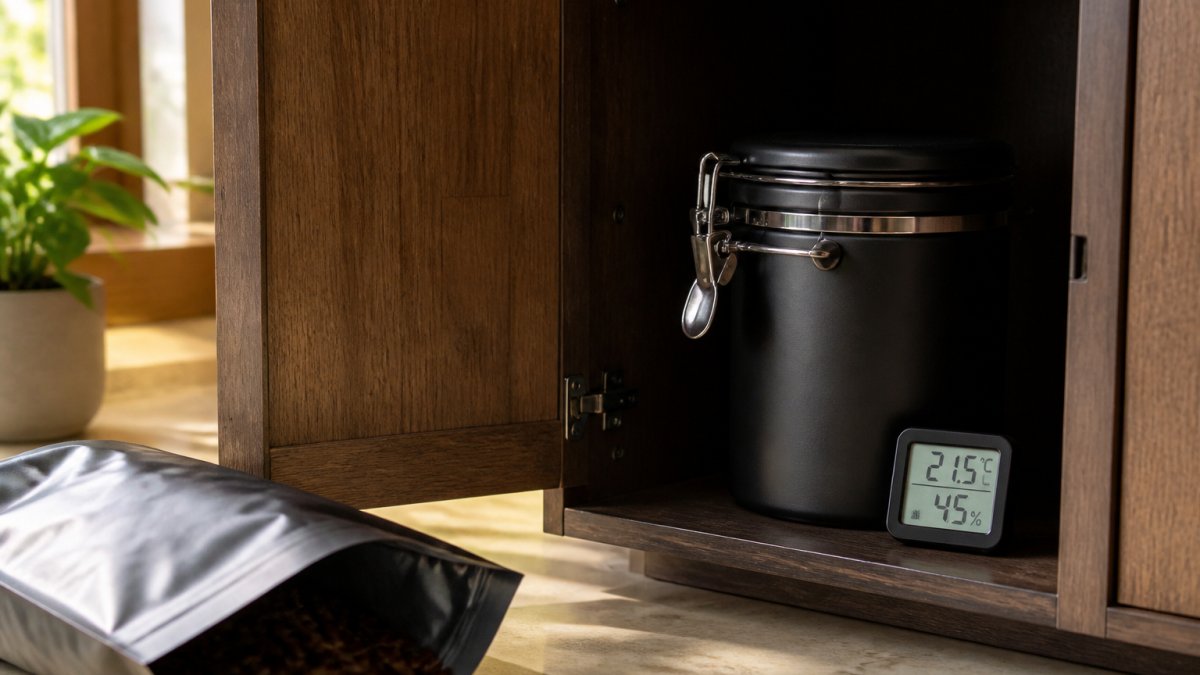
The best coffee storage containers block oxygen, light, and moisture at once. An opaque, airtight container with a one-way valve is the practical standard for most home setups, but the differences between methods matter once you're storing more than a week's worth of beans.
Here's how the main options compare:
| Method | Blocks Oxygen | Blocks Light | Headspace Control | Best For |
|---|---|---|---|---|
| One-way valve canister | Good | Yes, if opaque | Static (trapped air remains) | Daily use, 1-2 week supply |
| Vacuum seal (home sealer) | Excellent | Yes (opaque bags) | Near-zero | Portioned storage, 1+ month |
| Inert gas flushing | Excellent | Depends on vessel | Displaces oxygen with heavier gas | Bulk storage, commercial scale |
| Original bag, rolled | Poor | Maybe | Poor | Short-term only |
How a One-Way Valve Actually Works
A one-way valve is a small silicone or plastic membrane built into the bag or lid.
The catch: a valve only manages pressure. Any oxygen already inside when you seal it stays there, which is why headspace matters, a canister 80% full of beans still holds an oxygen reservoir that reacts with the bean surface over days.
Vacuum Sealing vs. Inert Gas Flushing
Vacuum sealing removes the air (and most of the oxygen) before sealing. Home sealers pull a partial vacuum rather than a true hard vacuum, but the oxygen reduction is substantial compared to a valve bag. The trade-offs:
- Bean crushing. Full vacuum on whole beans can compress and crack them, especially softer dark roasts. Many home sealers offer a "moist" or "gentle" setting that reduces vacuum strength, use it for coffee.
- Re-sealing cost. Every time you open a vacuum bag, you cut it and re-seal, which shortens the bag. Portioning into single-use bags avoids this.
- Bag opacity. Most vacuum bags are opaque, which conveniently blocks light as a side benefit.
Inert gas flushing replaces headspace oxygen with a heavier, unreactive gas, typically nitrogen or argon. These gases are denser than air, so they settle over the beans and displace oxygen; commercial roasters use this on packaging lines. Home kits exist but require a gas canister and sealed vessel, and cost more per use than vacuum sealing.
What to Look For in a Daily-Use Container
If you're buying one container for the counter, prioritize:
- Opaque body, stainless steel or matte-coated ceramic. Clear glass on an open shelf is a light exposure problem, not a style choice.
- Silicone-gasket seal, a twist-lock or clamp lid with a replaceable gasket holds pressure better than a press-fit lid.
- One-way valve, useful if you're storing beans within the first week post-roast, when degassing is still active. Less important for beans that have already settled.
- Size matched to consumption, a container you fill to the brim has less headspace oxygen than a large container half-full of beans.
The Headspace Variable Most Guides Skip
Oxygen exposure isn't just about whether the container is sealed, it's about how much oxygen is sealed in with the beans. A 12-ounce bag in a 32-ounce canister leaves roughly 20 ounces of air headspace, about 21% oxygen, and every lid opening resets that reservoir. Matching container size to bean volume is one of the cheapest upgrades you can make.
Step 2: Control Temperature, Light, and Humidity
Store beans in a cool, dark, dry place. A closed cabinet away from the stove and dishwasher beats a sunny countertop.
Heat and humidity are the quiet killers: every ten-degree bump speeds up the reactions that flatten flavor, and moisture absorption turns crisp acidity muddy.
Freezer vs. Room Temperature: What the Evidence Supports
The freezer works if you do it right. Cold storage slows oxidation, but only when beans are sealed tight and never thawed and refrozen.
Room temperature is fine for beans you'll finish within a couple of weeks; the freezer wins for bulk buys you won't touch for a month or more.
Avoiding Condensation and Thermal Shock
Condensation is the freezer's biggest trap: every time you pull beans out, moisture forms on the cold surface, thermal shock, which wrecks bean integrity. The fix: seal in single-use portions, and let a portion come to room temperature before opening it. Never scoop from a frozen bag and put it back.
Step 3: Identify the Signs of Stale Coffee Beans Early
Signs of stale coffee beans show up in smell, look, and taste before you'd expect. Catch them early and you can adjust your storage before a whole bag goes flat.
Watch for these signals:
- Beans look oily or dull instead of matte and dry
- The aroma is weak or smells like cardboard
- A bloom barely forms when you pour hot water
- The cup tastes flat, papery, or sour in a bad way
Sensory Checks You Can Do in 30 Seconds
Smell the bag right after opening. Fresh beans hit you with a clear aroma. Stale beans smell like almost nothing.
Then check the bloom. Pour hot water on a spoonful of grounds. Fresh coffee puffs up and releases gas. Weak bloom means weak flavor.
Step 4: Store Different Roast Levels and Green Beans Correctly
Roast level changes how fast beans oxidize, and the reason is structural. During roasting, cell walls expand and fracture as moisture and carbon dioxide escape; the longer and hotter the roast, the more those structures break down, so a dark roast is physically more porous than a light roast from the same green coffee.
That porosity cuts two ways: more open surface area means more sites for oxygen to react with oils and aromatic compounds, and dark roasts degas faster, so their freshness window is shorter on both ends, they peak sooner and fade sooner.
Why Dark Roasts Go Stale Faster
Two mechanisms stack against dark roasts:
- Surface oil. As roasting progresses past first crack and into second crack, oils migrate from the interior of the bean to the surface. Surface oils are directly exposed to oxygen and light, and they oxidize faster than oils still protected inside the bean matrix. A visibly oily dark roast is a bean that has already begun the clock on lipid oxidation.
- Greater porosity. The fractured cell structure lets oxygen penetrate deeper into the bean, not just react at the surface, so oxidation reaches more of the bean's aromatic reservoir.
Practically, a dark roast stored in the same container as a light roast will taste stale first. If you drink both, store the dark roast in smaller portions and use it faster, or freeze the dark roast while keeping the light roast on the counter.
Why Light Roasts Hold Up Longer
Light roasts retain more of their original cell structure. Oils stay largely internal, protected by intact cell walls, and the bean is less porous overall, slowing both oxygen penetration and oil exposure. A light roast holds acceptable quality noticeably longer than a dark roast from the same roaster, all else equal.
Medium Roasts: The Middle Ground
Medium roasts sit between the extremes. Some surface oil may appear after a few days and porosity is moderate; store them like a dark roast, but with a bit more slack on timing.
Green (Unroasted) Beans Are a Different Problem
Green coffee doesn't oxidize like roasted coffee, because the oils haven't been liberated by heat and the bean is structurally intact.
The dominant risk isn't oxidation, it's odor absorption and moisture. Green coffee is hygroscopic and highly porous at the surface, pulling aromas from whatever is stored nearby.
Storage rules for green beans:
- Keep them in a breathable bag or a container with some airflow, not a vacuum seal.
- Target a stable, cool, dry location. Fluctuating humidity is worse than a consistently slightly humid spot.
- Keep them away from spices, onions, garlic, cleaning supplies, and anything with a strong volatile aroma.
- Use them within a year for best results; older green coffee develops a muted, baggy flavor that roasting can't fix.
Matching Storage to Roast Level: A Quick Protocol
- Light roast: opaque airtight container at room temperature, use within 3-4 weeks. Freeze only for bulk backup.
- Medium roast: same container, use within 2-3 weeks. Watch for the first surface oil sheen as your cue to speed up consumption.
- Dark roast: smaller portions, tighter seal, use within 1-2 weeks on the counter, or freeze in single-use portions immediately after the rest period.
- Green beans: breathable bag, cool and dry, away from odors, use within a year.
The roast-level variable is the one most home storage guides flatten into a single rule. It isn't one rule, it's three, plus a completely different protocol for green coffee.
Step 5: Manage Opening Frequency and Daily Handling
Opening frequency matters more than people think: every time you open a container, you swap the carbon dioxide inside for fresh oxygen.
Fewer, faster openings mean slower oxidation, scoop what you need and close the lid immediately.
A few habits that help:
- Keep one small container for daily use and a larger sealed stash for backup
- Never leave the lid off while you grind
- Use a scoop, not your hands, to limit moisture transfer
- Buy amounts you'll finish within your freshness window
Common Mistakes That Speed Up Oxidation
The biggest mistake is storing beans in the fridge. It feels cold, but the fridge is humid and full of food odors. Beans soak up both.
Other common errors:
- Keeping beans in the original bag, loosely rolled
- Using a clear glass jar on an open shelf
- Grinding a whole week's worth at once
- Refreezing thawed beans repeatedly
- Buying more coffee than you can drink in a few weeks
For beans you'll drink soon, a sealed opaque container is enough; for a longer haul, portion and freeze. Ordering from a roaster that ships right after roasting gives you a head start, Iron Spur Coffee roasts to order, so the freshness window begins when your bag ships, not months earlier on a warehouse shelf. For grab-and-go trips, their Instant Coffee comes in a resealable pouch with 30 servings, keeping oxygen out between uses.

According to the FDA's guidance on food storage and shelf life, proper sealing and temperature control are the two biggest levers for slowing quality loss in stored foods, and coffee follows the same logic.
The Specialty Coffee Association's resources on coffee freshness echo this: freshness is a race against oxygen, and storage decides who wins.
Frequently Asked Questions
What is the 15-15-15 coffee rule?
The 15-15-15 rule is a home storage guideline: keep beans within 15 days of the roast date, store them at roughly 15 degrees Celsius (about 59 degrees Fahrenheit), and use them within 15 minutes of grinding. The first two numbers slow oxidation and degassing, while the third limits how much surface area is exposed to oxygen before brewing. Following it consistently matters more than buying expensive gear.
Is oxidized coffee safe to drink?
Yes, oxidized coffee is not a safety risk. Oxidation mainly affects aroma, flavor, and the oils in the bean, not food safety. You may notice flat or cardboard-like notes, muted sweetness, and a thinner body. If the beans show visible mold, moisture damage, or an off smell beyond staleness, discard them. Otherwise, stale coffee is unpleasant but not dangerous.
How can I tell if my coffee beans have oxidized?
Look for these signs of stale coffee beans: the beans lose their glossy surface and smell faint or papery when you open the bag, the grounds do not bloom when hot water hits them, and the brewed cup tastes flat with dull acidity. Beans that have oxidized also lose their distinct origin notes, so a fruity or chocolatey roast may taste generic. A quick sniff test before grinding catches most cases.
Does vacuum sealing coffee beans actually prevent oxidation?
Vacuum sealing removes most of the air around the beans, which slows oxygen exposure significantly. It works best when paired with cold storage and limited opening frequency, since every time you break the seal you reintroduce oxygen. Inert gas flushing, used by some roasters, replaces oxygen with nitrogen at the packaging stage and holds up better during shipping. For home use, a vacuum-sealed bag in the freezer is one of the most effective combinations.
Oxidation is relentless, but it's predictable. Seal your beans, keep them cool and dark, limit how often you open the bag, and you'll taste the difference in every cup. Iron Spur Coffee makes that easier with specialty-grade, high-elevation beans, small-batch roasting guided by precision thermal mapping to cut bitterness, and roasting to order for maximum flavor. Discover Iron Spur Coffee today and start your mornings with beans that were fresh the day they shipped.