

How Long Does Roasted Coffee Last? A Freshness Guide
Table of Contents
- How Long Roasted Coffee Actually Lasts: Whole Bean vs. Ground
- The Coffee Degassing Process and Why Roast Date Matters
- How to Keep Coffee Beans Fresh: 7 Storage Rules That Work
- Signs of Stale Coffee Beans: 6 Ways to Tell Before You Brew
- Does Coffee Expire? What the Date on the Bag Really Means
- Storage for Different Climates: Humidity, Heat, and Altitude
- Don't Toss It: Repurposing Stale Beans and Choosing Fresh Coffee
- Conclusion: Lock In Peak Flavor From the First Scoop
- Frequently Asked Questions
Last Updated: September 16, 2026
How Long Roasted Coffee Actually Lasts: Whole Bean vs. Ground
Roasted coffee lasts about two to four weeks at peak flavor after the roast date, and whole bean consistently outlasts ground coffee by a wide margin. The reason is surface area: grinding exposes coffee oils and aromatics to oxygen all at once, while whole beans keep most of that protected until you grind them. This guide from Iron Spur Coffee breaks down how long roasted coffee lasts in each form, what shortens that window, and how to store beans so the last scoop tastes as sharp as the first.
Whole bean coffee holds its character for roughly two to four weeks in a sealed container at room temperature. Ground coffee, by contrast, fades noticeably within days and is often flat within one to two weeks. If you want the honest answer to how long roasted coffee lasts, it depends less on a printed date and more on three things: roast date, storage method, and whether the beans are still whole.
| Form | Peak Flavor Window | Noticeable Decline | Best Storage |
|---|---|---|---|
| Whole bean, sealed | 2-4 weeks | After 4-6 weeks | Airtight, dark, room temp |
| Ground coffee | 3-7 days | After 1-2 weeks | Airtight, small batches |
| Freezer (whole bean) | 1-2 months | After 3 months | Vacuum-sealed, no thaw cycles |
The gap between whole and ground is the single biggest variable most people overlook.
The Coffee Degassing Process and Why Roast Date Matters
The coffee degassing process is the release of carbon dioxide trapped inside beans during roasting, and it continues for days to weeks after the roast. That gas matters because it protects flavor while it escapes; once degassing slows, oxygen moves in and begins breaking down the compounds you actually taste.
Roast date tells you where a bag sits on that curve. A bag roasted last week is still near peak flavor. A bag with only a "best by" date a year out tells you almost nothing about freshness, because that date is about safety and packaging, not peak flavor. This is why Iron Spur Coffee prints the roast date rather than hiding behind a distant best-by stamp.
How to Keep Coffee Beans Fresh: 7 Storage Rules That Work
To keep coffee beans fresh, control the three enemies of flavor: oxygen, light, and moisture. Here are the rules that actually move the needle.
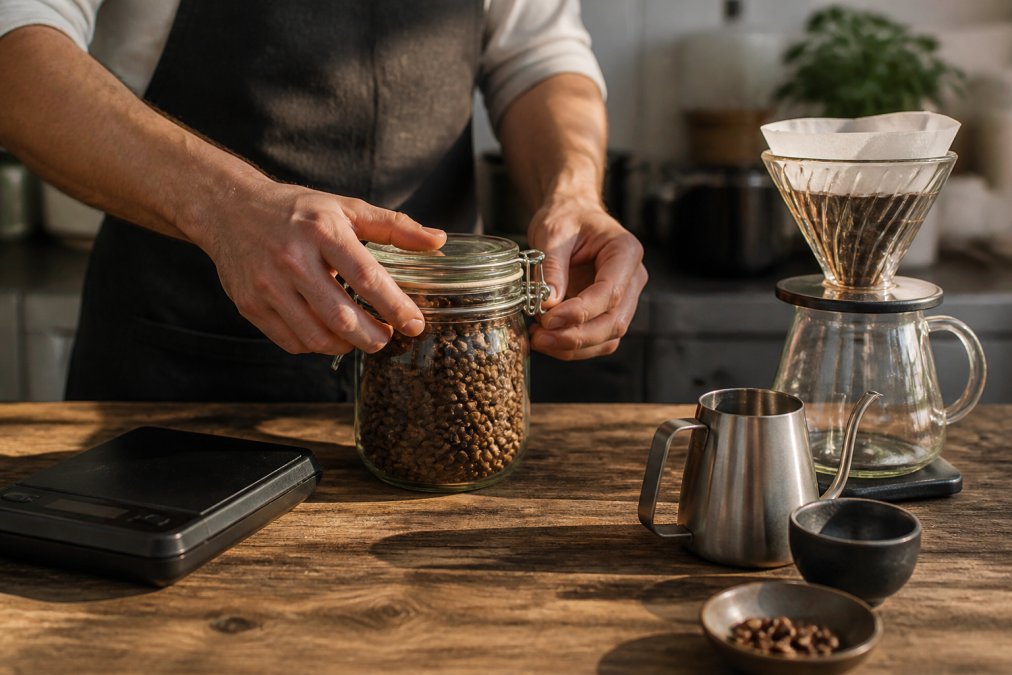
- Buy whole bean and grind right before brewing.
- Store in an airtight, opaque container, not the flimsy bag rolled shut.
- Keep beans at room temperature, away from the stove and windows.
- Buy in quantities you will finish within two to four weeks.
- Keep the container in a dark cabinet, since light exposure accelerates staling.
- Avoid transferring beans between containers repeatedly; each opening exposes them to air.
- Label the roast date so you always know how old the batch is.
Freezing vs. Refrigerating Coffee Beans
Freezing whole beans extends their life far better than refrigeration, provided you seal them properly. The freezer slows oxidation and locks in aroma; the refrigerator does the opposite, exposing beans to moisture and food odors every time the door opens. If you freeze, portion beans into vacuum-sealed bags and grind from frozen without thawing, so you never introduce condensation. Refrigeration is the worst of both worlds for daily-use beans.
Packaging That Protects: One-Way Valve Bags and Vacuum Seals
A one-way valve lets carbon dioxide escape while blocking oxygen from entering. Vacuum sealing goes further by removing nearly all air before storage. Non-valve packaging traps degassing gas and can leave beans sitting in a stale pocket of their own emissions.
Signs of Stale Coffee Beans: 6 Ways to Tell Before You Brew
Stale coffee announces itself before you taste it. Watch for these signs:
- A dull, flat aroma when you open the bag, instead of a sharp, sweet scent
- Beans that look dry and matte rather than slightly oily
- A muted, papery flavor in the cup with no sweetness
- Weak crema or a thin, watery extraction
- A stale smell in the grinder after grinding
- Beans that no longer smell distinct from one another
Does Coffee Expire? What the Date on the Bag Really Means
Coffee does not expire in the food-safety sense the way milk does; it declines in quality. A bag past its peak is not dangerous, but it is no longer worth brewing for flavor. The date on the bag usually reflects packaging and safety guidance, not the roast date that determines how long roasted coffee lasts at its best. That distinction is why a bag can be "safe" and still taste like cardboard.
Storage for Different Climates: Humidity, Heat, and Altitude
Most coffee storage advice assumes a mild, dry kitchen, but climate changes the rules. In a humid environment, moisture is the dominant threat because coffee beans are hygroscopic, they absorb water vapor from the air. Once bean moisture rises above roughly 12 percent, the beans lose crispness, extraction becomes inconsistent, and mold risk appears. In practice, this means a sealed container is not optional in a humid climate; it is the difference between beans that last two weeks and beans that taste flat in five days. A common pattern in humid regions is to add a food-safe desiccant packet to the storage container and to keep beans away from sinks, dishwashers, and open windows. If you freeze beans in a humid climate, double-bag them, because freezer frost is moisture, and moisture is the enemy.
In hot, dry climates, heat accelerates oxidation rather than moisture. Every 10 degrees Fahrenheit above room temperature roughly doubles the rate of the chemical reactions that stale coffee, so a bag sitting on a counter in a 90-degree kitchen fades faster than the same bag in a 70-degree kitchen. In arid regions, the freezer becomes more attractive for longer storage because there is less ambient moisture to introduce during handling. The trade-off is that repeated freeze-thaw cycles cause condensation, so portion before freezing and grind from frozen without thawing.
Altitude adds a third variable. At higher elevations, lower atmospheric pressure reduces the boiling point of water and can speed the release of carbon dioxide from beans. The practical effect is that beans may peak slightly faster and degas more aggressively in the first few days after roasting. A common pattern at altitude is to let beans rest 24 to 48 hours after the roast date before brewing, then consume them within the same two-to-four-week window.
A simple climate-adjusted storage checklist:
- Humid climate: airtight container plus desiccant, away from water sources, double-bag before freezing
- Hot, dry climate: store in the coolest dark cabinet available, consider freezing for storage beyond two weeks
- High altitude: rest beans 24-48 hours post-roast, then follow the standard two-to-four-week window
- Any climate: buy in quantities you will finish within two to four weeks, and label the roast date
The takeaway is that storage advice is not universal. The same valve bag that protects beans in a dry mountain kitchen may need a desiccant packet in a coastal apartment. Adjust for your climate, and the two-to-four-week peak window holds true almost anywhere.
Don't Toss It: Repurposing Stale Beans and Choosing Fresh Coffee
Stale beans still have uses, so do not bin them.
Conclusion: Lock In Peak Flavor From the First Scoop
The window on great coffee is short, and most of it is lost to poor storage long before the beans go bad.
Frequently Asked Questions
Can roasted coffee go bad?
Roasted coffee does not spoil the way milk does, but it goes stale. Once exposed to oxygen, light, and moisture, the coffee oils begin to oxidize and the flavor flattens. Whole bean coffee holds peak flavor for about 2 to 4 weeks after the roast date, while ground coffee fades in 1 to 2 weeks. After that window, it is safe to drink but tastes dull and papery.
Does freezing coffee beans extend their shelf life?
Freezing can extend freshness if done right. Keep beans in an airtight, vacuum-sealed container and store them in the back of the freezer, away from temperature swings. Do not thaw and refreeze repeatedly, because moisture builds up and causes freezer burn. Take out only what you need for a few days and let it sit sealed until it reaches room temperature before grinding.
How can you tell if coffee beans have gone stale?
Look for a dull, matte surface instead of an oily sheen, and smell the bag. Fresh beans release a strong, sweet aroma; stale ones smell like cardboard or hay. When you brew, stale beans produce a thin, flat cup with little crema and a weak finish. If the beans no longer smell like the roast you bought, they have lost most of their peak flavor.
Can I still use 2-year-old coffee beans?
You can brew them, but expect a muted, woody cup with almost none of the original flavor profile. Two-year-old beans are safe to consume if they were stored dry and free of mold, yet the oxidation and lipid degradation that happen over that time strip away aroma and sweetness. For better results, use them in rubs, compost, or as a fridge deodorizer and buy a fresh roast for drinking.