

Which Manual Burr Grinder Is Best for Beginners in 2026?
Last Updated: October 25, 2026
Quick Summary
The best manual burr grinders for beginners have a stable burr set, a repeatable adjustment mechanism, and a body you can grip without fighting it. Prioritize conical hardened stainless steel burrs, an aluminum body, and stepped settings, since stepped adjustment is easier to repeat than stepless for a first grinder.
- Conical burrs are the sensible beginner choice because they self-center reasonably well and turn at low speed.
- Hardened stainless steel burrs hold an edge far longer than ceramic, which chips if dropped.
- Start two or three clicks coarser than the manufacturer's espresso recommendation, then adjust one step at a time.
- Brush out the burr chamber every few uses and do a deeper clean monthly; never wash burrs in water.
- Buy from a maker who sells replacement burrs, keep the receipt, and register the warranty if offered.
Table of Contents
- What Actually Matters in a Beginner Manual Burr Grinder
- Hand Grinder Buying Guide: Budget, Effort, and Grind Range
- Picking a Manual Grinder for Espresso
- Picking a Manual Grinder for Pour-Over and Other Brew Methods
- Setting Your Grind: Beginner Calibration Without the Guesswork
- How to Clean a Manual Coffee Grinder and Keep It Running
- Total Cost of Ownership: Parts, Warranty, and What Wears Out
- Pair Your First Grinder With Coffee Worth Grinding
- Frequently Asked Questions
What Actually Matters in a Beginner Manual Burr Grinder
The best manual burr grinders for a beginner have a stable burr set, a repeatable adjustment mechanism, and a body you can grip without fighting it. Everything else is secondary.
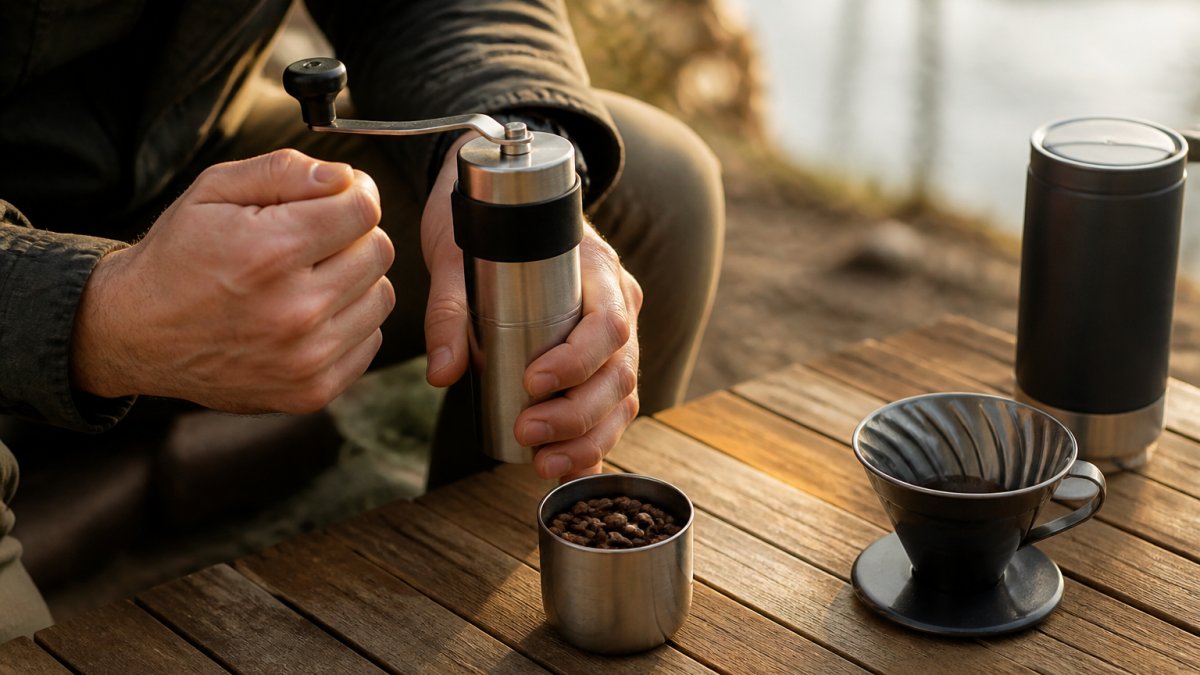
A manual burr grinder is a hand-cranked mill that crushes beans between two hardened burrs rather than chopping them with blades. Crushing produces uniform particle size and even extraction; shattering produces dust and boulders in the same dose, yielding a cup that tastes harsh and weak at once.
Burr Type, Build, and the Specs That Decide It
Conical burrs are standard in hand grinders and the sensible beginner choice: they self-center reasonably well, tolerate small alignment imperfections, and turn at low speed with modest effort. Flat burrs demand more torque and cost more.
The specs worth checking before you buy:
- Burr material: Hardened stainless steel holds an edge far longer than ceramic, which chips if you drop the grinder.
- Body material: An aluminum body resists flex. Plastic housings flex under load, and flex throws off burr alignment.
- Adjustment mechanism: Stepped settings click into fixed positions. Stepless settings move continuously. For a first grinder, stepped is easier to repeat.
Hand Grinder Buying Guide: Budget, Effort, and Grind Range
A manual burr grinders buying guide comes down to three trade-offs: what you spend, how hard you want to crank, and how many brew methods you need to cover. Entry-level grinders use smaller burr sets and more plastic, meaning slower grinding and more wobble; spending more buys bigger burrs, tighter tolerances, and metal where it counts.
Grinding effort is the spec nobody advertises. A small burr set grinding fine for espresso takes more turns and force than the same grinder set coarse for French press.
Grind range matters if one grinder must do everything. A grinder topping out at medium-fine handles pour-over and AeroPress but struggles with coarse French press. Check the stated range against the brew methods you actually use.
A simple decision path:
| Your situation | What to prioritize | What to skip |
|---|---|---|
| Pour-over only, one cup a day | Stepped adjustment, conical steel burrs | Wide grind range |
| Espresso focus | Fine-adjustment precision, axle stability | Large bean capacity |
| Camping and travel | Aluminum body, compact catch cup | Bean capacity |
| French press and drip | Coarse range, comfortable handle | Micro-adjustment |
| Tight budget | Metal burrs, plastic body acceptable | Stepless adjustment |
Picking a Manual Grinder for Espresso
A manual grinder for espresso needs fine adjustment precision above all else.
The second requirement is torque. Fine grinding takes force, and a small burr set with a short handle turns a morning ritual into a workout; a longer handle or larger burr set spreads that effort out.
Watch out: a grinder marketed as "espresso capable" that wobbles at the axle will produce gushers and channeling no matter how carefully you dial it in. Alignment beats adjustment count every time.
What 'Espresso Capable' Actually Requires
Most hand grinders can grind fine enough to choke a shot. Far fewer hold a setting across a 30-second extraction without drifting, or move in small enough increments to dial in a new bean without wasting half a bag.
Espresso-focused hand grinders typically use a stepped collar with a high click count concentrated toward the fine end, or a stepless collar with a locking ring. Both work.
A Beginner's Espresso Dial-In Sequence
Beginners often chase the perfect setting from the fine side, choke the basket, then overcorrect into a gusher. Bracket from the coarse side instead:
- Start two or three clicks coarser than the manufacturer's espresso recommendation.
- Grind a full dose, distribute it, tamp level, and pull a shot with a fixed dose and a fixed yield.
- If the shot runs fast and tastes sour or thin, go one step finer.
- If it runs slow and tastes bitter or harsh, go one step coarser.
- Change only one variable at a time, dose, yield, or grind, and record the setting that worked.
The goal is a repeatable starting point, not a perfect shot on day one; once you have a drinkable shot, small adjustments become meaningful.
Espresso Grinders vs. All-Purpose Grinders
If espresso is your only brew method, prioritize fine-adjustment precision and axle stability over bean capacity and grind range. If you also brew pour-over or French press, an all-purpose hand grinder with a wide range and a fine-stepped espresso zone is the better single purchase, but expect less click resolution at the espresso end than a dedicated espresso hand grinder.
For a broader look at matching grind size to brew method, see our guide to choosing the right coffee grind size.
Picking a Manual Grinder for Pour-Over and Other Brew Methods
A manual grinder for pour-over needs a consistent medium-fine setting and a comfortable handle, since you grind at that setting daily.
Discover Iron Spur Coffee Today →
For AeroPress, the same grinder works well across a slightly wider range, which makes it a forgiving second brew method for a beginner.
If you are building a pour-over setup, the kettle matters nearly as much as the grinder. Our gooseneck kettle buying guide covers the models worth pairing with a hand grinder.
Setting Your Grind: Beginner Calibration Without the Guesswork
Beginner calibration is simpler than most guides imply: start coarse, grind a small dose, brew it, and adjust one step finer until the cup turns bitter, then back off one step. You are bracketing the sweet spot from the coarse side, safer than chasing it from fine, where a single step can choke the brew.
Use this sequence:
- Set the grinder to a medium setting and grind a full dose.
- Brew with your normal method and taste.
- If the cup is sour or weak, go one step finer.
- If the cup is bitter or harsh, go one step coarser.
- Write down the setting that worked. Repeatability is the point.
For a full reference on matching settings to brew methods, see our guide to choosing the right coffee grind size.
How to Clean a Manual Coffee Grinder and Keep It Running
Knowing how to clean a manual coffee grinder separates a tool that lasts years from one that gums up in months. Coffee oils go rancid and taste like cardboard in the cup. Brush out the burr chamber every few uses and do a deeper clean monthly.
- Disassemble according to the manufacturer's instructions.
- Brush burrs and chamber with a dry brush. Never wash burrs in water.
- Wipe the body with a dry cloth.
Watch out: grinding flavored or heavily oiled beans leaves residue that transfers to every subsequent cup. Keep a dedicated grinder for those, or clean immediately after.
Total Cost of Ownership: Parts, Warranty, and What Wears Out
The purchase price is only part of the cost. The burr set wears out first, followed by the handle joint and catch cup threads. Quality hand grinders sell replacement burrs, so a well-built body can outlast two or three burr sets.
Check the warranty length and whether replacement burrs are actually available. A grinder with a solid warranty and stocked parts costs more upfront and less over five years.
The Wear Sequence, in Order
Hand grinders fail in a predictable order, which tells you what to inspect before buying:
- Burr set. The cutting edges dull gradually. A dull burr set grinds slower, produces more fines, and heats the grounds more. On a well-built grinder, burrs are a wear item, not a permanent part.
- Handle joint and crank arm. The connection between the handle and the axle takes the most torque. A loose or stripped joint is the most common mechanical failure on budget grinders.
- Catch cup threads. Repeated threading and unthreading wears plastic threads faster than metal ones. A cross-threaded cup is annoying but usually replaceable.
- Axle and bearing. A worn bearing introduces wobble, which ruins consistency long before the burrs are dull.
- Body and alignment. The body itself rarely fails, but drops and overtightening can knock the burr carrier out of alignment.
What to Check Before You Buy
- Replacement burrs are listed for sale by the manufacturer or a reputable parts seller, not just mentioned in the manual.
- The warranty covers the burr set or explicitly excludes it. Many warranties cover the body and mechanism but treat burrs as a consumable, which is reasonable, as long as you know going in.
- The handle and crank are replaceable rather than riveted or molded into the body.
Framing Value Over Time
To compare two grinders, divide the purchase price by the years you expect to use it, then add the cost of one replacement burr set if you plan to keep it long term. A grinder that costs more upfront but has stocked burrs and a replaceable handle often costs less per year than a cheaper grinder you replace outright. The structure is the same: purchase price, plus wear parts, minus warranty coverage, divided by expected service life.
For a beginner, the practical takeaway is simple: buy from a maker who sells parts, keep the receipt, and register the warranty if the manufacturer offers registration. That is the cheapest insurance a first grinder can have.
Pair Your First Grinder With Coffee Worth Grinding
A good grinder exposes the coffee you feed it. Fresh, well-roasted whole beans reward a consistent grind with clarity and sweetness; stale or poorly roasted beans taste flat no matter how precise your particle size.
At Iron Spur Coffee, we roast to order from specialty-grade, high-elevation beans, using precision thermal mapping to keep bitterness out of the roast. If you want to judge beans on their own merits, our guide to identifying high quality coffee breaks down what to look for, and our explainer on whole bean versus pre-ground freshness shows why grinding right before brewing is worth the extra minute.
Weighing a burr grinder against a blade model? Our comparison of burr versus blade grinders for French press covers the trade-offs in detail.
Frequently Asked Questions
Are manual burr grinders difficult to use?
Not really. You fill the hopper with beans, set the grind adjustment, hold the body steady, and turn the handle. A dose for one cup takes roughly 30 seconds to two minutes depending on the grinder, the grind size, and how hard the beans are. Finer espresso settings take more effort than coarse French press settings. Look for a textured grip and a body that sits comfortably in your hand, since those two details matter more than raw speed for daily use.
Can a manual grinder for espresso actually produce fine enough grounds?
Yes, but not every hand grinder can. Espresso needs a fine, consistent particle size, and stepless or finely stepped adjustment so you can dial in small changes. Check that the grinder's stated grind range reaches espresso fineness and that the burrs are aligned well enough to avoid uneven particles. Expect more physical effort at espresso settings, and plan on a few test shots to find the right setting before you get a reliable extraction.
How much should a beginner spend on a manual coffee grinder?
Spend enough to get conical burrs, a metal body, and a usable adjustment mechanism, because those three features drive grind consistency and durability. Very cheap grinders often use ceramic burrs with wobbly shafts, which produce uneven particles and make dialing in frustrating. Pricing varies by brand and build, so check current prices directly. A well-built grinder with replaceable parts usually costs less over time than replacing a cheap one every year.
How often should I clean a manual coffee grinder?
Brush out the catch cup and the burr chamber weekly if you grind daily, and do a fuller breakdown monthly. Oils from coffee beans build up on burrs and slow grinding while adding stale flavors. Use a stiff brush and a dry cloth, avoid water on the burrs, and never put a hand grinder in the dishwasher. If you switch between flavored and unflavored beans, clean between switches so the old oils do not carry over into your next brew.
Your first grinder will only be as good as the beans you put through it, and that is where we come in. Iron Spur Coffee roasts specialty-grade, high-elevation beans in disciplined small batches, using precision thermal mapping to eliminate bitter noise and roasting to order so the bag arrives fresh. If you want a cup that gives you a resilient, flawless foundation for the day, start with coffee worth grinding. Discover Iron Spur Coffee today.
