

Burr vs Blade Grinder for French Press: Which Wins?
Table of Contents
- Why the Burr vs Blade Grinder Choice Decides Your French Press Cup
- How Burr and Blade Grinders Actually Work
- Grind Consistency and Particle Size: The Core Difference
- How to Grind Coffee Beans for French Press
- Getting the Right Coarse Grind for French Press
- Burr Grinder Settings for French Press
- Choosing the Best Grinder for French Press on Your Budget
- Taste, Sediment, and Troubleshooting: What the Cup Tells You
- Frequently Asked Questions
Last Updated: October 19, 2026
Why the Burr vs Blade Grinder Choice Decides Your French Press Cup
The burr vs blade grinder decision shapes your French press coffee more than most gear upgrades.
A blade grinder produces a mix of powder and chunks: the powder over-extracts and turns bitter, the chunks under-extract and taste thin.
Below, we'll show how each grinder type works, what coarse grind for French press requires, and whether an upgrade is worth the money.
How Burr and Blade Grinders Actually Work
Burr and blade grinders reduce beans through different mechanisms, and that mechanism determines the grind distribution. A burr grinder crushes beans between two abrasive surfaces set a fixed distance apart. A blade grinder spins a metal blade at high speed and chops whatever is in its path.
Burr Grinders: Crushing Between Abrasive Surfaces
Two burrs, flat discs or conical cones, sit a set distance apart. Beans fall between them and get crushed as the burrs turn. The gap controls grind size, so adjusting it gives you repeatable settings.
Because the burrs crush rather than chop, particles exit at a fairly consistent size, with far less heat and static than a spinning blade creates. The tradeoff is price and, on manual models, effort.
Blade grinders: chopping at high speed
A blade grinder is a small cup with a spinning blade, closer to a food processor than a mill. You pulse and count seconds. Beans nearest the blade become fine powder while beans at the top stay coarse.
There's no grind adjustment, only time. That makes blade grinders cheap and simple, but uniform particles nearly impossible, and for a method as unforgiving as French press, that inconsistency matters.
Grind Consistency and Particle Size: The Core Difference
Grind consistency is the biggest difference between burr and blade grinders, and it directly controls extraction.
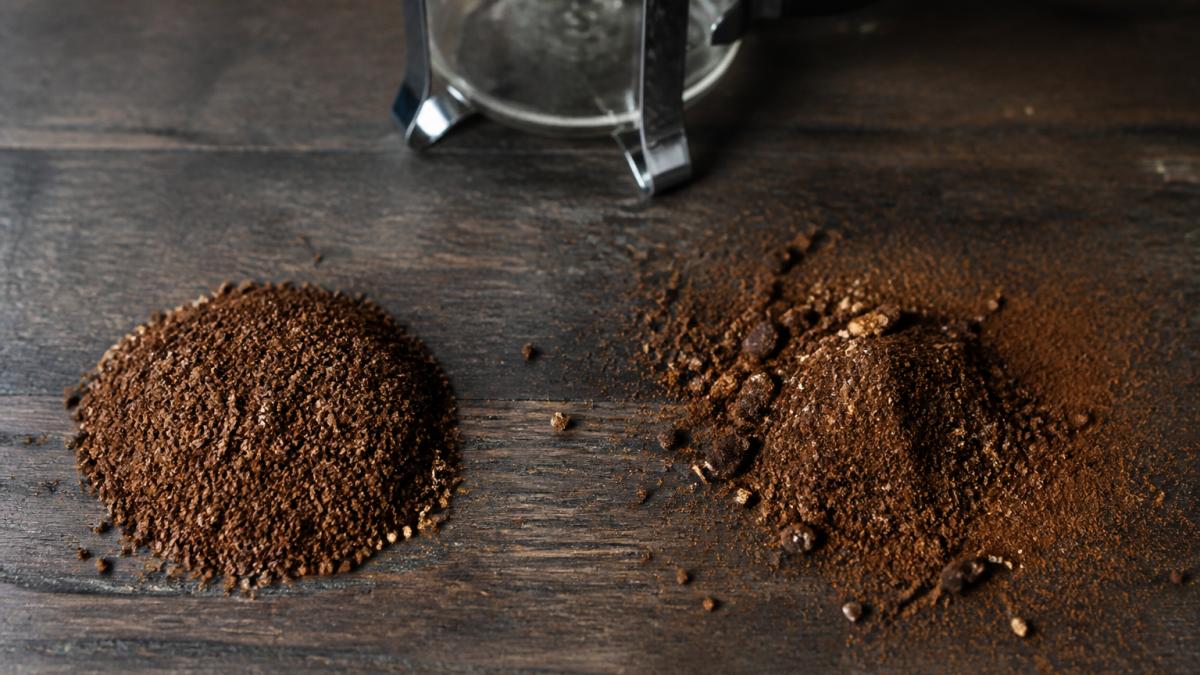
In a French press, grounds sit in hot water for around four minutes, then a metal mesh filter separates the liquid from most solids.
A burr grinder narrows the particle size spread, so the whole bed behaves predictably. A blade grinder widens it, so you're brewing several different coffees at once.
How to Grind Coffee Beans for French Press
Learning how to grind coffee beans for French press comes down to one target: a coarse, even grind that looks like sea salt. With a burr grinder, set it toward the coarse end and adjust. With a blade, technique matters more than the machine.
Here's how we'd approach it:
- Start with whole beans. Pre-ground coffee is already stale and gives you no control over particle size.
- Set a coarse target. Aim for particles roughly the texture of sea salt or coarse sand.
- Grind in short pulses with a blade. Shake the grinder between pulses so the coarse pieces cycle back toward the blade.
- Sift out the fines. A quick shake through a mesh sieve removes the powder that causes sediment and bitterness.
- Brew a test cup. Adjust grind before you adjust anything else.
Getting the Right Coarse Grind for French Press
The right coarse grind for French press keeps most particles in a narrow band, coarse enough to stay out of your cup, fine enough to extract fully in about four minutes.
A useful test: press the plunger slowly after brewing. If it fights you, the grind is too fine; if it drops with almost no resistance, too coarse.
For a blade grinder, the practical fix is sifting. Sieve out the fines before brewing and you'll cut sediment dramatically, even though the remaining particles still vary.
Burr Grinder Settings for French Press
Burr grinder settings for French press generally land in the coarsest third of the adjustment range, but the exact number depends on the grinder. Treat any number you read online as a starting point, not a rule. Here's how to find your grinder's French press setting deliberately, plus the manual-vs-electric differences.
Finding Your Starting Point
Most burr grinders use numbered clicks (common on manuals), stepped dials with labeled ranges, or stepless collars. For French press, start at the coarsest labeled setting or highest click count, then brew a test cup.
A useful physical check: the ground bed should look like coarse sea salt, with most particles visibly similar in size. A dusting of powder on top of larger chunks means you're too fine or the burrs are worn.
Discover Iron Spur Coffee Today →
Manual Burr Grinder Settings
Manual burr grinders express settings as click counts from the zero point (where the burrs touch). French press usually falls around 30-40 clicks from zero on common hand grinders, but the number varies by model and burr geometry. Two practical notes:
- Coarse settings require more turns because each rotation feeds fewer beans through a wider gap. Expect a longer crank time than at fine settings.
- Click counts drift if the adjustment ring loosens. Re-zero the grinder periodically by closing the burrs until they touch, then counting back to your French press setting.
Electric Burr Grinder Settings
Electric burr grinders vary more in how they hold a setting. Stepped dials are repeatable but coarse in resolution; stepless collars fine-tune but can drift during grinding. For French press:
- Note the dial position where you get a clean cup, and mark it with tape or a marker if the dial has no detents.
- Grind a small amount and check the bed before committing a full dose.
- On grinders with a hopper, avoid leaving beans in the hopper for long periods; stale beans grind differently and throw off your setting.
French Press Troubleshooting Linked to Grind
Your cup diagnoses your grind better than any label. Use these adjustments before changing anything else:
- Muddy cup with grit: too many fines. Move one step coarser, or sift fines through a mesh sieve if your grinder produces them regardless of setting.
- Harsh, bitter finish: over-extraction from powder. Coarsen the grind and shorten steep time slightly.
- Thin, sour, hollow cup: under-extraction from chunks. Grind finer or steep longer.
A Controlled Taste Test to Lock In Your Setting
Once you have a candidate setting, brew two batches with the same beans, dose, water, and steep time, changing only the grind by one step. Taste both blind. If the coarser cup is cleaner and sweeter, stay there; if it's weak, move finer. This is the same logic competitors describe for burr vs blade, applied within your burr grinder to find the French press setting that fits your palate and beans.
Choosing the Best Grinder for French Press on Your Budget
The best grinder for French press depends less on budget than on how much inconsistency you're willing to drink. But budget sets the floor, so here's the honest breakdown by price band.
| Budget Tier | Typical Price Band | Grinder Type | Grind Consistency | Best For | Main Tradeoff |
|---|---|---|---|---|---|
| Entry | Under $40 | Blade grinder | Low, wide particle spread | Occasional brewers testing the hobby | Sediment and uneven extraction; requires sifting and pulse technique |
| Mid | $40-$100 | Manual burr grinder | High, repeatable settings | Daily brewers who don't mind the effort | Hand-cranking takes time, especially at coarse settings |
| Upper | $100-$250 | Electric burr grinder | High, consistent and fast | Daily brewers and households | Higher upfront cost; entry-level electric burrs can be less consistent than a good manual |
| Premium | $250+ | Electric burr grinder with larger burrs | High, consistent, fast, and durable | Enthusiasts and multi-cup households | Cost is hard to justify for French press alone |
When a Blade Grinder Is Actually Enough
A blade grinder can make drinkable French press if you sift the fines and pulse carefully. Staying with a blade is strongest when:
- You brew French press once or twice a week, not daily.
- You're already willing to sift fines through a mesh sieve before brewing.
- You drink your coffee within a few minutes of pressing, so fines don't keep extracting in the beaker.
In those cases, a blade grinder plus a $10 sieve and disciplined one-second pulses gets you most of the way there, not as clean as a burr grind, but recognizably French press coffee rather than mud.
When Upgrading to a Burr Grinder Pays Off
The upgrade is likely to make a meaningful difference when any of these are true:
- You brew French press four or more times a week.
- You've noticed sediment, bitterness, or a muddy mouthfeel that sifting hasn't fixed.
- You want to change grind size deliberately for different beans or ratios.
A manual burr grinder in the $40-$100 band is the upgrade we'd recommend first: repeatable coarse settings for modest money, and less effort at French press coarseness than at espresso fineness. Electric burr grinders cost more but remove the effort and speed up your morning, which matters most for daily brewers and households.
Manual vs. Electric Burr Grinders for French Press
This decision matters more for French press than for espresso. At coarse settings, a manual burr grinder is easier to crank than at fine settings, so the effort penalty is smaller than you'd expect.
Electric burr grinders win on speed, capacity, and convenience for households. The risk at the entry end is that a cheap electric burr can be less consistent than a well-regarded manual at the same price.
That's where sourcing matters. Iron Spur Coffee roasts to order using specialty-grade, high-elevation beans, and our small-batch process uses precision thermal mapping to keep bitterness out of the roast. Good beans and a consistent coarse grind reinforce each other.
Taste, Sediment, and Troubleshooting: What the Cup Tells You
Sediment, bitterness, and weak flavor each point to a specific problem, and most French press complaints trace back to particle size.
- Muddy cup with grit: too many fines. Sift them out or grind coarser.
- Harsh, bitter finish: over-extraction from powder. Coarsen the grind and shorten steep time slightly.
- Thin, sour, hollow cup: under-extraction from chunks. Grind finer or steep longer.
A controlled taste test settles the burr vs blade grinder question for your palate. Same beans, dose, water, and steep time, one variable: the grind. Brew a burr-ground and a blade-ground batch side by side and taste both blind.
Frequently Asked Questions
Can you use a blade grinder for French press coffee?
Yes, but it takes technique. A blade grinder chops unevenly, so you get fine dust alongside coarse chunks. Pulse in short one-second bursts and shake the grinder between pulses to redistribute the beans. Stop as soon as the grounds look like coarse sea salt. Expect more sediment in the cup and a slightly muddier flavor than a burr grinder delivers, and plan to pour slowly through the press screen.
Do burr grinders make less sediment in French press coffee?
They usually do. A burr grinder produces uniform coarse particles, so fewer fines slip through the metal mesh screen. Blade grinders create a wide spread of particle sizes, and the fine dust passes straight into your cup. If silt at the bottom of your mug bothers you, a burr grinder plus a steady, slow plunge solves most of it. Grind coarser if sediment persists.
What grind setting should I use on a burr grinder for French press?
Start at the coarse end of the scale, roughly the texture of coarse sea salt, with particles around 0.8 to 1 millimeter across. On most dial grinders that is 8 to 12 clicks from the finest setting, but every model numbers differently. Brew one press, taste it, then adjust: bitter and silty means go coarser, thin and sour means go finer. Change one notch at a time.
Is an upgrade from blade to burr worth it for French press?
If you drink French press several times a week, yes. Manual burr grinders start around $30 to $50 and electric models cost more, while a blade grinder runs $15 to $25. The upgrade buys uniform particles, repeatable settings, and less sediment. Budget shoppers can still get decent results from a blade grinder with pulsed grinding and a slow pour, so the jump is about consistency more than raw capability.
The real challenge with French press isn't the gear, it's starting with beans worth grinding well. Iron Spur Coffee gives you specialty-grade, high-elevation beans roasted to order, with precision thermal mapping to keep bitterness out and complex sweetness in, plus fast, reliable delivery so your bag arrives ready for the next brew. Discover Iron Spur Coffee today and build a morning cup that holds up to a proper coarse grind.