

How Long Does Ground Coffee Stay Fresh
Table of Contents
- How Long Does Ground Coffee Stay Fresh
- Coffee Shelf Life After Opening
- Signs of Stale Coffee You Should Know
- The Best Way to Store Ground Coffee
- Oxidation and Flavor Degradation
- Whole Bean vs. Ground Coffee Freshness
- Freezing Ground Coffee: Does It Work
- Conclusion
- Frequently Asked Questions
Last Updated: August 31, 2026
How Long Does Ground Coffee Stay Fresh
Ground coffee stays fresh for about two weeks after opening, though optimal flavor is closer to one week. Oxidation accelerates dramatically once you open a bag, attacking the coffee's aromatics and flavor compounds. Ground coffee has exponentially more surface area than whole beans, so degradation moves faster. At Iron Spur Coffee, we emphasize this distinction because it directly impacts your morning brew.
Proper storage in an airtight container in a cool, dark place can extend freshness to three weeks. Poor storage, leaving the bag open on a counter or in a cupboard with temperature fluctuations, reduces that window to five to seven days. Understanding these variables helps you maximize your investment in quality beans.
Coffee Shelf Life After Opening
Once you open a bag of ground coffee, the clock starts immediately. Most specialty roasters recommend consuming ground coffee within two weeks of opening for best flavor, though it remains technically safe beyond that point.
Degradation accelerates in the first 24 to 48 hours, when the most volatile aromatics escape (peer-reviewed research). By day seven, you'll notice a measurable shift: the coffee tastes flatter, acidity becomes muted, and sweetness diminishes. By day 14, most ground coffee has lost enough flavor compounds that the difference becomes obvious even to casual drinkers. This is why Iron Spur Coffee emphasizes roasting to order, fresh roasted coffee consumed within the optimal window delivers the quality we promise.
Signs of Stale Coffee You Should Know
Stale coffee announces itself through multiple sensory signals. Fresh ground coffee has a rich, complex smell with notes like chocolate, fruit, nuts, or florals depending on roast and origin. Stale coffee smells muted and flat.
Visual changes also tell the story. Fresh ground coffee appears vibrant and dark; stale coffee looks dull and lifeless. Taste is the final confirmation, stale coffee tastes thin, lacks sweetness and complexity, and bitterness becomes more prominent.
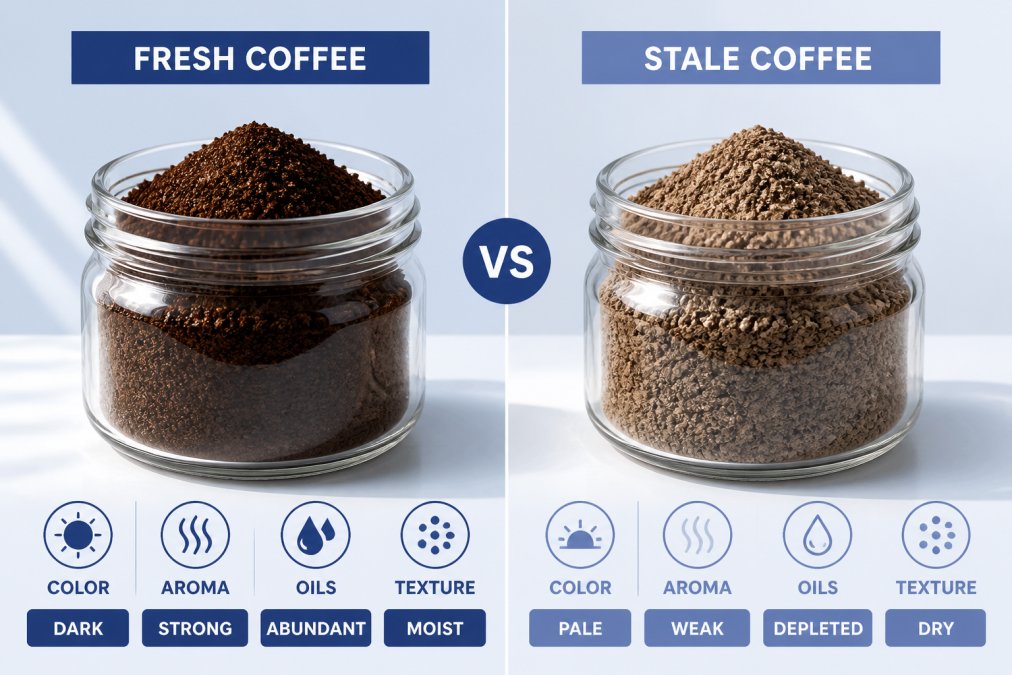
A less obvious signal is the absence of degassing. Fresh roasted coffee releases carbon dioxide for several days after roasting. If you notice small bubbles or a slight "bloom" when water first hits the grounds, that's degassing, a sign the coffee is genuinely fresh.
The Best Way to Store Ground Coffee
Storage is where most people make critical mistakes. The solution requires understanding three core variables: oxygen exposure, light, and temperature stability.
Airtight containers and one-way valves
An airtight container is non-negotiable. No ziplock bags left partially open, no original bags left unsealed, no mason jars without proper lids. One-way valves let carbon dioxide escape while blocking oxygen from entering, which is why specialty roasters use them. However, they don't prevent oxidation entirely, they slow it.
For ground coffee specifically, the surface area problem makes airtight storage even more critical than for whole beans. Ground coffee has roughly 15 to 20 times more surface area than whole beans of equivalent weight, so oxygen attacks it much faster (peer-reviewed research).
The best container combines airtight sealing with minimal headspace. Transfer your ground coffee to a container just large enough to hold it. Glass containers with rubber gasket seals work well; vacuum-sealed containers work better.
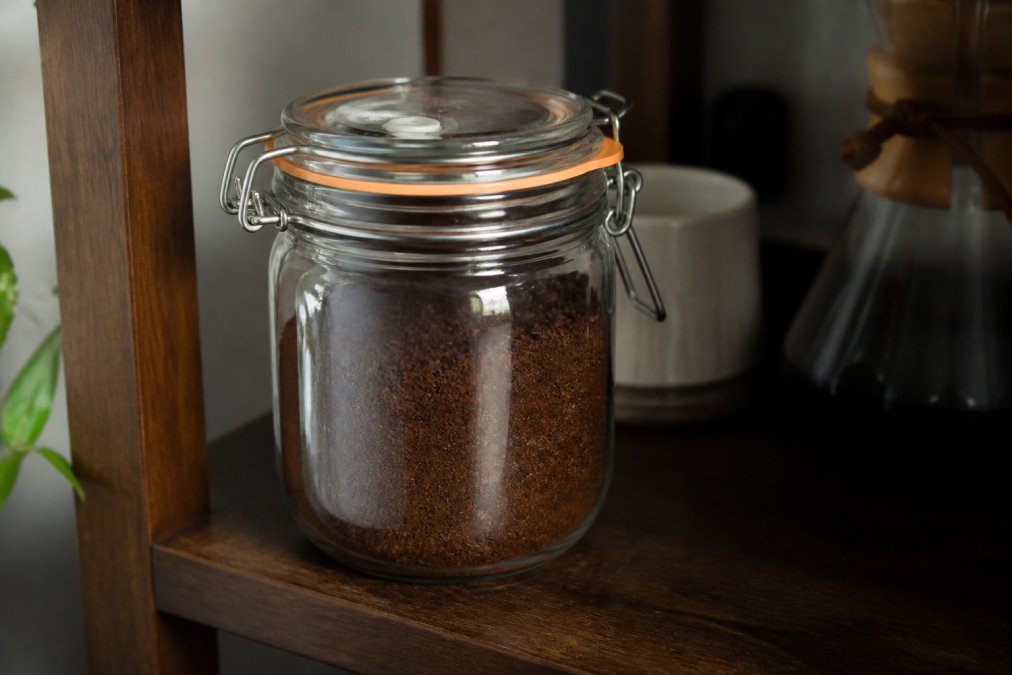
Temperature and light control
Temperature stability matters more than absolute coldness. Ground coffee stored at a constant 60 degrees Fahrenheit stays fresher longer than coffee cycling between 50 and 75 degrees daily. Temperature fluctuations cause condensation, which introduces moisture and accelerates oxidation.
Light is equally critical. UV and visible light accelerate flavor compound degradation. Store your ground coffee in a cool, dark place, a kitchen cupboard away from the stove or a pantry works well. Avoid windowsills, open shelves, or areas near your coffee maker where heat and steam create fluctuations.
The ideal storage setup combines three elements: an airtight, opaque container in a cool, dark location with minimal temperature fluctuation.
Oxidation and Flavor Degradation
Oxidation is the chemical process where oxygen molecules interact with organic compounds in coffee. This process is inevitable; you can only slow it, not stop it.
When coffee is roasted, heat develops hundreds of flavor compounds that are chemically unstable. Once roasted, they begin breaking down immediately. Oxygen accelerates this breakdown dramatically. Ground coffee oxidizes faster than whole beans because grinding increases surface area, creating thousands of new surfaces for oxygen to attack.
The flavor compounds most vulnerable to oxidation are the aromatics, the volatile compounds that create complexity and brightness. These escape first, which is why stale coffee loses aroma before it loses all flavor. The remaining compounds are less volatile but also less interesting, which is why stale coffee tastes flat and one-dimensional.
The takeaway: oxidation is a chemical process you can slow through proper storage but never completely stop. This is why freshness matters and why roasting to order makes a measurable difference.
Whole Bean vs. Ground Coffee Freshness
Whole beans stay fresh significantly longer than ground coffee. A sealed bag of whole beans maintains optimal freshness for four to six weeks after opening; ground coffee typically peaks within two weeks (peer-reviewed research). The difference comes down to surface area, a whole bean presents a small, protected surface to oxygen, while grinding breaks that seal and exposes the interior.
For maximum control over freshness, buy whole beans and grind immediately before brewing. If you choose ground coffee for convenience, buy smaller quantities more frequently. Some specialty roasters, including Iron Spur Coffee, offer single-serve options that solve this problem. The 12 Pack Single Serve Coffee Capsules provide pre-ground coffee sealed with no oxygen inside, preserving freshness until you brew.


Freezing Ground Coffee: Does It Work
Freezing can extend shelf life, but it requires specific execution. The critical mistake is repeated freezing and thawing, every cycle creates condensation that accelerates oxidation and can promote mold growth.
Freezing works only if you portion your coffee before freezing and thaw each portion just once, immediately before brewing. Divide your ground coffee into small bags or containers for one week of brewing. Freeze all but one portion. Remove one portion from the freezer, let it come to room temperature (30 minutes to an hour), and use it that week. This approach can extend freshness to four weeks total.
Refrigeration is less effective than freezing but still helpful. However, refrigerators have moisture and temperature fluctuations that create condensation. Room-temperature storage in an airtight container usually works better unless your refrigerator is extremely dry and stable. Never freeze or refrigerate coffee in an open container.
Conclusion
Ground coffee stays fresh for approximately two weeks after opening when stored properly in an airtight container away from light, heat, and moisture. The first week delivers peak flavor.
Most coffee drinkers don't need complicated storage systems. An airtight opaque container in a cool, dark cupboard works. The real investment is buying coffee fresh and consuming it within the optimal window. This is why many specialty roasters, including Iron Spur Coffee, emphasize roasting to order, you receive freshly roasted beans designed to be consumed at peak freshness.
If you're serious about flavor, buy whole beans and grind immediately before brewing. If convenience matters more, buy smaller quantities of ground coffee more frequently, or choose pre-sealed single-serve options like Iron Spur's 12 Pack Single Serve Coffee Capsules, which seal out oxygen and maintain freshness until you brew.
Frequently Asked Questions
Does ground coffee actually go bad or just lose flavor?
Ground coffee doesn't become unsafe to drink, but it deteriorates in quality. Oxidation and exposure to air, light, and moisture break down aromatics and flavor compounds, creating stale, flat-tasting coffee. The brew quality declines noticeably, but it remains safe to consume.
What's the best way to store ground coffee for maximum freshness?
Store ground coffee in an airtight container with a one-way valve in a cool, dark place away from heat and direct sunlight. Vacuum-sealed bags or containers minimize oxygen exposure and slow oxidation. Keep it away from the refrigerator or freezer unless you plan long-term storage. Grind size matters too, finer grounds have more surface area and degrade faster than whole beans, so buy pre-ground only what you'll use within a reasonable timeframe.
How long does ground coffee last after opening the bag?
Once opened, ground coffee stays fresh for 1-2 weeks if stored properly in an airtight container. Exposure to oxygen accelerates oxidation. Each time you open the bag, you introduce moisture and air that degrade the coffee's flavor profile and aromatics. Resealable bags with one-way valves help, but transferring to a dedicated airtight container extends freshness longer than keeping it in the original packaging.
Should you freeze ground coffee to keep it fresh longer?
Freezing can extend shelf life if done correctly, but it risks freezer burn and condensation that damages flavor. Only freeze ground coffee if you won't use it within a few weeks. Use airtight, vacuum-sealed containers to prevent moisture exposure. Thaw completely before opening to avoid condensation inside the container. For everyday use, a cool dark pantry is better than freezing, which can alter the sensory profile and acidity of your brew.
Ground coffee quality depends entirely on freshness. Invest in storage that protects what you've paid for, and consume your coffee within the optimal window. Iron Spur Coffee's commitment to roasting to order means you receive coffee at peak freshness, with the complex sweetness and deep flavor notes that make specialty coffee worth the investment. Discover Iron Spur Coffee today and experience the difference fresh roasting makes.
This article was written using GrandRanker