

Can You Brew Small Batch Coffee at Home?
Last Updated: November 13, 2026
Quick Summary
You can brew small batch coffee at home by using a 1:16 ratio, such as 18 grams of coffee to 288 grams of water for one 8-ounce cup. Weigh the beans whole, grind right before brewing, and match your grind to a manual method like pour-over, French press, or AeroPress.
- A common small batch coffee brewing ratio is 1:16, or one gram of coffee per sixteen grams of water.
- Use 18 grams of coffee grounds for one 8-ounce cup brewed with about 288 grams of water.
- For two cups in a French press, use 32 grams of coarse coffee and 512 grams of water at 200°F.
- Aim for a water temperature between 195°F and 205°F when brewing.
- If your drip machine's minimum brew volume is above two cups, brew four cups and store the extra in a preheated thermal carafe.
Table of Contents
- Why Small Batch Coffee Brewing Beats a Full Pot
- The Small-Batch Coffee Brewing Ratio That Actually Works
- How Much Coffee Grounds for One Cup?
- How to Brew Coffee Without a Machine
- A Batch Brew Coffee Recipe Scaled for Two Cups
- Grind Size, Water Temperature, and Other Variables That Matter
- Troubleshooting Small-Batch Coffee: Fix Bitter, Sour, or Weak Brews
- Choosing the Right Beans for Your Small-Batch Brew
- Frequently Asked Questions
Why Small Batch Coffee Brewing Beats a Full Pot
Small batch coffee is the practice of brewing one or two cups at a time with a measured dose, a controlled ratio, and a grind matched to the method. It gives you a fresher cup, less waste, and full control over strength.
Small batches give you control over your brew, whether you roast or brew at home. A twelve-cup pot makes sense for a diner. It rarely makes sense for one person with a schedule.
The Waste Problem With Standard Drip Machines
Most automatic drip machines are built around a full carafe. Fill the basket for two cups and the water spreads across a wide bed and cools before it finishes. You pour one cup and dump the rest.
A smaller batch fixes both problems at once. You brew only what you drink.
Freshness You Can Taste in Every Cup
Coffee starts losing aroma the moment it is ground. A cup brewed from freshly ground beans tastes sweeter and fuller than one sitting on a warmer for an hour.
Small batches force you to grind right before brewing. That single habit does more for flavor than any gadget.
The Small-Batch Coffee Brewing Ratio That Actually Works
A common small-batch coffee brewing ratio is 1:16. That means one gram of coffee for every sixteen grams of water. For a single cup, use 18 grams of coffee and 288 grams of water.
This ratio is a common starting point for many brewers. Adjust it in small steps:
- Want it stronger? Move toward 1:15.
- Want it lighter? Move toward 1:17.
- Keep the water fixed and change only the coffee at first.
Weighing Coffee vs. Scooping: Why Grams Matter
A scoop is not a measurement. Depending on grind and how you pack it, one tablespoon can hold wildly different weights. Two identical scoops can brew two different cups.
A digital scale removes the guesswork. If you are on the fence about buying one, our guide to whether a digital coffee scale is worth it breaks down what you actually gain.
How Much Coffee Grounds for One Cup?
Use 18 grams of coffee grounds for one 8-ounce cup, brewed with about 288 grams of water at a 1:16 ratio. For a milder cup, drop to 16 grams. For a bolder cup, go up to 20 grams.
Here is a quick reference for common small-batch sizes:
| Cups | Coffee | Water | Typical Method |
|---|---|---|---|
| 1 cup | 18 g | 288 g | Pour-over |
| 2 cups | 32 g | 512 g | French press |
| 2 cups | 30 g | 480 g | AeroPress, two rounds |
Weigh the beans whole, then grind. Grinding first and scooping after is where most small-batch mistakes start.
How to Brew Coffee Without a Machine
You do not need a machine to brew excellent coffee. A dripper, a kettle, and a filter will do it. But the right manual method depends on how many cups you are making, how much effort you want to spend, and what flavor profile you are after. Here is how the main small-batch options compare.
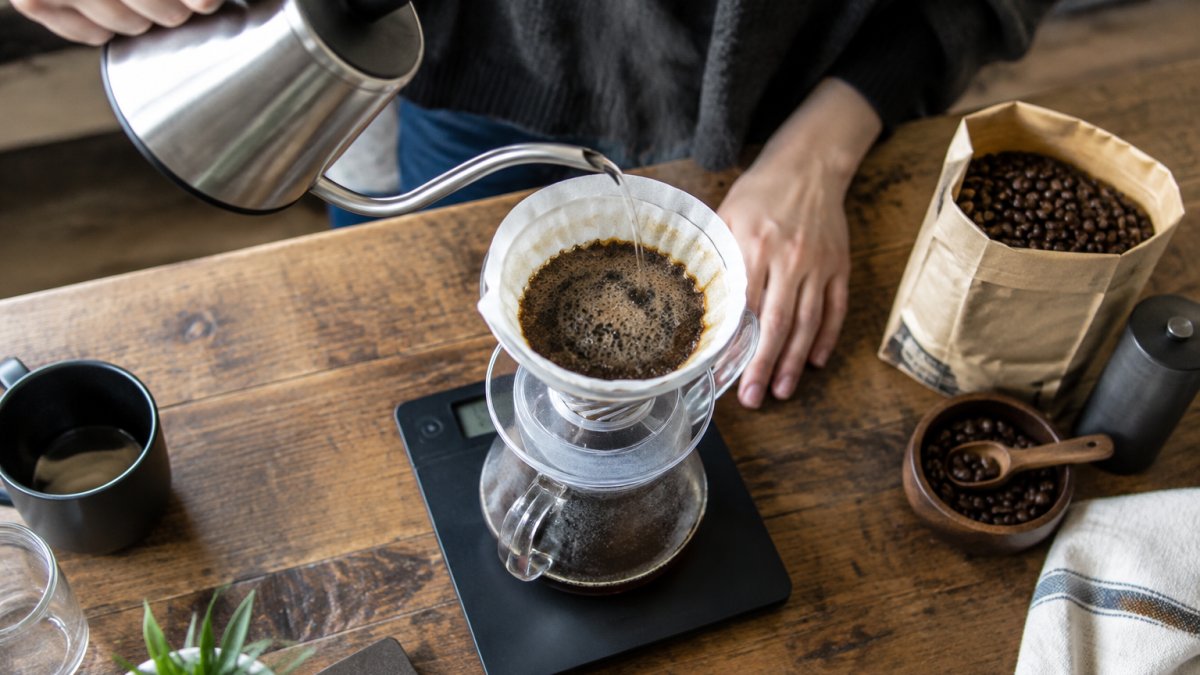
Side-by-Side Method Comparison for One or Two Cups
| Method | Best For | Effort | Equipment | Flavor Character |
|---|---|---|---|---|
| Pour-over | One cup, clarity and control | Medium | Dripper, paper filter, gooseneck kettle, scale | Clean, bright, separates flavor notes |
| French press | Two cups, body and richness | Low | Press, coarse filter, scale | Full-bodied, heavier mouthfeel, some sediment |
| AeroPress | One cup, travel and forgiveness | Low | AeroPress, paper or metal filter, scale | Concentrated, smooth, low acidity |
| Immersion dripper | One or two cups, hands-off steeping | Low | Immersion dripper, paper filter, scale | Balanced, between pour-over and French press |
| Standard drip machine | Two or more cups, convenience | Low | Machine, paper filter, scale | Consistent but prone to uneven extraction at small volumes |
Pour-over gives control over a single cup because you can adjust pour speed and agitation in real time. French press is a straightforward path to a rich two-cup batch. AeroPress is forgiving when your grind or temperature is slightly off.
Pour-Over Method for a Single Cup
Total time: about 4 minutes You'll need: dripper, paper filter, gooseneck kettle, scale, 18 g coffee, 288 g water
- Heat water to just off a boil, around 200°F.
- Rinse the paper filter with hot water, then dump the rinse.
- Add 18 g of medium-fine grounds and level the bed.
- Pour 40 g of water to bloom the coffee. Wait 30 seconds.
- Pour in slow circles until you hit 288 g total.
- Let it drain fully. Total brew time should land near 2:30 to 3:00.
Rinsing the filter removes paper taste and preheats the dripper.
Watch out: if your pour-over drains in under two minutes, your grind is too coarse or your pour was too fast, and the cup will taste thin and sour.
French Press and AeroPress for Small Batches
The French press is the easiest small-batch tool you can own. Use a coarse grind, 32 g of coffee, and 512 g of water for two cups.
The AeroPress suits one cup and travels well. Use a fine-medium grind and about 15 g of coffee. Steep a minute, press gently.
Watch out: with a French press, pressing too fast forces fines through the mesh and leaves grit in the cup.
Which Method Should You Pick?
Choose pour-over if you drink one cup at a time and want the clearest flavor. Choose French press if you usually make two cups and prefer body over clarity. Choose AeroPress if you want one cup with minimal cleanup or you brew away from home. Choose an immersion dripper if you want the hands-off ease of a French press with the cleaner cup of a paper filter.
A Batch Brew Coffee Recipe Scaled for Two Cups
Here is the batch brew coffee recipe we would hand a friend.
- Coffee: 32 g, coarse grind
- Water: 512 g at 200°F
- Steep: 4 minutes
The math is simple: halve a standard 64-gram pot recipe and you get a two-cup batch. The trick is grind.
Watch out: if you keep the same grind for a two-cup batch as your full pot, the smaller bed extracts faster and the cup tastes harsh. Go one notch coarser.
Small-Batch Settings for an Automatic Drip Machine
A standard home drip machine is built around a full carafe. Brew two cups in a twelve-cup machine and the water spreads across a wide basket, the bed stays shallow, and the slurry cools before it finishes.
If your machine has a small-batch setting, use it. That setting slows the water flow and sometimes pulses the spray head so the shallow bed gets more contact time. If your machine does not have one, you can still brew two cups with these adjustments:
- Use a smaller basket if one is available. A wide basket with a thin bed is the main cause of uneven extraction at low volume.
- Grind slightly finer than you would for a full pot. The shorter brew cycle and shallower bed need more surface area to extract fully in the time available.
- Preheat the carafe and the brew path. Run a cup of hot water through the empty machine first, then dump it. This keeps the small volume from cooling mid-brew.
Watch out: if your drip machine's manual lists a minimum brew volume above two cups, do not fight it. Brew four cups and store the extra in a preheated thermal carafe, or switch to a manual method for one- and two-cup batches.
Scaling Down Without Losing Consistency
When you reduce a recipe, three variables change at once: the bed depth, the contact time, and the thermal mass of the slurry. A smaller bed extracts faster, a shorter brew cycle gives less contact time, and a smaller volume of water loses heat more quickly. That is why a recipe that works at twelve cups can taste thin or harsh at two.
To keep extraction consistent across batch sizes, adjust in this order:
- Keep the ratio fixed. Stay at 1:16 by weight and change only the grind and technique.
- Grind finer as the batch gets smaller. A two-cup batch usually needs a grind one or two steps finer than a full pot on the same machine.
- Preheat everything. A preheated carafe and brew path compensate for the lower thermal mass of a small batch.
- Shorten the brew time slightly. A smaller bed drains faster, so expect the total brew to finish sooner and adjust grind to hit your target time.
A common pattern is that brewers who scale down keep the full-pot grind and wonder why the cup tastes weak. The fix is almost always a finer grind and a preheated carafe, not more coffee.
Grind Size, Water Temperature, and Other Variables That Matter
Grind size is the biggest lever you control. Coarse grinds brew slow and clean. Fine grinds extract fast and can turn bitter.
Water temperature matters too. Aim for 195°F to 205°F. Boiling water scalds delicate roasts; water below 190°F under-extracts and tastes sour.
Water quality plays a quiet role. For a deeper walkthrough on dialing in grind, see our guide on choosing the right coffee grind size.
Troubleshooting Small-Batch Coffee: Fix Bitter, Sour, or Weak Brews
Small batches make mistakes more noticeable. A small change in grind or dose shows up quickly in the cup. Use this table to correct the most common problems.
| Problem | Likely Cause | Fix |
|---|---|---|
| Bitter, harsh | Grind too fine or water too hot | Grind coarser, drop temp to 200°F |
| Sour, thin | Under-extracted, water too cool | Grind finer, raise temp, lengthen brew |
| Weak, watery | Too little coffee for the water | Tighten ratio toward 1:15 |
| Muddy, silty | Too many fines in the bed | Use a coarser grind, rinse the filter |
For a pour-over that tastes thin and watery, the cause is usually grind or ratio, not the beans. Our article on why your pour over tastes thin and watery walks through the exact fixes. If bitterness is your main complaint, our guide on brewing smooth coffee without bitterness covers the variables in order.
Choosing the Right Beans for Your Small-Batch Brew
Bean choice sets the ceiling on your cup. Small batches reward good beans because there is nowhere for flaws to hide.
Medium roasts are forgiving across methods. Lighter roasts show more fruit and acidity.
Brazil Santos is a medium roast with cocoa notes and a smooth, elegant cup, priced at $23.99.
Store beans in an airtight container away from light and heat. Our guide on how to store coffee beans for maximum freshness covers the details.
Brewing one great cup takes less effort than most people expect. Start with our Brazil Santos or explore the full lineup and build a morning routine that holds up.
Frequently Asked Questions
What coffee-to-water ratio works best for a small batch?
Start with a 1:15 to 1:17 ratio by weight. For one 8-ounce cup, that means roughly 15 grams of coffee to 250 grams of water. For two cups, use 30 grams of coffee and 500 grams of water. A 1:15 ratio gives a bolder, stronger cup, while 1:17 is lighter and more tea-like. Adjust within that range to match your taste, and always weigh your coffee on a digital scale rather than scooping.
Can you brew small-batch coffee without a coffee maker?
Yes. A pour-over cone, French press, or AeroPress all brew one or two cups without electricity. A pour-over setup costs under $30 and gives you the most control over pour speed and extraction. A French press requires no paper filters and steeps in about four minutes. The AeroPress is the most compact option and works well for travel or camping, which fits an outdoor routine.
How do you keep small-batch coffee from tasting bitter?
Bitterness usually comes from over-extraction: water that is too hot, a grind that is too fine, or steeping too long. Use water between 195 and 205 degrees Fahrenheit, grind medium for drip and medium-coarse for French press, and keep brew time under four minutes for pour-over. Freshly roasted beans also help; stale coffee tastes flat and harsh no matter how you brew it.
What grind size should I use for batch-brew coffee?
For a standard drip machine or pour-over, use a medium grind that looks like coarse sand. French press needs a coarse grind similar to sea salt. AeroPress works best with a fine-medium grind. If your brew tastes sour or weak, grind finer; if it tastes bitter or dry, grind coarser. A burr grinder gives you more consistent particles than a blade grinder, which matters more in small batches because there is less room for error.
