

Using Sensory Cues for Roast Consistency Every Batch
Last Updated: November 22, 2026
Quick Summary
You use sensory cues for roast consistency by tracking sight, smell, sound, touch, and taste against fixed checkpoints on every batch, then logging observations so the next roast has a reference point. First crack is your anchor for development, and the cupping loop confirms whether your sensory read was right.
- Set up a fixed station with daylight-balanced light, one trier, a visible timer, and a log sheet before charging the roaster.
- First crack sounds like popcorn starting and marks the anchor point where roast consistency is won or lost.
- Record actual values like first crack at 9:15, not checkmarks, then calculate the spread across ten batches.
- Line up three consecutive batches and find the first metric that diverges to localize drift to a phase.
- Run drills like sound-only roasts and blind sample comparisons to build a shared sensory vocabulary.
Table of Contents
- How Do You Use Sensory Cues for Roast Consistency?
- What You Need Before the First Batch
- The Coffee Roasting Stages Chart You Can Smell, Hear, and See
- How to Evaluate Coffee Roasting Quality With All Five Senses
- Building a Sensory Log That Protects Coffee Roast Profile Consistency
- Roast Progression Cupping: Closing the Loop From Roaster to Cup
- Calibration Drills and Fixes for Conflicting Cues
- Order Iron Spur Coffee and Taste a Consistent Roast
- Frequently Asked Questions
How Do You Use Sensory Cues for Roast Consistency?
A roast profile is only as reliable as the person reading it. For a closer look at how small batch roasted coffee enables that precision control, see our guide.
Most roasting guides lean on numbers and skip the human side. But first crack is a sound, not a number. Bean color is a sight.
Below, we break down how to build that skill into a repeatable system: checkpoints, the log, the cupping loop, and calibration drills that keep a roast profile tight.
What You Need Before the First Batch
Set up your station before you charge the roaster. A consistent setup removes half the variables that wreck roast consistency.
Here is the short list:
- A good light. Natural daylight or a daylight-balanced lamp. Warm bulbs lie about bean color.
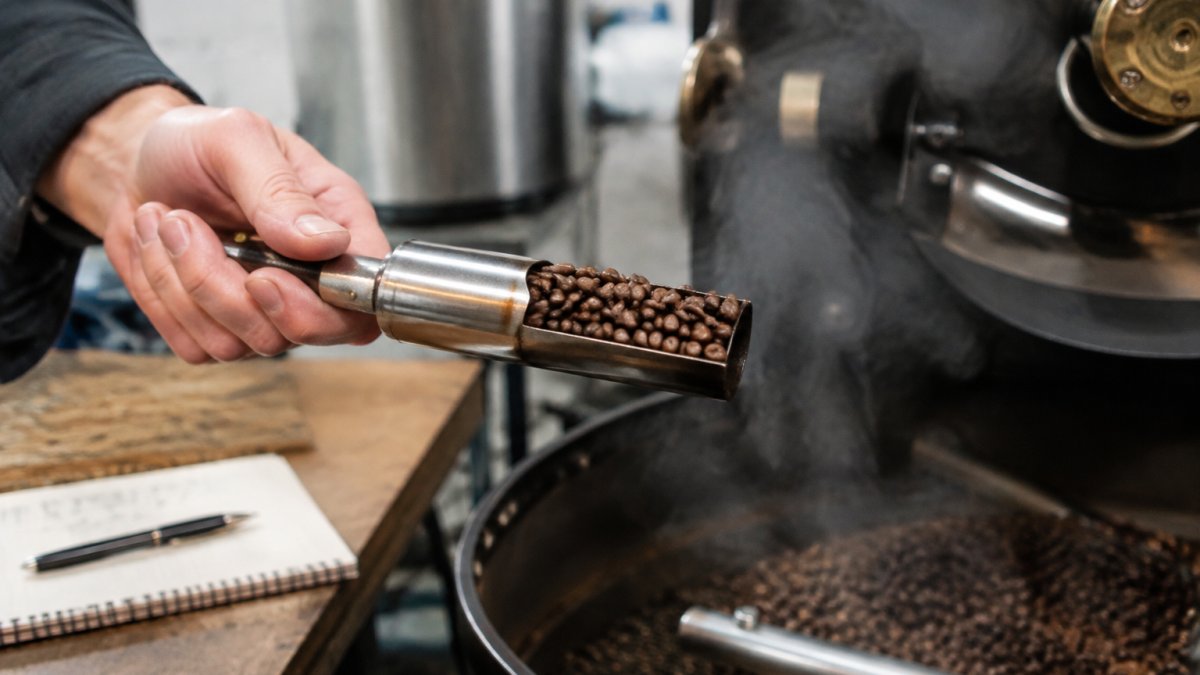
- A trier. Your window into the drum. Use the same one every time.
- A timer you can see. Not your phone in a pocket.
Fix your environment too. Drafts, humidity, and a cold room all change how a roast behaves. Note room conditions in your log to catch drift later.
A common mistake is changing gear mid-week. New trier, new light, new notebook, and suddenly nothing matches. Keep the station boring and identical.
The Coffee Roasting Stages Chart You Can Smell, Hear, and See
A coffee roasting stages chart maps each phase of the roast to a sensory checkpoint you can detect in real time. The chart below tracks what you smell, hear, see, and feel at each stage.
| Stage | What You Smell | What You Hear | What You See | What You Feel |
|---|---|---|---|---|
| Drying | Grass turning to bread | Quiet, low rumble | Pale yellow-green beans | Damp, soft surface |
| First crack | Sweet, bready, faint fruit | Sharp popping | Color turn to tan-brown | Beans swell and firm up |
| Development | Deep sweetness, caramel | Softer crackle | Even brown, smooth surface | Light, dry, hard |
| Second crack | Sharp, smoky, roasty | Fast snapping | Dark, oily sheen | Brittle, light |
Stage 1: Drying and the Grass-to-Bread Shift
The drying phase is where you learn to trust your nose. Green beans smell grassy; as moisture leaves, that note fades into something like warm bread.
Watch the color too. Beans move from pale green to yellow, then light tan. If the color stalls, your heat is low.
Stage 2: First Crack and the Color Turn
First crack is the loudest cue in the roast. It sounds like popcorn starting, sharp and distinct.
At the same moment, bean color turns from tan to brown. Surface texture tightens. This is your anchor point for roast development, and it is where roast consistency is won or lost.
Stage 3: Development and Second Crack
Development is the stretch after first crack. Smell deepens into caramel and stone fruit. The crackle softens.
Second crack arrives as a faster, sharper snap and a smoky note. Push past it and you are into dark roast territory; stop short and you risk underdeveloped, grassy coffee. For how roast level changes the cup, see our guide to light vs dark roast profiles.
How to Evaluate Coffee Roasting Quality With All Five Senses
Evaluating coffee roasting quality means scoring each sense separately, then checking that they agree. When they disagree, the bean is telling you something.
Run this five-sense check on every batch:
- Sight: Bean color even across the batch? Surface smooth or oily?
- Smell: Sweet and bready, or sharp and smoky?
- Sound: Did first crack land where your log says it should?
- Touch: Cool a bean, rub it. Dry and hard, or soft and spongy?
- Taste: Cup it. Sweetness, acidity, body, aftertaste.
A trained panel does this by consensus; a solo roaster does it by repetition.
For deeper reading on how roast development shapes flavor, the Specialty Coffee Association's roasting guidance is a solid reference.
Building a Sensory Log That Protects Coffee Roast Profile Consistency
A sensory log protects coffee roast profile consistency by turning what you see, smell, and hear into a written record you can compare batch to batch. Without it, you rely on memory, and sensory memory fades fast.
Here is the template we use. Copy it into a notebook or spreadsheet, but treat the right-hand column as the part that does the work.
- Batch number and date
- Bean origin and lot
- Charge weight and charge temperature
Turning the Log Into a Consistency Measure
A log becomes a consistency tool when you define what "the same" means. Pick three to five anchor metrics and set an acceptable band around each.
Record the actual value, not just a checkmark. "First crack at 9:15" is data. "First crack happened" is not. After ten batches, calculate the spread on each anchor metric: the difference between the fastest and slowest batch.
Batch-to-Batch Comparison Without Guesswork
Line up three consecutive batches side by side and read across the rows. Look for the first metric that diverges, not the last. If charge weight and temperature match but time to color turn drifts by 45 seconds, the divergence started in the drying phase, likely airflow, ambient humidity, or bean moisture. If color turn matches but first crack timing drifts, the issue is in the ramp between them.
Watch out: logging only the batches that go well defeats the purpose. The bad batches teach you where your thresholds should sit.
What to Do With the Verdict Column
The keep/adjust/dump verdict is only useful if tied to a specific action. When you mark a batch "adjust," write the adjustment in the same row: "reduce charge temp by 10°F," "extend development 20 seconds," "check airflow damper." Compare the next batch against the adjusted expectation, not the original.
For a closer look at how roast level changes the cup once the log is dialed in, see our guide to light vs dark roast profiles.
Roast Progression Cupping: Closing the Loop From Roaster to Cup
Roast progression cupping is the step most roasters skip. You cup the finished roast, score it blind, and feed that score back into the next batch.
Set up a blind cupping. Label cups with numbers, not roast names. Score sweetness, acidity, body, and aftertaste on a simple scale.
Then compare. Does the cup match what your log predicted?
This loop is where roast consistency actually lives. For a closer look at why roast timing and freshness matter in the cup, read whether roasting to order matters.
Calibration Drills and Fixes for Conflicting Cues
Conflicting cues are normal and fixable. When your nose says "done" and your log says "keep going," you need a tiebreaker, but better to understand why the cues diverged. Most conflicts trace to bean density and moisture, batch size, airflow and ambient conditions, or a machine that behaves differently from the one your reference notes were built on. Diagnose the source before you pick a winner.
A Conflict-Resolution Workflow
When sight, smell, sound, and temperature disagree, run this sequence in order:
- Check the cup first. The cup is the final judge. If the finished coffee tastes sweet, structured, and complete, the roast landed where it needed to regardless of what the trier showed.
- Check the log second. Compare the current batch against the last three batches of the same bean. If the divergence is isolated to this batch, look for a station or environment change. If it is a trend across batches, your reference expectations have drifted.
- Check the bean third. High-density, high-moisture beans from high-elevation farms often run first crack later and quieter than a lower-density lot. If you switched lots without recalibrating, the cues will lie to you.
- Trust your nose last, not never. Aroma is the most trainable cue and the most sensitive to development, but it is also the easiest to misread under fatigue or a cold room. Use it to confirm, not to override the cup.
Calibration Drills That Build Shared Vocabulary
Try these in rotation:
- Blind sample comparison. Cup three roasts of the same bean at different development levels. Rank them without labels. The goal is not to guess the roast level but to describe the difference in the same words each time.
- Color matching. Line up five bean samples from light to dark. Name each roast level from sight alone, then check against the actual drop temperatures. Repeat until your sight calls match the numbers within one step.
- Sound-only roast. Cover the trier window and roast by ear. Note where first crack lands. Compare to a normal batch. This drill exposes how much you rely on sight and how well you actually hear the crack.
Environmental and Equipment Variables That Skew Cues
Cues are only comparable when conditions are comparable.
Record these variables in the log alongside sensory observations. When a conflict appears, check the environment and equipment rows first. A batch that reads "off" on every sense was usually roasted under different conditions, not roasted wrong.
For a closer look at why roast timing and freshness matter in the cup, read whether roasting to order matters.
Order Iron Spur Coffee and Taste a Consistent Roast
Roast consistency is a discipline: a fixed station, a written log, five-sense checkpoints, and a cupping loop that closes the gap between roaster and cup.
Our small-batch roasting uses precision thermal mapping to eliminate bitterness. We roast to order to deliver maximum flavor and freshness.
If you want to taste what a tight roast profile delivers, start with our French Roast, a dark roast built on specialty-grade Central American coffee. For a blend that shows consistency across origins, try our 6 Bean Blend.
Consistent coffee is not an accident. It comes from disciplined roasting and a process you can trust.
Frequently Asked Questions
What sensory cues indicate that coffee is roasting properly?
Four cues run in sequence. Sight shows bean color moving from green to tan to brown and surface oils appearing at darker levels. Smell shifts from grassy to bread-like to caramel and then to sharp, smoky notes. Sound delivers first crack as a popcorn-style burst and second crack as a quieter, faster crackle. Touch tells you density: beans feel heavy and hard early, lighter and more brittle near the endpoint. When all four agree, the roast is tracking its profile. When one drifts, log it and compare against your roast curve before adjusting.
How can I make coffee roasts more consistent from batch to batch?
Fix the variables you control and record the ones you cannot. Charge weight, charge temperature, airflow, and gas settings should match your reference batch. Then log first crack time, finish temperature, bean color, and aroma at each stage in a sensory log. Review the log after every session and change one variable at a time so you know what caused the shift.
Can sensory cues replace roast temperature and time measurements?
No, and they should not. Temperature and time give you the roast curve and finish temperature; sensory cues tell you whether the beans are actually behaving the way that curve predicts. A batch can hit the same finish temperature and still taste underdeveloped if airflow or bean density changed. Use the numbers as your map and your senses as the confirmation. When the two disagree, trust your palate for quality and your data for diagnosis, then adjust the profile.
How do you evaluate roast consistency through cupping?
Cup the same lot from consecutive batches side by side, blind, using identical dose, grind, water temperature, and steep time. Score acidity, body, sweetness, aftertaste, and any roast defects such as ashy or baked notes on a simple scale. A consistent roast profile produces cups you cannot tell apart. If one cup reads flatter or more bitter, go back to that batch's sensory log and check first crack timing and finish temperature. Repeatability in cupping is what proves roast consistency, not a single good cup.
