

Signs of an Over-Extracted Espresso Shot to Watch For
Last Updated: November 7, 2026
Quick Summary
Signs of an over extracted espresso include harsh, lingering bitterness, a dry or astringent mouthfeel, and burnt or ash-like flavors. The shot may also taste flat or hollow. Shots that run too long or too fine often show these traits, and you can usually fix them by making the grind coarser or shortening the shot.
- Bitterness that overpowers sweetness and fruit notes is the clearest warning sign.
- Dryness and astringency feel like strong tea steeped too long, with a lingering puckering feeling.
- A 1:2 ratio, 18 g in and 36 g out in 25-30 seconds, is a common starting recipe.
- Change grind first, then yield, dose, and temperature, adjusting one variable at a time.
- Pull two shots at the same settings before deciding a change failed.
Table of Contents
- What Over-Extracted Espresso Tastes Like
- Dull, Muted, and Hollow Flavor Cues
- Over-Extraction vs Under-Extraction: How to Tell Them Apart
- Using Shot Time and Visual Cues to Confirm the Problem
- How to Fix Over-Extracted Espresso One Variable at a Time
- Why Different Beans and Roast Levels Change the Picture
- Dialing In Your Next Shot With a Repeatable Routine
- Frequently Asked Questions
Over-extracted espresso is one of the most common reasons a home or cafe shot tastes wrong. Even the best beans can taste harsh when the shot runs too long or too fine. Knowing the signs of over-extraction helps you fix the problem fast, usually by adjusting one variable.
What Over-Extracted Espresso Tastes Like
Over-extraction happens when too many compounds dissolve from the coffee grounds during the shot. The result is a cup that tastes heavy, bitter, and drying. Most people notice the problem within the first sip.
Here are the three main taste signals to watch for.
Bitterness as the main warning sign
Bitterness is the clearest sign of an over-extracted shot. It shows up as a sharp, lingering taste at the back of the tongue. A little bitterness is normal in dark roasts, but harsh bitterness that dominates the flavor usually points to extraction that ran too long.
A quick test: if the bitterness overpowers any sweetness or fruit notes, the shot probably went too far.
Dryness and astringency on the palate
Astringency feels different from bitterness. It creates a dry, puckering feeling, like strong black tea left to steep too long. Your mouth may feel coated or rough after swallowing.
- Dryness that lingers for several seconds
- A grainy or chalky mouthfeel
- Less body than a balanced shot should have
Harsh and burnt flavors
Burnt flavors taste like ash or charred wood. They often appear when the shot runs too hot or too long. Harsh notes feel sharp and unpleasant rather than rich.
If your espresso tastes like it was toasted past its best, check your extraction time before you blame the beans.
Dull, Muted, and Hollow Flavor Cues
Not every over-extracted shot tastes bitter. Some taste flat and empty, which can be easy to miss.
Dull or muted flavor means the shot lacks clarity.
Hollow flavor feels thin in the middle of the sip, with bitterness at the start and end.
Watch out: a flat, hollow shot can also come from stale beans, so check freshness before you adjust the grind.
Over-Extraction vs Under-Extraction: How to Tell Them Apart
Under-extracted shots taste sour, sharp, and salty. Over-extracted shots taste bitter, dry, and harsh. Both can feel unbalanced, so the difference matters when you troubleshoot. If your shots taste flat even after adjusting, check whether your beans are stale before changing the grind.
Use this quick guide:
- Sour and thin: likely under-extracted. Grind finer or extend the shot slightly.
- Bitter and dry: likely over-extracted. Grind coarser or shorten the shot.
- Balanced and sweet: your extraction is close to right.
Some shots show both problems at once. That usually means uneven extraction, which we cover in the next section.
Using Shot Time and Visual Cues to Confirm the Problem
Taste is your best guide, but timing and appearance can confirm what you are tasting, as long as you treat them as supporting evidence, not proof. A shot can run long and still taste balanced if the grind is coarse and the dose is high, and a shot can finish in 22 seconds and taste bitter if the puck channeled.
What to record on every shot
Before you change anything, pull one shot and write down four numbers:
- Dose in grams, weigh the dry coffee in the basket.
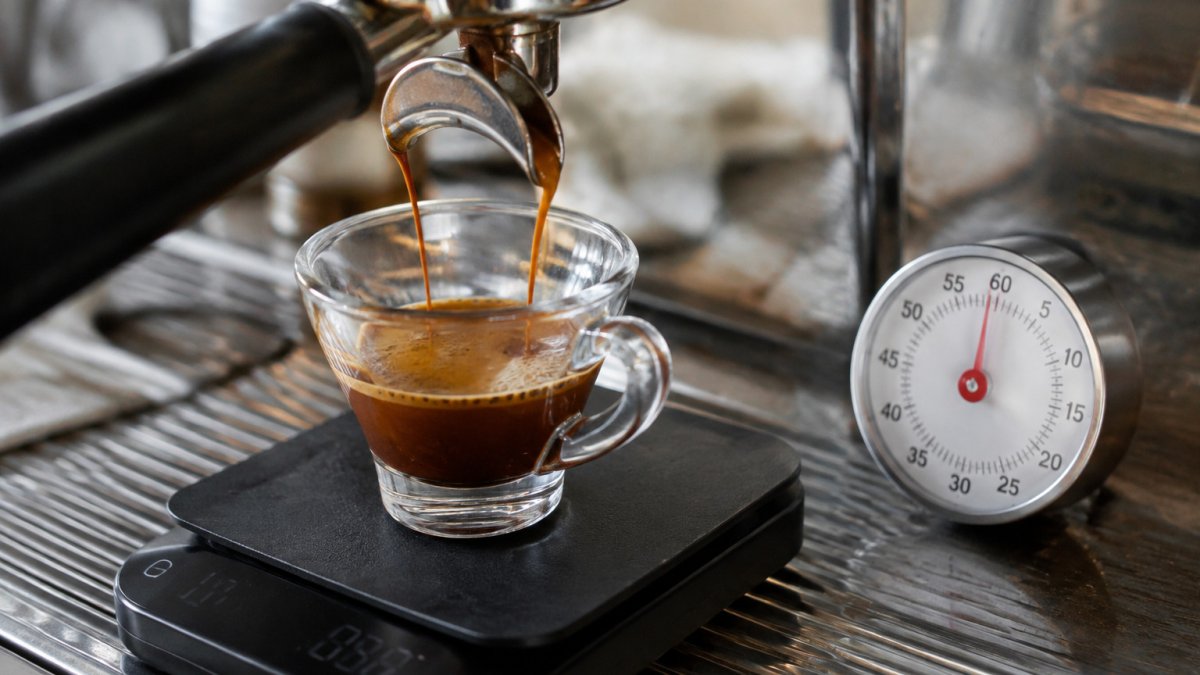
- Beverage weight in grams, weigh the cup on a scale as the shot pulls.
- Shot time in seconds, start the timer when the pump engages.
- Flow behavior, note whether the stream was thin and fast, thick and slow, or sputtered and uneven.
A common starting recipe for a standard double is 18 g in, 36 g out, in 25-30 seconds. That is a 1:2 brew ratio. If your shot runs 18 g in, 45 g out in 38 seconds, you have both a longer ratio and a longer time, two variables that push toward over-extraction. If it runs 18 g in, 36 g out in 20 seconds, the time is short but the ratio is normal, which points more toward under-extraction or channeling than over-extraction.
Reading the flow and the puck
Watch the first few seconds. A healthy shot starts with a slow, syrupy drip that builds into a thin tiger-striped stream. A shot that gushes immediately and turns pale is usually under-extracted or channeling.
After the shot, knock out the puck and look at it. A puck with a deep divot on one side, a crack, or a soft muddy patch suggests channeling, water found a fast path through the bed instead of flowing evenly.
Separating over-extraction from look-alikes
Use this short diagnostic before you touch the grinder:
- Taste the same beans as a pour-over or cupping. If the bitterness is present there too, the roast or the bean is the source, not your espresso recipe.
- Check the roast date. Coffee past 4-6 weeks from roast tastes flat and hollow regardless of extraction. Stale beans can mimic over-extraction.
- Look for channeling signs. If the shot spritzes, the puck has cracks, or the flow is uneven, fix distribution and tamp before changing grind.
- Confirm with time and weight. Only after the first three checks should you treat a long time or a high yield as evidence of over-extraction.
Watch out: crema color alone is a weak signal. Very dark, thin crema can come from over-extraction, but it can also come from a dark roast or a cold portafilter. Pale crema often points to under-extraction, but a light roast can produce pale crema even when the shot is balanced.
How to Fix Over-Extracted Espresso One Variable at a Time
The fastest way to fix over-extraction is to change one thing at a time and measure the result. If you change grind, dose, and temperature together, you will not know which change worked. The routine below uses concrete starting values so each adjustment is repeatable.
Start from a known recipe
Pick a baseline and hold it for the first test:
- Dose: 18 g in a standard double basket.
- Yield: 36 g out (1:2 ratio).
- Time: 25-30 seconds.
- Temperature: 200°F if your machine allows adjustment.
Pull one shot at this baseline and taste it. If it is bitter, dry, and harsh, you have confirmed over-extraction and can begin adjusting.
Adjust grind first
Grind is the highest-leverage variable. Make one small step coarser, on most stepless grinders that is a 5-10 micron shift, or roughly one numbered mark on a stepped grinder. Pull another shot at the same dose and yield and note the new time. A good target is to shave 3-5 seconds off the shot while keeping the 1:2 ratio.
Adjust yield second
If grind alone does not fix it, keep the grind and reduce yield. Change from 36 g out to 32 g out at the same dose. That lowers the brew ratio from 1:2 to about 1:1.8 and shortens contact time. Taste again. A 4 g reduction is enough to notice a change without throwing the recipe off. If the shot is still bitter, try 30 g out next.
Adjust dose third
If yield changes are not enough, reduce dose by 1 g, from 18 g to 17 g, and keep the same yield target. A smaller dose creates a thinner bed that resists over-extraction slightly, but it also changes the ratio, so recheck time and taste. Do not drop more than 2 g at once; below 16 g in a double basket you risk uneven extraction.
Adjust temperature last
Temperature is the last lever because it affects flavor subtly. Lower brew temperature by 2°F, from 200°F to 198°F, and pull another shot at your current best grind, dose, and yield. Dark roasts often taste better at 196-198°F, while light roasts may need 200-202°F. Change temperature only after grind, yield, and dose are dialed in.
Keep a controlled log
Write down each shot with these fields:
- Dose in grams
- Yield in grams
- Shot time in seconds
- Grind setting
- Temperature
- Taste note (bitter, balanced, sour, hollow)
Change only one field per shot. After three or four shots you will see which variable moved the taste.
Watch out: do not chase a single bad shot. One channeled or uneven shot can taste bitter even when the recipe is fine.
Espresso brew ratio and dose guidance from the Specialty Coffee Association
Change one variable at a time, in this order, and taste after each change.
| Variable | Starting value | Adjustment |
|---|---|---|
| Grind | Current setting | Go one step coarser; aim to cut 3-5 seconds |
| Yield | 36 g out | Reduce to 32 g out (about 1:1.8) |
| Dose | 18 g in | Drop by 1 g to 17 g; never more than 2 g at once |
| Temperature | 200°F | Lower by 2°F to 198°F |
Why Different Beans and Roast Levels Change the Picture
Not every bean extracts the same way.
If you want a more forgiving cup, choose a low-bitterness bean for your next bag. To understand how roast level shapes these differences, a side-by-side breakdown of light and dark profiles can help you match your beans to your recipe.
Iron Spur's Deadwood Dark is a house blend that is great for espresso and a good option to test your recipe. For a sweeter profile, try Blonde, a sweet blend great for sweet espresso.


Dialing In Your Next Shot With a Repeatable Routine
Consistency matters more than perfection. Use the same dose, the same water temperature, and the same tamping pressure each time. Then change only one variable per session.
Keep a simple log:
- Dose in grams
- Grind setting
- Shot time in seconds
- Taste notes (bitter, balanced, sour, or hollow)
After a few sessions, patterns appear. If you want a structured way to build that routine, a step-by-step guide to roast profiles explains how beans behave as you dial in.
Iron Spur's Italian Roast, our darkest roast, and Saddleback Espresso, a medium/dark blend from Kenya, Tanzania, and Ethiopia, are both useful for practicing this routine across different flavor profiles.

Over-extraction is fixable once you know what to taste and what to change. Start with bitterness and dryness, confirm with shot time, and adjust one variable at a time.
Frequently Asked Questions
What does over-extracted espresso taste like?
Over-extracted espresso usually tastes bitter, dry and sometimes harsh or burnt. The finish can feel astringent, leaving your mouth puckered or drying out after each sip. Sweetness fades and the flavor often seems flat or hollow. If you taste these cues together, especially with a shot that pulled slowly, the extraction has likely gone too far. Adjusting the grind coarser or shortening the shot time is usually the first fix to try.
Can you still drink over-extracted espresso?
Yes, over-extracted espresso is safe to drink, but it is unpleasant. The bitterness and dryness can mask the bean's natural sweetness and character. Many people use an over-extracted shot in a milk drink, where the milk softens the harshness. For the best flavor, though, pull a new shot with a coarser grind, a shorter extraction time or a smaller dose and compare the results side by side.
How can you tell over-extracted espresso from under-extracted espresso?
Over-extracted espresso tastes bitter, dry and astringent, while under-extracted espresso tastes sour, thin and salty. Over-extracted shots usually run slowly with dark, sometimes choked flow. Under-extracted shots run quickly and look pale or blonde. Changing one variable at a time, such as the grind, makes it easier to see which direction you need to move.
Which espresso variables should I adjust to reduce over-extraction?
The main variables are grind size, dose, yield and water temperature. Grinding coarser speeds up flow and shortens shot time. Lowering the dose or stopping the shot earlier reduces the amount of coffee extracted. Lowering brew temperature can also soften bitterness. Change only one variable per shot so you can clearly link each adjustment to the taste result.
