

How to Store Coffee Beans Without a Container
Table of Contents
- Why the One-Way Valve Bag Is Your First Line of Defense
- How to Keep Coffee Beans Fresh in the Original Bag
- Emergency DIY Storage Hacks for Coffee Beans
- Room Temperature vs. Freezer: Where to Store Coffee Beans
- How Long Do Coffee Beans Last Without a Container?
- Signs of Stale Coffee Beans and a Visual Degradation Timeline
- Climate-Specific Storage Advice for Coffee Beans
- Conclusion: Buy What You Can Store
- Frequently Asked Questions
Last Updated: September 9, 2026
The biggest threat to your coffee isn't time; it's exposure. Oxygen, moisture, heat, and light work together to strip away the volatile compounds that give freshly roasted beans their aroma and flavor. According to guidance from the National Coffee Association on coffee freshness, oxidation begins almost immediately after roasting, which is why proper storage matters from day one. Whether you're a field professional needing a reliable morning brew or a connoisseur protecting a premium batch, knowing how to store coffee beans without a container is a skill worth mastering. At Iron Spur Coffee, we roast to order and ship fast, but we also know that how you handle the bag after it arrives determines the quality of every cup you brew.
Why the One-Way Valve Bag Is Your First Line of Defense
A one-way valve bag is the most effective storage solution you already own. These bags feature a small plastic valve that lets carbon dioxide escape after roasting while blocking oxygen from entering, which slows degradation significantly. Coffee beans release CO2 for days after roasting, and without that valve, pressure would build and the bag would burst.
The valve, the opaque material, and the heat-sealed seams all work together to protect the beans from light sensitivity and oxygen exposure. Most specialty roasters, including Iron Spur Coffee, use this exact packaging to ensure the product arrives in peak condition.
How to Keep Coffee Beans Fresh in the Original Bag
Whole bean coffee stays fresh longer than pre-ground coffee, and keeping it in the original bag with the valve intact is your best move without a separate container. The original packaging is opaque, non-reactive, and designed to maintain the flavor profile for weeks. The most common mistake is tearing the bag open carelessly, which damages the seal and accelerates staleness.
Folding and Clipping Techniques That Actually Seal
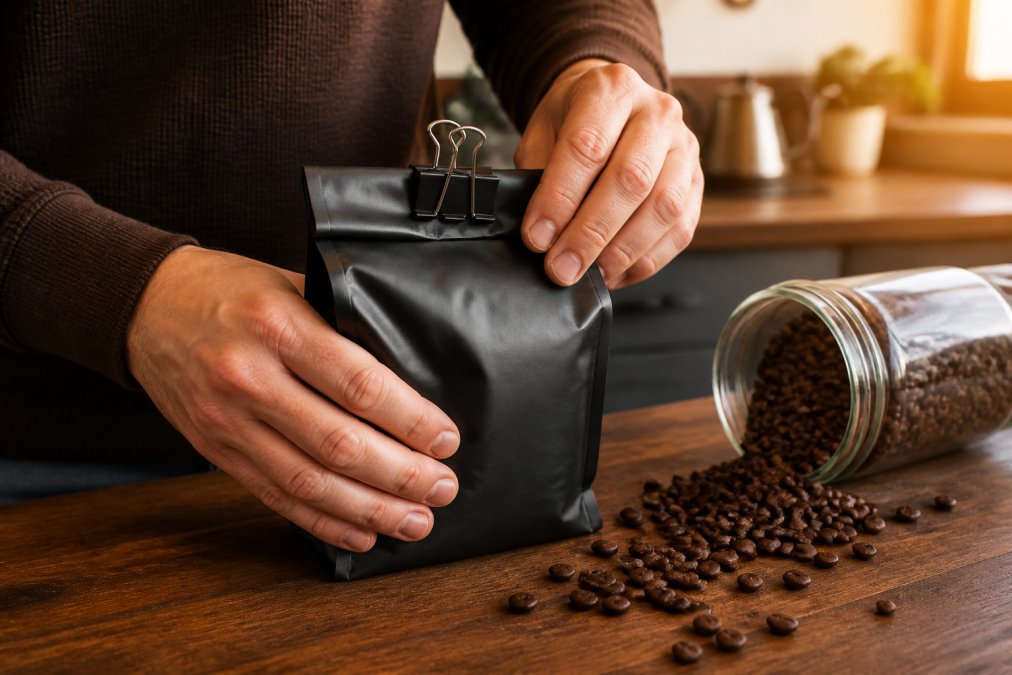
To create a proper seal, press the air out of the bag gently, then fold the top down twice in tight, even rolls. Secure the fold with a binder clip or a clothespin; standard office clips work well because they apply even pressure across the fold. The goal is to create a gasket-like seal that minimizes air contact with the beans inside.
Avoid leaving the bag crumpled or loosely rolled, as this allows air to circulate around the beans. A tight fold combined with a sturdy clip can maintain freshness nearly as well as a dedicated canister for short-term storage. Store the clipped bag in a cool, dry environment, away from the stove or direct sunlight.
Emergency DIY Storage Hacks for Coffee Beans
Most storage guides tell you to buy a container, but that doesn't help when you're at a campsite, in a temporary apartment, or simply forgot to pack one. These practical, temporary solutions prioritize the enemies of coffee: oxygen, light, heat, and moisture. They are not permanent fixes, but they will keep your beans drinkable for a few days to a couple of weeks.
The Mason Jar Method: A Step-by-Step Guide
A standard glass mason jar is the closest DIY equivalent to a proper canister, provided you follow a specific protocol.
- Choose the right jar: Use a wide-mouth pint or quart jar. Ensure the lid's rubber seal is intact and free of cracks.
- Pre-heat the jar: Rinse the jar with hot water and dry it thoroughly. This removes residual moisture and ensures the jar is at room temperature before adding beans, preventing condensation.
- Fill and seal: Fill the jar to the top with beans, leaving as little headspace as possible. The less air in the jar, the slower the oxidation process. Screw the lid on tightly.
- Block the light: Glass is transparent, so light exposure is a major risk. Place the sealed jar inside a cool, dark cabinet or wrap it completely in a kitchen towel or aluminum foil.
The trade-off: The jar is not a one-way valve system. CO2 released by the beans will build up pressure. For the first few days, you should "burp" the jar once daily by briefly opening the lid to release pressure. After a week, the off-gassing slows significantly. This method is best for beans you'll use within 7-10 days.
The Vacuum Sealer Hack: For Long-Term Emergency Storage
If you own a vacuum sealer, you have a powerful tool for creating a near-perfect storage environment without a dedicated coffee container.
- Portion first: Divide your beans into single-use or single-week portions. Every time you open a vacuum-sealed bag, you reintroduce oxygen to the remaining beans.
- Use the right bags: Standard vacuum sealer bags are food-safe and have a very low oxygen transmission rate. Do not use cheap, non-branded bags, as they may not form a proper seal.
- Seal and store: Vacuum seal each portion. The removal of oxygen is the single most effective thing you can do to slow staleness. Store the sealed bags in a cool, dark place.
The trade-off: This method is excellent for long-term storage (up to a month or more) because it eliminates the primary enemy: oxygen. However, it requires equipment and planning. The beans will also be slightly compressed, which is harmless.
The Opaque Freezer Bag Method: A Quick Fix
For a truly temporary solution, a high-quality, opaque freezer bag can work for a few days.
- Squeeze out the air: Place the beans in the bag. Seal it almost completely, leaving a small gap. Gently press the bag to force out as much air as possible, then finish sealing.
- Double-bag for security: Place the first bag inside a second freezer bag and repeat the air-squeezing process. This provides a second layer of protection against oxygen and moisture.
- Store in the dark: Freezer bags are often translucent. Place the double-bagged beans inside a paper bag or a dark cabinet.
The trade-off: This is the weakest of the three methods, offering minimal protection against oxygen. Use this only for beans you'll consume within 3-4 days.
Room Temperature vs. Freezer: Where to Store Coffee Beans
Room temperature is the correct choice for beans you will use within two to three weeks. A stable, cool environment around 70 degrees Fahrenheit, away from heat and humidity, preserves the oil extraction and aroma better than any other method.
Freezing is a viable option only for long-term storage of beans you won't touch for a month or more. The danger is condensation: every time you remove the bag from the freezer, moisture forms on the cold beans, which damages the flavor profile. To freeze successfully, portion the beans into small, airtight packages and remove only what you need, allowing them to come to room temperature before opening.
How Long Do Coffee Beans Last Without a Container?
Coffee beans last roughly two to four weeks at peak freshness when stored properly in their original one-way valve bag in a cool, dry place. Beyond that window, they don't spoil in a safety sense, but the volatile compounds that create complex sweetness and deep flavor notes fade noticeably.
If you rely on emergency DIY methods like a mason jar or plastic container, expect peak freshness to drop to about one to two weeks. Without any seal at all, beans can go stale in a matter of days. The trade-off is simple: better sealing equals a longer shelf life.
Signs of Stale Coffee Beans and a Visual Degradation Timeline
Stale coffee beans are easy to identify once you know what to look for. Fresh beans have a glossy, oily sheen on the surface, which indicates the oils have not yet degraded. As beans age, they become dull, dry, and matte in appearance.
The timeline follows a predictable pattern. In the first week, beans look oily and smell intensely aromatic. By week two, the sheen begins to fade and the aroma softens. Around week three to four, the beans turn dry and brittle, and the signature smell of fresh coffee gives way to a flat, papery scent. When brewed, stale coffee produces a weak crema and a muted, cardboard-like taste.
Climate-Specific Storage Advice for Coffee Beans
Your local climate isn't just a factor in your storage strategy; it's the primary determinant of which enemy, moisture or heat, will destroy your beans first. The standard advice to "store in a cool, dry place" is useless if you live in a place that is inherently humid or hot. Here are specific protocols for the two most challenging environments.
High-Humidity Climates (Relative Humidity Above 60%)
In humid environments, moisture is your coffee's #1 enemy. Beans are hygroscopic, meaning they actively absorb water from the air. This absorbed moisture accelerates the staling process, causes the beans to lose their crispness, and can lead to a dull, flat cup.
The Protocol:
- Minimize air exposure: The air itself is a carrier of moisture. When you open your original one-way valve bag, work quickly. Press out as much air as possible before resealing with a clip.
- Use a desiccant: Food-safe silica gel packets (the kind that come in shoe boxes or electronics packaging) are excellent at absorbing ambient moisture (the FDA). Place one or two packets inside your coffee bag or storage jar. Do not use the blue indicating silica gel, as it contains cobalt chloride, which is toxic. Use the clear or white variety.
- Avoid the refrigerator: The refrigerator is a high-humidity environment. Condensation will form on the beans every time you open the door, causing rapid degradation.
- Find the driest spot: In a humid home, the driest spot is often an interior closet, away from exterior walls where condensation can form. Avoid basements, which are typically damp, and kitchens, where cooking steam adds humidity.
- Consider a vacuum sealer: If you live in a consistently humid climate, a vacuum sealer is the most effective tool for long-term storage. By removing air, you also remove the moisture it carries.
The Risk Profile: In high humidity, beans stored in a poorly sealed bag can go stale in 3-5 days (ncausa.org). They may also develop a musty or cardboard-like aroma, a clear sign that moisture has compromised the bean's cellular structure.
Hot, Arid Climates (Temperatures Above 85°F)
In hot, dry climates, heat is the primary accelerant of staleness. High temperatures cause the volatile aromatic oils in the beans to evaporate and oxidize at a much faster rate, resulting in a flat, lifeless cup.
The Protocol:
- Find the coolest room: This is often a north-facing room or a room on the ground floor of a multi-story home. The kitchen is almost always the worst place, as ovens, stovetops, and dishwashers generate significant heat.
- Use a cooler: For extreme heat waves, a basic insulated cooler (like a lunch box) placed in a closet can provide a stable, cooler microclimate. Do not add ice packs, as the condensation will be counterproductive.
- Store in smaller batches: The more often you open your main storage bag, the more warm air you introduce. Divide your beans into smaller, sealed portions (e.g., a 3-day supply) so you only open the main bag once or twice a week.
- Consider the freezer for long-term: In a hot climate, the freezer is a more viable option for beans you won't use within two weeks. The key is to portion them into small, airtight packages and remove only what you need, allowing them to come to room temperature before opening to prevent thawing-related moisture damage.
The Risk Profile: In extreme heat, beans stored on a countertop can lose their aromatic intensity in as little as 48 hours. The oils will break down, and the beans will become dry and brittle, producing a brew that is bitter and lacks the nuanced sweetness of a fresh roast.
Conclusion: Buy What You Can Store
The most practical advice for protecting your coffee is to buy in quantities you will use within two to three weeks. This approach sidesteps most storage problems entirely. When you do need to store beans longer, the original one-way valve bag, properly folded and clipped, remains your best option without a dedicated container.
At Iron Spur Coffee, we support this philosophy by roasting to order and shipping quickly, so your beans arrive at peak freshness and stay that way. Our specialty-grade, high-elevation beans are precision-roasted in small batches using thermal mapping to eliminate bitterness, delivering complex sweetness and deep flavor notes in every cup. For adventures where carrying whole beans isn't practical, our [instant coffee(/products/instant-coffee) packets | ironspurcoffee.com] offer the same bold profile in a resealable pouch that needs no storage strategy at all.
Frequently Asked Questions
Is it okay to store coffee beans in a Ziploc bag?
A Ziploc bag works as a short-term fix for a few days, not a long-term solution. Squeeze out as much air as possible before sealing to slow oxidation. The issue is that Ziploc bags lack a one-way valve, so CO2 released by fresh beans builds up and can affect the flavor profile. For best results, use the original one-way valve bag with a clip, or transfer to a Ziploc only if you plan to brew within a few days.
How long will coffee beans stay fresh in an unopened bag?
In an unopened one-way valve bag, whole bean coffee stays fresh for about 4 to 6 months from the roast date. The valve lets CO2 escape without letting oxygen in, which slows degradation. Once you open the bag, the clock speeds up. If your bag lacks a valve, assume the shelf life is shorter and plan to brew sooner.
Is it better to keep coffee beans in the fridge or freezer?
Neither is ideal for daily-use beans. The fridge exposes beans to moisture and nearby food odors, which ruins the flavor profile. The freezer works only for long-term storage of unopened, vacuum-sealed bags. If you freeze beans, portion them first so you never thaw and refreeze the whole batch. Condensation from thawing introduces moisture, which accelerates staleness. Room temperature in an airtight, opaque container remains the gold standard for storing coffee beans.
Storing coffee without a container comes down to understanding your enemies: oxygen, moisture, heat, and light. Master the simple techniques of folding, clipping, and choosing the right environment, and you will protect the flavor you paid for. Discover Iron Spur Coffee today and taste what properly roasted, properly stored coffee should be.