

How to Keep Coffee Beans Fresh: 7 Proven Steps
Table of Contents
- Step 1: Understand What Actually Kills Coffee Bean Freshness
- Step 2: Choose the Best Coffee Storage Containers for Long-Term Freshness
- Step 3: Find the Right Location to Keep Coffee Beans Fresh
- Step 4: Know Your Coffee Bean Shelf Life and Peak Flavor Windows
- Step 5: Freezing Coffee Beans the Right Way
- Step 6: Storing Ground Coffee vs. Whole Beans
- Step 7: Avoid These Coffee Storage Mistakes That Ruin Flavor
- Signs Your Coffee Beans Are No Longer Fresh
Last Updated: August 3, 2026
Most coffee drinkers unknowingly destroy their beans before the first brew. Knowing how to keep coffee beans fresh is the single biggest variable separating a flat, lifeless cup from one that delivers the complex sweetness and deep aroma you paid for. This guide from Iron Spur Coffee covers the exact science and practical steps behind preserving peak flavor, from container selection to freezing protocols.
The real enemies of fresh coffee are oxidation, moisture, heat, light, and the off-gassing process that begins the moment roasting ends. Understanding each one changes how you store coffee permanently.
Below, we'll walk through seven proven steps that address every stage of coffee freshness, including container material science, climate-specific storage, and long-term freezing protocols.
Step 1: Understand What Actually Kills Coffee Bean Freshness
Off-gassing is the release of carbon dioxide from freshly roasted coffee beans. After roasting, CO2 escapes slowly over several days. The problem starts when off-gassing slows and oxygen takes over. Oxidation is the primary driver of staling, oxygen reacts with volatile compounds inside the bean, breaking down the aromatic oils responsible for flavor. Heat accelerates this reaction. Light, particularly UV light, degrades those same compounds. Moisture triggers hydrolysis, which attacks the organic acids that give specialty coffee its brightness.
The Off-Gassing Process and Why It Matters
Freshly roasted coffee should not go into a sealed airtight container immediately after roasting. Trapping CO2 with no outlet creates pressure that can compromise packaging. This is precisely why one-way valve bags exist: the valve allows CO2 to escape without letting oxygen in, maintaining the internal atmosphere during the critical first 72 hours post-roast.
A common mistake is transferring freshly delivered beans into a decorative ceramic jar with a loose lid. That single decision exposes the beans to ambient humidity and oxygen, cutting peak flavor life significantly.
Step 2: Choose the Best Coffee Storage Containers for Long-Term Freshness
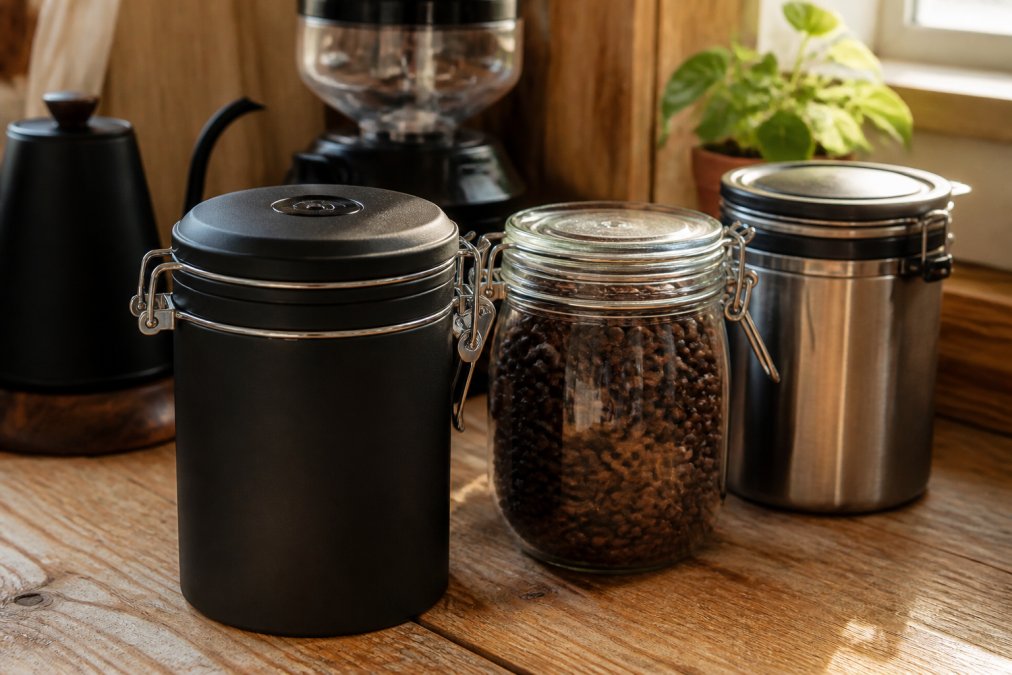
The best coffee storage containers block oxygen, block light, regulate internal atmosphere, and do not transfer odors to the beans. Those four criteria immediately eliminate most kitchen canisters.
Container Material Science: What Your Canister Is Actually Doing
Ceramic and opaque porcelain offer excellent UV protection and thermal stability. Look for fully glazed interiors with a compression or rubber-sealed lid.
Stainless steel is non-porous, odor-neutral, and blocks UV light completely. The downside is thermal conductivity: it responds quickly to ambient temperature changes, which can create condensation if the container moves between warm and cold environments.
Glass is chemically inert but transparent glass offers zero UV protection. If you use glass, it must be opaque or stored inside a dark cupboard.
Plastic is the worst choice for long-term storage. Even food-grade plastic is porous at a microscopic level, allowing oxygen exchange and odor absorption over time.
One-Way Valve Bags vs. Airtight Canisters
One-way valve bags are purpose-built for coffee storage. For beans consumed within two to three weeks of roasting, a high-quality valve bag sealed tightly after each opening is the most practical option.
Airtight canisters with vacuum-seal mechanisms are better for medium-term storage beyond three weeks. Vacuum-seal canisters actively remove oxygen from the headspace, extending shelf life beyond what a passive valve bag can achieve.
| Container Type | UV Protection | Oxygen Control | Best For | Weakness |
|---|---|---|---|---|
| One-way valve bag | Good (opaque) | Passive CO2 release | 0-3 weeks post-roast | Single-use design |
| Vacuum-seal canister | Depends on material | Active oxygen removal | 3-6 weeks | Requires manual pumping |
| Ceramic canister | Excellent | Moderate (seal quality varies) | Daily use, aesthetic storage | Porosity if unglazed |
| Stainless steel canister | Excellent | Good (non-porous) | High-traffic kitchens | Thermal conductivity |
| Clear glass jar | None | Poor | Short-term if stored in dark | UV degradation risk |
Step 3: Find the Right Location to Keep Coffee Beans Fresh
The ideal storage location is a cool, dark place with stable ambient temperature and low humidity. A closed kitchen cupboard away from the stove, oven, and dishwasher satisfies most criteria.
Direct sunlight is disqualifying. UV exposure degrades volatile compounds within days. Storage above or beside heat-generating appliances accelerates staling. Refrigerators create condensation on beans every time you open the door.
Climate-Specific Storage: Hot, Humid, or Dry Environments
In hot, humid environments where ambient humidity exceeds 70%, a vacuum-seal canister is essential. Consider storing beans in a secondary sealed container inside a climate-controlled room rather than a kitchen that heats up during cooking.
In dry, high-altitude environments, low humidity accelerates the evaporation of aromatic compounds from the bean's surface. Airtight storage is critical, and smaller batch storage reduces the frequency of opening the container.
Step 4: Know Your Coffee Bean Shelf Life and Peak Flavor Windows
Coffee bean shelf life depends on roast date, not the "best by" date printed on bags. The roast date is the only number that matters.
For specialty whole beans, peak flavor typically occurs between 5 and 21 days post-roast. After 21 days, flavor begins to flatten. By 45 days, most aromatic complexity has degraded noticeably. By 90 days, the coffee is technically safe to drink but functionally stale.
Ground coffee degrades dramatically faster. The increased surface area exposes far more volatile compounds to oxygen simultaneously. Ground coffee hits its peak flavor window within hours of grinding and degrades meaningfully within 30 minutes if left exposed. Pre-ground coffee stored in a bag loses most of its complexity within one to two weeks.
According to the Specialty Coffee Association's guidance on coffee freshness, the roast date is the primary freshness indicator consumers should reference.
Step 5: Freezing Coffee Beans the Right Way
Freezing coffee beans is a legitimate long-term storage method when done correctly. Freezing slows oxidation and volatile compound degradation to near-zero.
The rules for freezing coffee beans are non-negotiable:
- Freeze only once. Repeated freeze-thaw cycles cause condensation to form on the beans, driving moisture into the bean's structure and accelerating staling.
- Use vacuum-sealed bags. Standard zip-lock bags allow oxygen exchange even when sealed.
- Portion before freezing. Divide beans into single-brew or single-week portions before freezing so you only thaw what you need.
- Thaw completely before opening. Bring the sealed bag to room temperature before opening to prevent condensation.
- Label with roast date and freeze date. Beans frozen within the first week post-roast and consumed within three months maintain excellent flavor. Beyond six months, even frozen beans show degradation.
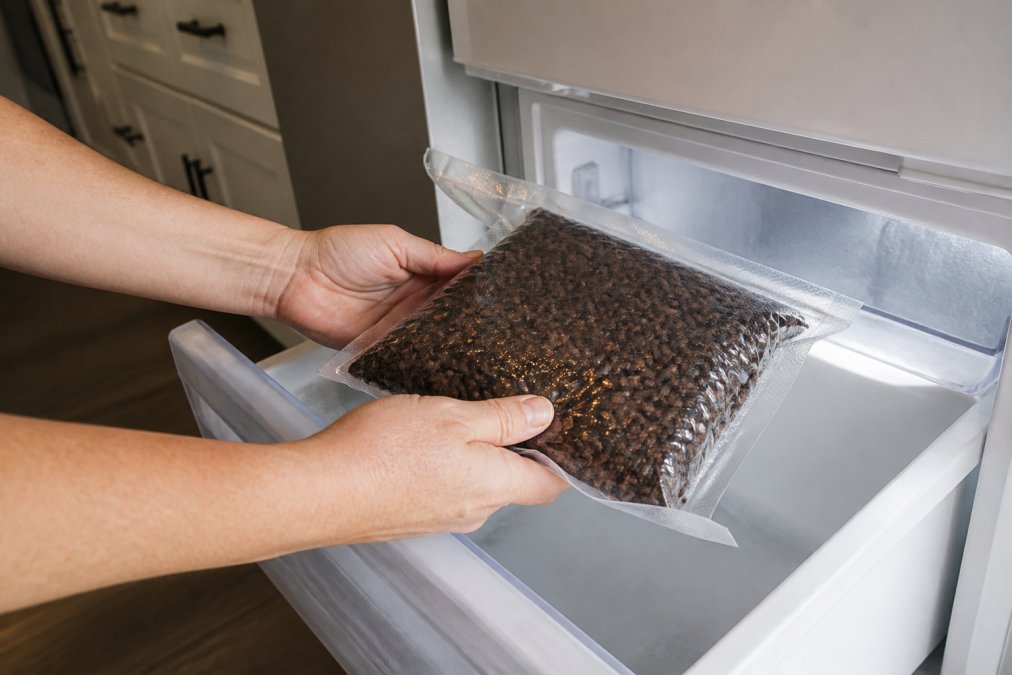
As documented in research on coffee storage and volatile compound retention, frozen storage significantly preserves aromatic compounds compared to room-temperature storage over equivalent time periods.
Step 6: Storing Ground Coffee vs. Whole Beans
Whole beans are structurally intact. The bean's outer layer acts as a natural barrier, slowing oxygen penetration. Grinding destroys that barrier completely. A fine espresso grind has exponentially more surface area exposed to oxygen than the same weight of whole beans.
Grind immediately before brewing whenever possible. For those who do pre-grind, store in a vacuum-seal container, consume within one to two weeks, and never freeze unless vacuum-sealed in single-use portions.
For multi-day trips, grind fresh and vacuum-seal individual portions the night before departure. Single-serve vacuum-sealed packets protect flavor better than a shared bag opened repeatedly.
Step 7: Avoid These Coffee Storage Mistakes That Ruin Flavor
Storing on the counter in a clear container. UV exposure and ambient heat degrade volatile compounds within days. Move beans into a dark cupboard immediately.
Buying in bulk without a storage plan. Match purchase quantity to your brewing cycle, or freeze excess in portioned vacuum-sealed bags.
Using the original bag without resealing properly. Rolling the bag tightly and clipping it shut is not the same as a proper airtight seal. Transfer beans to a dedicated airtight container after opening.
Ignoring the roast date. Check the roast date, not the best-by date.
Storing near strong odors. Coffee absorbs ambient aromas. Storing beans next to spices, onions, or cleaning products transfers those compounds into the coffee.
According to food science guidance on coffee storage from the National Coffee Association, air, moisture, heat, and light are the four primary factors that accelerate coffee staling.
Signs Your Coffee Beans Are No Longer Fresh
No bloom when brewing. Fresh ground coffee produces a visible bloom as CO2 escapes. Stale coffee produces little to no bloom.
Flat or papery aroma. Fresh beans smell complex: fruity, chocolaty, nutty, floral. Stale beans smell flat, papery, or faintly sour.
Oily surface with rancid smell. When surface oils oxidize, they smell rancid, similar to old cooking oil.
Dull, one-dimensional flavor. Specialty coffee delivers layered flavor. Stale coffee collapses to a single flat note, often bitter or woody.
Visual fading. Fresh beans have consistent color and slight sheen. Exposed beans develop a chalky, faded appearance.
All of these signs are preventable. Proper airtight storage, attention to roast dates, and consistent application of the steps above keeps coffee beans fresh through their entire peak flavor window.
Stale coffee is a preventable problem. Iron Spur Coffee roasts to order using precision small-batch methods designed to preserve complex sweetness and deep flavor notes from the first cup to the last. Discover Iron Spur Coffee today and start every morning on a flawless foundation.
Frequently Asked Questions
How long can whole coffee beans stay fresh?
Whole coffee beans generally hold peak flavor for two to four weeks after the roast date when stored in an airtight container away from heat, light, and moisture. They remain drinkable for up to three months, but volatile compounds responsible for aroma and complex flavor degrade steadily after that first month. Buying in smaller batches tied to your brewing cycle is the most reliable way to keep coffee beans fresh from bag to cup.
Should you store coffee beans in the original bag?
The original bag works well short-term if it has a one-way valve, which lets carbon dioxide escape during off-gassing without letting oxygen in. However, most bags are not fully resealable, so oxidation accelerates once opened. For storage beyond a few days, transfer beans to an airtight container with a proper seal. This is one of the most common coffee storage mistakes that quietly strips flavor before you even notice.
Does keeping coffee beans in the freezer keep them fresh?
Freezing coffee beans works for long-term batch storage, but only when done correctly. Beans must be vacuum-sealed or placed in a truly airtight bag to prevent freezer burn and condensation. The critical rule: never refreeze. Remove only what you need for your current brewing cycle, let it reach room temperature before opening the bag, and store the rest sealed. Repeated temperature swings cause moisture buildup that accelerates staling and ruins the flavor profile.
What is the worst way to store coffee beans?
Leaving coffee beans in an open container on a kitchen counter near a stove or window combines every threat at once: direct sunlight, ambient heat, humidity, and constant oxygen exposure. A clear glass jar on a sunny countertop is particularly damaging because UV light degrades volatile compounds rapidly. Refrigerating beans in an unsealed bag is another poor choice, as the humidity and food odors inside a refrigerator absorb directly into the porous bean surface.
Will a Ziploc bag keep coffee beans fresh?
A standard zip-close bag provides minimal protection. It does not create a true vacuum seal, allows oxygen to remain in contact with the beans, and offers no UV protection. For short trips or overnight use, it is acceptable. For any storage beyond 24 to 48 hours, a proper airtight container or one-way valve bag is a meaningful upgrade. The porosity of coffee beans means they absorb surrounding odors quickly, which a Ziploc bag does nothing to prevent.
How does light and heat affect coffee bean freshness?
Heat accelerates the chemical reactions that break down the volatile compounds responsible for aroma and flavor. Ambient temperatures above 70°F speed up degradation noticeably. Direct sunlight compounds the problem by adding UV radiation, which attacks the same compounds even faster. A cool dark place with stable thermal conditions, such as a cupboard away from the oven or dishwasher, dramatically slows staling compared to open countertop storage.
This article was written using GrandRanker