

Does Thermal Mapping Reduce Coffee Bitterness?
Table of Contents
- How Thermal Mapping Targets the Chemistry of Bitterness
- Coffee Roasting Temperature Profiles That Prevent Bitter Compounds
- The Impact of Roast Degree on Bitterness
- How to Avoid Bitter Coffee: Brewing Variables That Compound Roasting Errors
- Equipment-Specific Thermal Calibration for Home Brewers
- What Thermal Mapping Cannot Fix (and What to Ignore)
- Frequently Asked Questions
Last Updated: September 10, 2026
How Thermal Mapping Targets the Chemistry of Bitterness
Does thermal mapping reduce coffee bitterness? Yes, when roasters use it to hold bean temperature inside a controlled curve instead of letting it spike. Bitterness in coffee comes from compounds that form when beans absorb too much heat too fast, and thermal mapping is how a roaster sees and corrects that heat before it ruins the batch. At Iron Spur Coffee, we use precision thermal mapping in our small-batch roasting process for exactly this reason: bitterness is a roasting problem long before it becomes a brewing problem. Below, we'll show you what the mapping actually measures, how roast profiles prevent bitter compounds, and which brewing variables you can fix at home.
Thermal mapping is the practice of recording bean temperature continuously through a roast and plotting it against time to produce a roast curve. It differs from checking a single temperature reading because it tracks the rate of change, not just the peak. That curve tells a roaster whether heat is climbing smoothly or stalling and spiking, which is the difference between a sweet, balanced cup and a harsh one.
What Thermal Mapping Measures That Standard Roasting Misses
Standard roasting checks one number: the temperature at a given moment. Thermal mapping records the whole trajectory, including how fast the bean mass heats between phases. That rate matters more than the reading itself.
A roaster watching a single probe can hit the "right" final temperature and still scorch the outside of the bean while the inside lags behind. Mapping catches that gap. It shows the moment heat outpaces the bean's ability to absorb it, which is when bitter, ashy notes develop.
Thermal Mapping vs. Thermal Stability: Why the Distinction Matters
These two terms get used interchangeably, and that's a mistake. Thermal stability describes how well equipment holds a target temperature without fluctuation. Thermal mapping describes what the bean actually experiences over time.
Stable equipment is a prerequisite, not the goal. A roaster can hold a perfectly stable drum temperature and still produce a bitter batch if the bean's internal curve climbs too steeply. Mapping is the diagnostic; stability is the tool that makes the diagnostic useful. Most guides stop at "keep your temperature steady" and never explain that steadiness alone tells you nothing about extraction chemistry.
The common advice to chase a stable temperature is incomplete. What matters is the shape of the curve the bean follows, not the flatness of the machine's readout.
Coffee Roasting Temperature Profiles That Prevent Bitter Compounds
Bitter compounds form when beans spend too long in the development phase at high heat. A disciplined roast profile moves the bean through drying, browning, and development with controlled rate-of-rise, then ends the roast before harshness develops. Coffee roasting temperature profiles that prevent bitterness share one trait: they never let the rate of rise reverse sharply near the end.
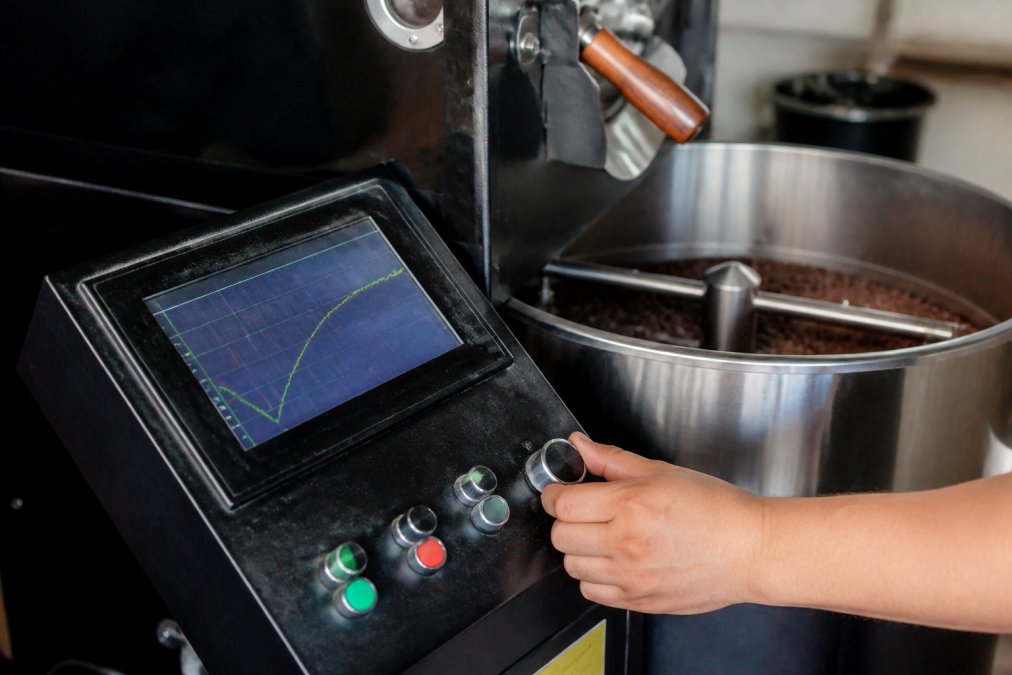
The Roast Curve: Drying, Maillard, and Development Phases
Every roast moves through three phases, and bitterness is decided in the last two.
- Drying phase: Free moisture leaves the bean. Heat input is high but the bean's internal temperature stays low because water absorbs the energy.
- Maillard phase: Sugars and amino acids react to build flavor and aroma. This is where sweetness and body develop.
- Development phase: The bean's structure opens up and oils migrate outward. Push this phase too long or too hot and bitter, smoky compounds dominate.
A mapped roast shortens or cools the development phase the moment sweetness peaks. Without mapping, a roaster is guessing at that moment.
The Impact of Roast Degree on Bitterness
The impact of roast degree on bitterness is direct, but the mechanism is more specific than "darker equals bitter." Bitterness in roasted coffee comes largely from two compound families that form and accumulate as heat exposure increases: chlorogenic acid lactones (which form when chlorogenic acids are heated and cyclize) and phenylindanes (which form when those lactones polymerize under continued heat). Both are heat- and time-dependent, which is exactly why a mapped roast curve, not a roast label, is the real control point.
Here is how the two families behave across the roast:
- Chlorogenic acid lactones begin forming during the Maillard phase as bean temperature climbs past roughly 300 degrees Fahrenheit. A moderate, controlled rate of rise produces a small, pleasant amount that reads as mild bitterness and adds structure to the cup.
- Phenylindanes form later, during development, when lactones are exposed to sustained heat. Push development long or hot and phenylindane concentration rises sharply, producing the harsh, lingering, ashy bitterness most people are actually tasting when they say "this coffee is bitter."
This is why roast degree is a useful shorthand but a poor diagnostic. Two beans roasted to the same final color can carry very different phenylindane loads depending on how the development phase was run. A roaster who maps the curve can end development the moment sweetness peaks, before lactones have time to polymerize. A roaster watching only final temperature and color cannot see that moment pass.
| Roast Degree | Flavor Tendency | Bitterness Risk | Best For |
|---|---|---|---|
| Light | Bright, acidic, fruity | Low | Pour-over, filter |
| Medium | Balanced, sweet, nutty | Moderate | Drip, espresso |
| Dark | Smoky, bold, heavy | High | Espresso, milk drinks |
A practical takeaway: if a cup tastes bitter and the beans are dark, the bitterness was likely locked in at the roaster, and no grind or temperature change will remove it. If the beans are light or medium and the cup is still bitter, the roast is probably not the culprit, move downstream to brewing variables. Thermal mapping is what lets a roaster tell those two cases apart before the bag ships.
Discover Iron Spur Coffee Today →
How to Avoid Bitter Coffee: Brewing Variables That Compound Roasting Errors
Knowing how to avoid bitter coffee starts with accepting that brewing can amplify a roasting mistake but never fix one. If the beans were over-developed, the best you can do is minimize further extraction of bitter compounds. The three variables below do most of that work.
Water Temperature, Grind Size, and Contact Time
Water temperature, grind size, and contact time interact, so changing one usually demands adjusting another.
- Water temperature: Aim for the optimal range of 195 to 205 degrees Fahrenheit (peer-reviewed research). Water above that range pulls harshness out fast (PubMed).
- Grind size: Coarser grinds slow extraction and reduce bitterness; too fine and you over-extract in seconds (peer-reviewed research).
- Contact time: Longer contact increases extraction yield. Shorten it when you taste harshness creeping in.
Equipment-Specific Thermal Calibration for Home Brewers
Equipment-specific thermal calibration means matching your brewing method's heat behavior to the coffee, not the other way around. Most guides stop at "preheat your gear." The more useful skill is running a thermal map of your own setup, a short diagnostic that records actual water temperature at the point of contact with the coffee over the full brew, so you can see where heat drops or spikes.
How to Thermal Map a Home Brewer
You do not need lab equipment. A fast-read digital thermometer with a thin probe (often sold as an instant-read or probe thermometer) is enough. The procedure is the same across methods:
- Set up the brew exactly as you normally would, same dose, same grind, same water volume.
- Place the probe in the coffee bed (for drip and pour-over) or at the group head exit (for espresso), positioned so it reads the water actually touching the grounds, not the air above them.
- Log the temperature at fixed intervals, every 15 to 30 seconds is enough for drip and pour-over; every few seconds for espresso.
- Plot temperature against time and compare the shape to your target range of 195 to 205 degrees Fahrenheit.
What you are looking for are two specific defects:
- Cold spots: a drop of more than about 5 degrees below your target during the main brew. This under-extracts part of the bed and leaves the cup sour and thin, which drinkers often misread as "weak" rather than bitter.
- Temperature spikes: a rise above roughly 205 degrees Fahrenheit, usually late in the brew as the water level drops and the heating element has less mass to buffer against. This over-extracts the last portion of the bed and is the most common cause of a cup that turns bitter in the final third.
What Each Method Typically Shows
- Drip machines: Many budget units swing well outside the optimal range during the brew cycle. A thermal map often reveals a spike in the last minute as the reservoir empties. Preheating the carafe and running a warm-up cycle with plain water before brewing reduces the swing.
- Pour-over: Heat loss happens through the cone and the slurry surface. A map usually shows a steady decline across the pour. Pre-rinsing the filter and keeping the kettle near the top of the optimal range (around 205 degrees Fahrenheit at the spout) compensates.
- Espresso: The group head holds heat well, but the first shot after idle can run cool. A map of back-to-back shots typically shows the second and third shots landing closest to target. Pull a warming shot if precision matters.
The principle is the same across all three methods: measure what your equipment actually does, then calibrate to it. Thermal mapping is the diagnostic; the adjustments above are the fix.
What Thermal Mapping Cannot Fix (and What to Ignore)
Thermal mapping cannot rescue stale beans, poor water, or a grinder that produces inconsistent particles. It corrects heat-related bitterness, and that's the limit of its reach.
Ignore claims that mapping guarantees a perfect cup regardless of method. It doesn't. What it does is remove one major source of bitterness so the other variables become solvable. A mapped roast gives you a clean starting point; your brewing discipline does the rest.
Bitter coffee is usually a roasting problem wearing a brewing disguise, and chasing grind settings alone won't solve it. Iron Spur Coffee roasts to order using precision thermal mapping on specialty-grade, high-elevation beans, ensuring the curve is controlled. Our small-batch process targets complex sweetness and deep flavor notes, and our fast, reliable delivery means your beans arrive fresh. Discover Iron Spur Coffee today and start your morning with a cup built to eliminate bitter noise.
Frequently Asked Questions
What kills the bitterness in coffee?
Bitterness comes from over-extraction and from roast defects that develop harsh compounds. Thermal mapping during roasting prevents those defects by keeping bean temperature within a precise curve, so sugars caramelize without scorching. At the brewing stage, lower water temperature (195-205°F), a coarser grind, and shorter contact time reduce how much bitterness ends up in your cup. The roast does most of the work; brewing adjustments handle the rest.
Does roasting temperature affect coffee bitterness?
Yes, directly. Roasting too fast or too hot past first crack develops bitter, ashy notes. Roasting too slow can bake the beans and flatten sweetness. Coffee roasting temperature profiles that ramp gradually through the Maillard phase and finish with controlled development time produce higher sweetness and lower bitterness. Thermal mapping lets a roaster hold each phase within a few degrees instead of guessing.
How do I adjust grind if my coffee is too bitter?
Go coarser. A finer grind increases surface area and speeds extraction, pulling bitter compounds out faster. If your cup tastes harsh or drying, move one or two clicks coarser on your grinder and keep everything else the same. If it turns sour and weak, you went too far. One variable at a time is the only way to know what fixed it.
What is the 15-15-15 rule for coffee?
The 15-15-15 rule is a simple brewing ratio: 15 grams of coffee to 15 ounces of water, brewed for 15 minutes in a cold brew or French press method. It produces a balanced, low-acid cup because the long steep at room temperature extracts sweetness without pulling harsh compounds. It works well for outdoor brewing when you do not have a scale or thermometer handy.