

Does Cream in Coffee Cancel Health Benefits?
Last Updated: October 24, 2026
Quick Summary
Cream does not cancel coffee's health benefits, but it changes the nutritional equation depending on how much you add. Antioxidants and polyphenols remain present in brewed coffee regardless of cream, though cream in coffee health benefits are modified by added calories and saturated fat that accumulate with portion size and frequency.
- One tablespoon of heavy cream adds approximately 50 calories and 3.5 grams of saturated fat per cup.
- Two tablespoons of heavy cream in two cups daily adds about 14 grams of saturated fat, exceeding the American Heart Association's daily recommendation of 11 to 13 grams.
- Fat from cream can slow caffeine absorption, delaying alertness but potentially extending focus duration.
- Black coffee delivers caffeine and antioxidants with virtually zero calories and no saturated fat contribution.
- Half-and-half adds roughly 20 calories and 1.2 grams of saturated fat per tablespoon, a smaller impact than heavy cream.
Table of Contents
- Black Coffee vs Coffee with Cream: The Core Differences
- Health Benefits of Black Coffee
- How Much Calories and Saturated Fat Does Cream Add?
- Does Cream in Coffee Cancel Health Benefits?
- Black Coffee vs Coffee with Milk: Which Is Healthier?
- Healthy Ways to Drink Coffee for Maximum Benefits
- Choose Your Coffee Strategy with Iron Spur Coffee
- Frequently Asked Questions
Black Coffee vs Coffee with Cream: The Core Differences
Black coffee is coffee brewed without any added cream, milk, sugar, or other ingredients. Coffee with cream contains added dairy or non-dairy cream that increases calories and saturated fat content. The difference extends beyond taste and texture to the nutritional profile and how your body processes the beverage.
When you drink black coffee, you're consuming primarily water, caffeine, and naturally occurring coffee compounds like polyphenols and antioxidants. Adding cream introduces fat, which changes the caloric density and can affect how quickly your body absorbs caffeine.
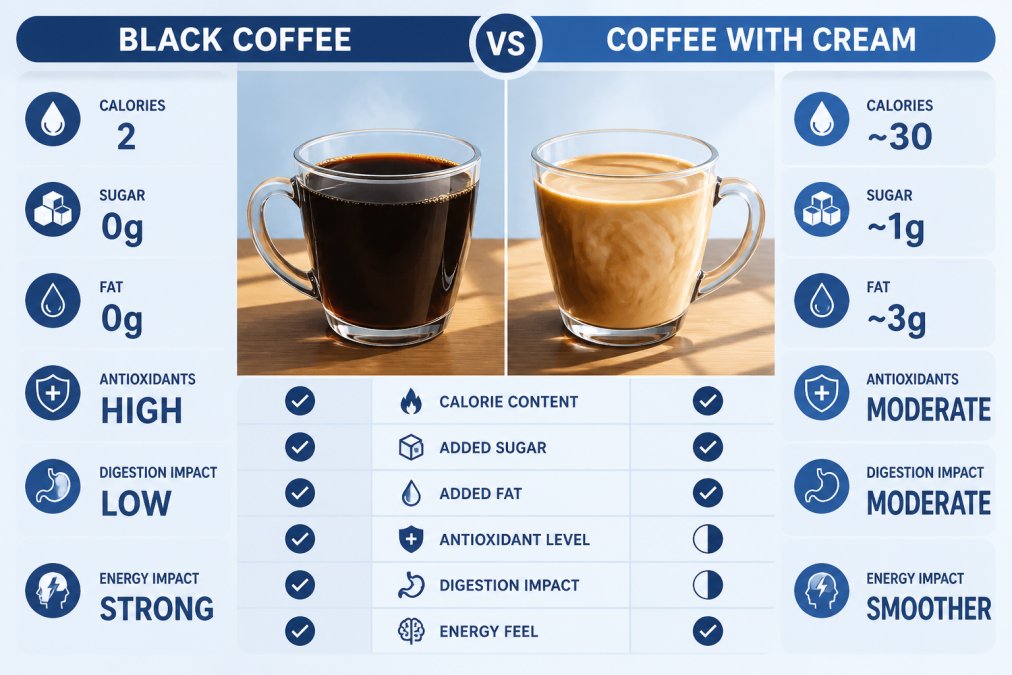
The choice affects your daily caloric intake, saturated fat consumption, and how you experience the cream in coffee health benefits, so understanding the differences helps you choose intentionally.
Health Benefits of Black Coffee
Black coffee delivers a concentrated dose of caffeine and bioactive compounds that research suggests support alertness, mood, and metabolic function. The caffeine in black coffee blocks adenosine receptors in your brain, reducing fatigue and improving focus. Most people notice these effects within 20 to 30 minutes of consumption.
Black coffee also contains polyphenols and antioxidants that neutralize free radicals. Low-acid coffee offers another important health benefit to consider as part of your morning routine. Regular consumption has been associated with reduced disease risk for certain conditions, though responses vary by genetics, diet, and lifestyle.
Many people also report improved motivation and mental clarity from black coffee, a psychological benefit that combines with caffeine's physiological effects.
Athletic performance also benefits from black coffee's caffeine content. Athletes and active individuals often consume black coffee before workouts because caffeine enhances endurance and may reduce perceived exertion.
National Institutes of Health research on caffeine and cognitive function
How Much Calories and Saturated Fat Does Cream Add?
The nutritional impact of cream depends on the type, portion size, and cups per day, so it helps to quantify realistic portions rather than assume a single tablespoon.
A single tablespoon of heavy whipping cream adds approximately 50 calories and 3.5 grams of saturated fat. That is higher than many people expect, because heavy cream is roughly 36% milk fat by weight. Two tablespoons, a common pour for someone who likes their coffee rich, adds about 100 calories and 7 grams of saturated fat, which is more than half of the American Heart Association's recommended daily saturated fat limit of roughly 11 to 13 grams on a 2,000-calorie diet.
Half-and-half, a blend of milk and cream typically around 10 to 12% milk fat, adds about 20 calories and 1.2 grams of saturated fat per tablespoon. Whole milk adds roughly 9 calories and 0.5 grams of saturated fat per tablespoon. Two percent milk adds about 6 calories and 0.3 grams of saturated fat, and skim milk adds roughly 3 calories with essentially no saturated fat.
Non-dairy creamers vary widely and are not automatically lighter. Coconut-based creamers often contain 1.5 to 2 grams of saturated fat per tablespoon, comparable to half-and-half. Almond and oat creamers typically contain less saturated fat but frequently include added sugars, emulsifiers, and stabilizers that change the nutritional trade-offs. Reading the label matters more than the category name.
| Cream Type | Calories per Tablespoon | Saturated Fat per Tablespoon | Typical Use Case |
|---|---|---|---|
| Heavy whipping cream | ~50 | ~3.5g | Rich flavor, low-carb diets |
| Half-and-half | ~20 | ~1.2g | Balanced taste and texture |
| Whole milk | ~9 | ~0.5g | Lighter body, some nutrients |
| 2% milk | ~6 | ~0.3g | Lower saturated fat |
| Skim milk | ~3 | ~0g | Minimal caloric impact |
| Almond creamer | ~10-15 | ~0.5-1g | Plant-based preference |
| Coconut creamer | ~15-20 | ~1.5-2g | Dairy-free with fat |
| Oat creamer | ~15-20 | ~0.5-1g | Creamy texture, check added sugar |
The dose-response effect matters most. One tablespoon of half-and-half daily adds about 20 calories and 1.2 grams of saturated fat, a modest contribution. Two tablespoons of heavy cream in three cups daily adds about 300 calories and 21 grams of saturated fat, exceeding the daily recommendation on its own.
Annualized, one tablespoon of half-and-half daily adds roughly 7,300 calories per year; two tablespoons of heavy cream in two cups daily adds roughly 73,000. Whether that becomes weight gain depends on your total intake, but portion size and frequency deserve more attention than the cream-versus-black debate alone.
American Heart Association dietary guidelines on saturated fat intake
Does Cream in Coffee Cancel Health Benefits?
Cream does not cancel coffee's health benefits, but it changes the nutritional equation depending on how much you add and what you are optimizing.
Antioxidants and polyphenols. Chlorogenic acid and other polyphenols are present in the brewed coffee itself and are not removed by adding cream. The antioxidant content of the beverage is essentially unchanged.
Caffeine absorption and alertness. Fat can slow gastric emptying and delay caffeine absorption, so the alertness boost may arrive more gradually and last longer.
Calories and weight management. This is where the difference is most concrete. Black coffee contributes virtually no calories. Coffee with two tablespoons of heavy cream contributes about 100 calories per cup.
Saturated fat and cardiovascular risk. The American Heart Association recommends limiting saturated fat to about 5 to 6% of total daily calories, roughly 11 to 13 grams on a 2,000-calorie diet.
Disease-risk associations. Observational studies linking coffee to lower risk of type 2 diabetes, Parkinson's disease, and certain liver conditions generally do not isolate the effect of cream. These associations do not prove causation or that cream negates benefits; the evidence is strongest for coffee as a broad category, not a specific preparation.
Teeth and staining. Black coffee is acidic and can contribute to enamel staining over time. Cream does not prevent staining and may add sugar if you use a sweetened creamer, which increases cavity risk.
National Institutes of Health research on coffee and health outcomes
Black Coffee vs Coffee with Milk: Which Is Healthier?
Black coffee is nutritionally lighter than coffee with milk, with essentially zero calories and no saturated fat; milk adds both, depending on type and serving size.
Whole milk adds roughly 9 calories and 0.5 grams of saturated fat per tablespoon. Two percent milk reduces this to about 6 calories and 0.3 grams of saturated fat. Skim milk provides roughly 3 calories and essentially no saturated fat per tablespoon. The nutritional gap between black coffee and milk-based coffee narrows considerably when you use lower-fat milk options.
However, milk adds calcium, vitamin D, and protein, nutrients that black coffee doesn't provide. Some people find that adding milk improves their tolerance to coffee, particularly those with sensitive stomachs. The milk's protein and fat content can slow gastric emptying, reducing the acidic irritation that black coffee sometimes causes.
The practical answer depends on your priorities: black coffee wins for minimal caloric intake, while coffee with milk remains reasonable if you value its nutrients and your caloric budget accommodates it, especially with lower-fat options.
Healthy Ways to Drink Coffee for Maximum Benefits
Brewing smooth coffee without bitterness preserves the complex flavor notes and makes black coffee more enjoyable to consume regularly. Smooth coffee without bitterness at home requires attention to water temperature, brew time, and bean freshness.
Black coffee's benefits are maximized without added sugar, which introduces empty calories and blood sugar spikes. If unsweetened black coffee is unpalatable, try a small amount of honey or a non-caloric sweetener rather than cream, which adds saturated fat.
Timing matters for coffee consumption. Drinking black coffee within two hours of waking maximizes its alertness benefits and aligns with your body's natural cortisol rhythm.
Moderation supports long-term coffee consumption benefits. Most research suggests that 3 to 5 cups of coffee daily falls within a safe range for most adults, though individual tolerance varies. Excessive caffeine consumption can increase anxiety, disrupt sleep, and cause dependence.
FDA guidance on caffeine consumption and daily limits
Black coffee is the most direct path to maximum nutritional value, but the best coffee is the one you'll drink consistently.
Choose Your Coffee Strategy with Iron Spur Coffee
The choice between black coffee and coffee with cream reflects your health priorities, taste, and routine. Black coffee delivers caffeine and antioxidants without caloric or saturated fat additions; cream offers richness at a cost that accumulates over time.
At Iron Spur Coffee, we've built our specialty-grade beans and precision roasting process specifically to make black coffee worth drinking. Our small-batch roasting with thermal mapping eliminates the bitterness that drives many people toward cream in the first place.
Black Creek, our house blend of Central and South American coffees, delivers the nutty, sweet chocolate notes and clean bright finish that make black coffee genuinely satisfying.

If you're committed to maximizing black coffee's health benefits, quality beans matter. Specialty-grade, high-elevation coffee roasted to order provides the complex sweetness commodity coffee doesn't deliver, making your morning routine a foundation built on intentional choices.
The decision reflects how you fuel your day. Choose based on your health goals, tolerance for coffee's acidity, and willingness to prioritize consistency over perfection.
Frequently Asked Questions
Is it healthier to drink coffee black or with cream?
Black coffee retains all its antioxidants and polyphenols without added calories or saturated fat. A single tablespoon of cream adds roughly 50 calories and 3 grams of saturated fat per cup. If you're focused on maximizing coffee's health benefits, black coffee is the cleaner choice. However, moderate amounts of cream don't eliminate coffee's benefits entirely, the difference depends on your overall dietary goals and how much cream you use.
How many calories does cream add to a cup of coffee?
A tablespoon of heavy cream adds about 50 calories and 5 grams of fat, with roughly 3 grams saturated. Half-and-half adds approximately 20 calories and 1.5 grams of fat per tablespoon. Whole milk adds about 10 calories per tablespoon. The total depends on serving size, many people use 2-3 tablespoons, which can add 100-150 calories if using heavy cream. Measuring your add-ins helps you stay aware of the cumulative effect on your daily intake.
Does cream in coffee reduce its health benefits?
Cream doesn't eliminate coffee's antioxidants or caffeine, but it does add calories and saturated fat that may offset some benefits if consumed in large quantities daily. Research on coffee's health outcomes, including reduced risk for Parkinson's disease and depression, is based primarily on observational studies and applies to coffee consumption as a whole. Modest amounts of cream (1-2 tablespoons) are unlikely to negate these associations, but heavy daily use could shift the equation, especially for those managing saturated fat intake.
What's the best way to drink coffee for health?
Black coffee maximizes the intake of beneficial compounds like polyphenols and caffeine without added calories or saturated fat. If you prefer cream or milk, keep portions small, a splash rather than a pour. Avoid sweetened creamers and added sugar, which introduce empty calories and can spike blood sugar. Timing matters too: drinking coffee in the morning or early afternoon supports alertness and athletic performance without disrupting sleep. Consistency and moderation, typically 3-5 cups daily, align with research showing the strongest associations with health outcomes.
