

Best High Elevation Coffee Beans for Pour Over
Table of Contents
- Why High Elevation Coffee Beans Win at Pour Over
- Quick Comparison: 7 High Elevation Beans
- 1. High Plains Colombia: Best Overall for Pour Over
- 2. Kenya: Brightest Acidity and Floral Notes
- 3. Guatemala: Best for Chocolate and Fruit Balance
- 4. Uganda: Boldest Body for Field and Trail
- 5. Papua New Guinea: Caramel and Honey Sweetness
- 6. Peru: Silky Sweet and Citrus-Forward
- 7. Nicaragua: Cocoa, Floral, and Citrus Tones
- How to Brew Pour Over Coffee with High Elevation Beans
- Frequently Asked Questions
Last Updated: September 20, 2026
Why High Elevation Coffee Beans Win at Pour Over
High elevation coffee beans are seeds grown above roughly 1,200 meters, where cool air and slow cherry maturation produce denser beans with sharper acidity and cleaner flavor. That density is exactly what a pour over rewards. At Iron Spur Coffee, we roast these beans in small batches with thermal mapping to keep that clarity intact.
Altitude slows everything down. Cherries ripen over a longer stretch, sugars develop more fully, and the bean packs on more mass.
Density, Acidity, and Flavor Clarity
Density, acidity, and flavor clarity move together in mountain-grown coffee. Denser beans hold up to hotter water and longer contact time, and that structure translates into bright, defined cups.
- Density: Slow maturation creates tighter cell structure and higher mass.
- Acidity: Cool nights preserve the organic acids that read as citrus, berry, or floral notes.
- Flavor clarity: Washed processing strips fruit residue, so origin character comes through clean.
Quick Comparison: 7 High Elevation Beans
Here are the seven high elevation coffee beans worth brewing, ranked by what they do best in a pour over.
| Bean | Elevation | Tasting Profile | Best For |
|---|---|---|---|
| High Plains Colombia | 1,300-1,500 m | Dried orange, berry, chocolate | Best overall |
| Kenya | 1,700-1,890 m | Orange, lemon, floral | Brightest acidity |
| Guatemala | 1,200-1,616 m | Dark chocolate, bright fruit | Chocolate-fruit balance |
| Uganda | 1,500-2,500 m | Floral, chocolate, dark fruit | Boldest body |
| Papua New Guinea | 1,350 m | Caramel, honey, fruit | Honeyed sweetness |
| Peru | 1,100-1,700 m | Salted caramel, citrus | Silky, easy drinking |
| Nicaragua | 900-1,590 m | Cocoa, floral, citrus | Cocoa-forward cups |
1. High Plains Colombia: Best Overall for Pour Over
Our top pick is High Plains Colombia, and it earns that spot on structure. Grown by smallholder farmers around Medellín at 1,300 to 1,500 meters on volcanic loam, it is fully washed and dried in solar dryers to protect the crop from rain.

Specialty Coffee Association brewing standards
2. Kenya: Brightest Acidity and Floral Notes
Kenya is the bean to buy when you want acidity that announces itself. Grown in Othaya, Nyeri County, at 1,700 to 1,890 meters, it is fully washed and dried on raised beds.

3. Guatemala: Best for Chocolate and Fruit Balance
Guatemala is a balanced bean. Smallholder farmers in Antigua grow it between 1,200 and 1,616 meters on volcanic loam, fully washed and sun dried.

4. Uganda: Boldest Body for Field and Trail
Uganda delivers the heaviest body on this list. Grown in Sipi, Kapchorwa District, at 1,500 to 2,500 meters, it is fully washed and sun dried from Bourbon lines: SL14, SL28, and Blue Mountain.
5. Papua New Guinea: Caramel and Honey Sweetness
Papua New Guinea is the sweetest cup here. Small agricultural cooperatives in Chimbu grow it at 1,350 meters on volcanic loam, fully washed and sun dried.
6. Peru: Silky Sweet and Citrus-Forward
Peru is the easiest drinker of the group. The Cooperativa Agricola de Servicisios Norandino grows it in Piura and Amazonas between 1,100 and 1,700 meters, gully washed and sun dried.
7. Nicaragua: Cocoa, Floral, and Citrus Tones
Nicaragua rounds out the list with a cocoa-forward profile. Smallholder farmers in Molino Norte, Matagalpa, grow it between 900 and 1,590 meters on clay minerals, fully washed and fermented for 12 to 14 hours before drying on patios and raised beds.
How to Brew Pour Over Coffee with High Elevation Beans
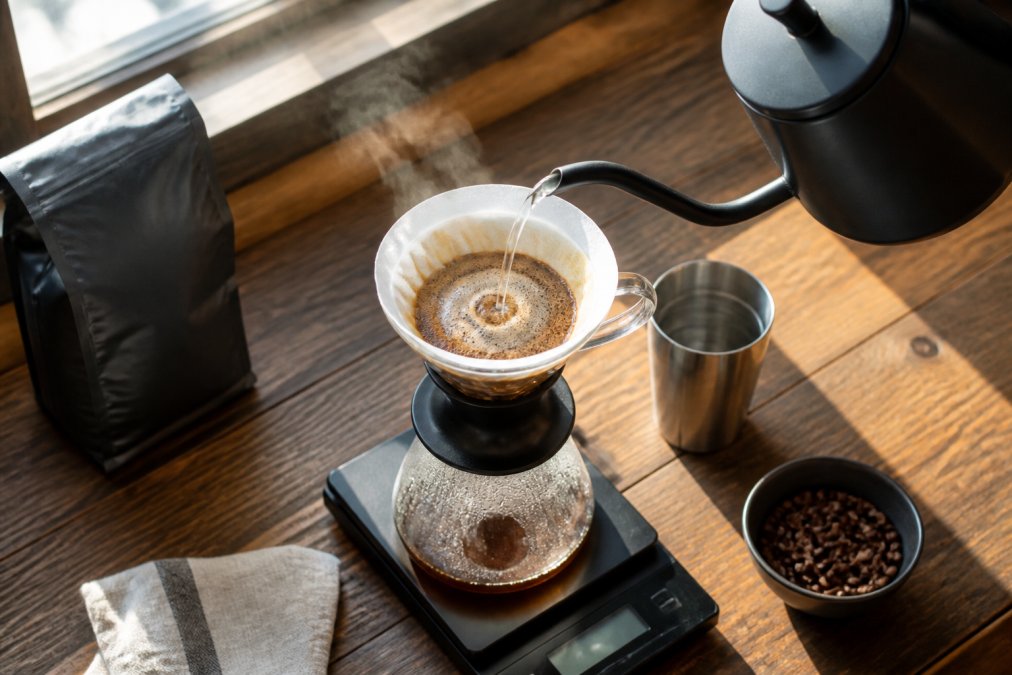
Brewing high elevation coffee beans well comes down to compensating for two things at once: dense bean structure and a lower boiling point. Dense beans need more work from the water to extract fully, but at elevation the water itself is cooler when it boils, so you have less thermal headroom to do that work. Get both wrong and you get a sour, hollow cup from beans that cost more than anything on the grocery shelf.
Why Altitude Changes the Brew, Not Just the Bean
Water boils when its vapor pressure equals atmospheric pressure. At sea level that happens at 212°F. As you climb, air pressure drops and the boiling point falls with it, roughly 1.9°F for every 500 feet of elevation gain. At 5,000 feet water boils near 203°F; at 7,000 feet it is closer to 198°F. That matters because a kettle that reads "boiling" is not delivering the same energy it would at sea level, and dense high-grown beans are the least forgiving beans to under-extract.
The Four Adjustments, With Real Numbers
- Weigh your beans. Use a 1:16 brew ratio: 20 grams of coffee to 320 grams of water. Dense beans tolerate a slightly tighter ratio, so 1:15 (20 g to 300 g) is a reasonable starting point if you want more intensity.
- Grind medium-fine. Aim for the texture of table salt. High-grown beans usually sit at the finer end of that range because their density slows extraction. If your brew finishes under 2:30, grind finer; over 3:30, grind coarser.
- Heat water to 200-205°F, and check your actual boiling point. At sea level, take the kettle off the boil and let it sit 30-45 seconds. At 5,000 feet, water boils around 203°F, so you are already in range the moment it boils; do not wait, or you will brew with water in the 190s. At 7,000 feet, boiling water is roughly 198°F, which is below the target window, use it immediately and accept a slightly longer brew time, or extend your ratio slightly to compensate.
- Bloom for 30-45 seconds. Pour twice the coffee's weight in water (about 40 g for a 20 g dose) and let it sit. Fresh beans release carbon dioxide, and skipping this step causes uneven extraction.
- Pour in slow circles. Three pours, working from the center outward, keeping the bed level. At altitude, keep the pours a touch slower, the lower boiling point means the slurry loses heat faster, and a fast pour drops bed temperature before extraction is complete.
- Finish between 2:30 and 3:30. Total brew time is your best signal. Too fast means grind finer; too slow means grind coarser.
Total time: about 8 minutes. Difficulty: beginner.
Dripper-Specific Calibration at Altitude
Most guides treat pour over as one method. It is not. Each dripper has a different flow rate, and flow rate interacts with the lower boiling point in a different way. Here is how to calibrate the three most common shapes.
What Is the Best Grind Size for Pour Over?
The best grind size for pour over is medium-fine, roughly the texture of table salt. High elevation beans usually need to sit at the finer end of that range because their density slows extraction. If your brew finishes under 2:30, grind finer. Over 3:30, grind coarser. At altitude, treat those time windows as your primary signal, they tell you whether the lower boiling point is costing you extraction.
Frequently Asked Questions
What type of coffee beans are best for pour over coffee?
High elevation coffee beans, particularly single-origin Arabica varieties like Typica, Caturra, and Bourbon, work best for pour over. These beans grow slowly at altitude, developing dense cell structure and complex acidity that pour over brewing highlights. Medium roasts are ideal because they preserve floral and fruity profiles without the bitterness that dark roasting introduces. Look for beans grown above 1,200 meters for the best flavor clarity.
How does altitude affect the flavor profile of high elevation coffee?
High elevation coffee develops more slowly in cooler mountain temperatures, building denser beans with concentrated sugars and acids. This produces brighter acidity, more floral notes, and fruitier profiles compared to lower-grown beans. The volcanic loam soil common at high altitudes also adds mineral complexity. Beans from 1,500 meters and above typically show the most pronounced flavor clarity and sweetness when brewed as pour over.
Does pour over brewing change at higher elevations?
Yes. At high altitude, lower atmospheric pressure means water boils at a lower temperature, so you need to adjust your brew temperature and grind size. Water boils around 202°F at 5,000 feet instead of 212°F at sea level. Use a finer grind to compensate for reduced extraction efficiency, and extend your brew time slightly. A gooseneck kettle with temperature control helps maintain thermal stability.
What is the best grind size for pour over with dense high-altitude beans?
Start with a medium-fine grind, similar to table salt, and adjust based on flow rate. Dense high elevation coffee beans resist extraction, so you may need to go one step finer than you would with lower-grown beans. If your brew drains in under 2:30, grind finer. If it takes over 4 minutes, grind coarser. Aim for a total brew time of 3 to 3:30 minutes including the bloom.
What are the best roast levels for high-altitude beans?
Medium roast is the sweet spot for high elevation coffee beans. It preserves the complex acidity, floral notes, and fruity profiles that altitude develops while caramelizing enough sugars for body and sweetness. Light roast works for washed process beans with bright acidity, like Kenyan or Nicaraguan lots. Avoid dark roast, which masks the density-driven flavor clarity you paid for.
High elevation coffee rewards discipline: the right grind, the right water, and a bean whose origin you can actually verify. Iron Spur Coffee sources specialty-grade beans from high-elevation estates and roasts them in small batches with precision thermal mapping to strip out bitter noise, then roasts to order so the bag arrives fresh. Every origin ships at $23.99 with fast, reliable delivery.
Discover Iron Spur Coffee today and start your morning on a foundation that holds.