

How to Measure Coffee Extraction Temperature Accurately
Last Updated: November 16, 2026
Quick Summary
Measure coffee extraction temperature by inserting a fast, accurate probe 1 to 2 inches into the stirred coffee bed and waiting for the reading to hold steady. Check kettle water first, read at a consistent moment like 30 seconds after the first pour, and log every reading.
- Preheat your dripper and cup with hot water so cold ceramic does not steal heat from the slurry.
- Insert the probe at least 1 inch into kettle water and wait 3 to 5 seconds for a steady reading.
- For espresso, probe the stream about 1 inch below the portafilter and average three pulls.
- Check thermometer calibration with an ice bath, which should read near 32°F.
- Extraction yield equals TDS percent times beverage weight divided by dry dose, times 100.
Table of Contents
- Why Coffee Extraction Temperature Decides What's in Your Cup
- Choosing a Coffee Brew Temperature Thermometer
- How to Measure Coffee Extraction Temperature at Home
- How to Measure Coffee Extraction Temperature for Espresso
- The Extraction Yield Formula Coffee Drinkers Should Know
- Temperature Gradients and Heat Loss During Brewing
- Troubleshooting Inconsistent Temperature Readings
- Build a Repeatable Morning Measurement Routine
- Frequently Asked Questions
Why Coffee Extraction Temperature Decides What's in Your Cup
Water temperature is the throttle on coffee extraction. Push it too high and you strip out harsh, bitter compounds. Drop it too low and the cup turns sour and thin. Learning how to measure coffee extraction temperature gives you control over that trade-off instead of guessing at it.
Heat decides flavor, and the same logic applies at your brew station. A few degrees of drift changes what dissolves into your cup.
Coffee extraction temperature is the temperature of the water as it contacts the coffee grounds during brewing. It is not the temperature of your mug, your kettle's display, or the room.
Extraction Temperature vs. Extraction Yield: Two Different Measurements
Most guides blur these together. They are not the same thing.
- Extraction temperature is a heat reading, measured in degrees Fahrenheit or Celsius.
- Extraction yield is a percentage: how much of the dry coffee dose dissolved into the brew.
- One uses a thermometer. The other uses a refractometer and a scale.
You can brew at a perfect temperature and still get a weak cup if your grind or ratio is off. You can also hit a great yield percentage while your brew water was too cool. Measure both, but never confuse them.
Choosing a Coffee Brew Temperature Thermometer
A coffee brew temperature thermometer needs three things: accuracy, a fast response time, and a probe thin enough to reach the coffee bed. Skip any of those and your readings mislead you.
Here is how the main types compare:
| Thermometer Type | Typical Accuracy | Response Time | Best For |
|---|---|---|---|
| Instant-read digital | Within about 1°F | 2-5 seconds | Kettle water and slurry checks |
| Thin probe digital | Within about 1°F | 3-6 seconds | Pour-over coffee bed readings |
| Thermocouple | Within about 1°F | Under 2 seconds | Espresso and fast, repeated checks |
| Dial kitchen thermometer | Often off by several degrees | 20+ seconds | Not recommended for brewing |
Accuracy, Calibration, and Response Time
Accuracy tells you how close a reading sits to the true temperature. Response time tells you how fast the probe catches up. Both matter, and they are not the same spec.
Check calibration with an ice bath: a mix of crushed ice and water should read near 32°F (Mercury Thermometer Alternatives: Verification Methods for Alternative Thermometers | NIST). If your thermometer drifts, adjust it or replace it. A probe that lags by ten seconds will read low during a fast pour. That is measurement error, not a brewing problem.
How to Measure Coffee Extraction Temperature at Home
Measuring coffee extraction temperature at home takes about a minute and follows six repeatable steps. Do them in the same order every time, and write down the number even when it looks wrong. The goal is a comparable reading, not a perfect one.
- Preheat your vessel. Rinse the dripper and cup with hot water so cold ceramic does not steal heat. A room-temperature ceramic dripper can pull several degrees out of the slurry in the first pour.
- Heat your brew water. Bring it to a boil, then let it settle to your target range. Give the kettle a swirl so the water temperature evens out before you pour.
- Check the kettle water first. Insert the probe at least 1 inch into the water and wait for the reading to hold steady for 3 to 5 seconds. This is your reference temperature before the water leaves the kettle.
- Stir the slurry, then measure. Give the coffee bed a gentle stir so heat spreads evenly, then insert the probe 1 to 2 inches into the wet grounds. Wait for the number to stop climbing before you read it.
- Read at a consistent moment. Take the coffee bed reading at the same point in every brew, such as 30 seconds after the first pour. Timing consistency matters more than the exact second you choose.
- Log the number. Write down the temperature, dose, grind setting, and brew time together. A reading without the surrounding variables is hard to act on later.
Watch out: inserting the probe only at the surface of the coffee bed. A probe that barely touches the top reads steam and air, not the slurry, and will run several degrees high.
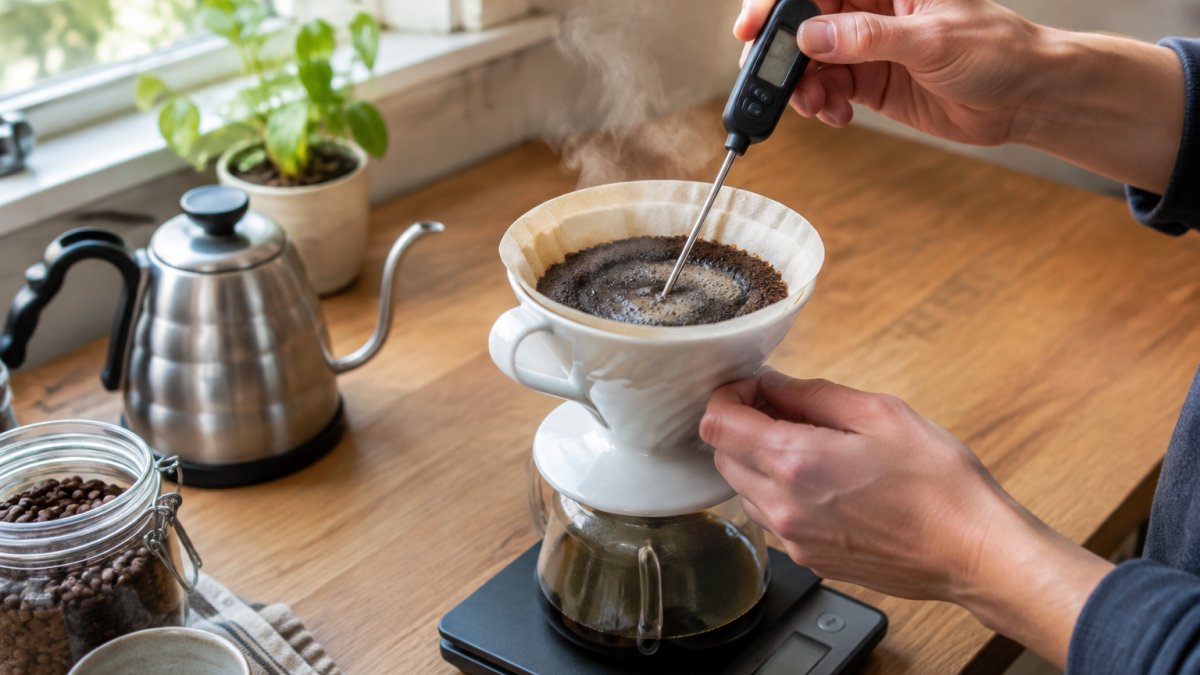
Probe Placement and Timing by Brewing Method
Where the probe goes changes by method, and each placement measures a different temperature. Treat them as separate readings rather than one universal number.
- Pour-over: place the probe 1 to 2 inches into the coffee bed after the bloom, not floating in the dripper. Read 30 seconds after the first main pour. This captures slurry temperature, which runs cooler than kettle water.
- French press: stir the crust, then probe the slurry at mid-depth. Read at the 2-minute mark. The immersion bed holds heat longer than a pour-over bed, so the reading stays more stable.
- Drip machine: probe the water in the reservoir before brewing and the stream from the shower head during the brew. The two readings often differ by several degrees.
- Kettle outlet: hold the probe in the water stream as you pour. This is the closest reading to the water temperature contacting the grounds, but it cools fast in the air.
If you want brewing setups that make temperature control easier to manage, our guide to the 5 best methods for brewing strong coffee at home walks through the gear. Readers comparing equipment can also review the 7 best brewing methods for single origin coffee before committing.
How to Measure Coffee Extraction Temperature for Espresso
Measuring coffee extraction temperature for espresso means reading the water at the group head, not the coffee in the cup. Pull a shot into a room-temperature cup with a probe in the stream, and you capture the water temperature as it leaves the machine. The cup reading will run cooler because the coffee loses heat on the way down.
Expect a fast reading. Espresso water moves quickly, so a slow probe will miss the peak. Repeat the test three times and average the results. One pull tells you almost nothing.
Group Head Placement and Machine Sensor Lag
Place the probe directly under the group head basket, centered in the stream, about 1 inch below the portafilter. Hold it steady for the full shot and note the highest stable number, not the first number you see.
Built-in machine sensors are convenient but usually sit upstream of the group head, so they read the boiler or thermoblock rather than the water hitting the coffee. A common pattern is for the machine display to read several degrees higher than a probe in the stream.
Watch out: pulling a shot into a cold cup and calling that the brew temperature. The cup reading reflects heat lost to the cup and the air, not the water temperature at the group head.
The Extraction Yield Formula Coffee Drinkers Should Know
The extraction yield formula coffee drinkers use is simple: divide the dissolved coffee solids by the dry coffee dose, then multiply by 100.
Extraction yield (%) = (TDS % × beverage weight) ÷ dry coffee dose × 100
Here is a worked example:
- Dry dose: 18 grams
- Beverage weight: 300 grams
- TDS reading: 1.35%
- Dissolved solids: 1.35% × 300 = 4.05 grams
- Yield: 4.05 ÷ 18 × 100 = 22.5%
A refractometer gives you total dissolved solids, or TDS. A scale gives you beverage weight. Together they turn a vague "tastes weak" into a number you can adjust against.
Temperature Gradients and Heat Loss During Brewing
Heat loss during brewing is the quiet reason your readings drift. Water cools as it leaves the kettle, crosses the air, and hits a cold dripper. The coffee bed itself pulls heat out of the slurry.
Preheating fixes most of it. So does brewing in a warm room without a cold draft across the counter.
Cold brewing sits at the far end of this spectrum, since extraction happens with no added heat at all. If that method interests you, our step-by-step cold brew guide covers the full process.
Troubleshooting Inconsistent Temperature Readings
Inconsistent readings usually trace to one of four causes. Work through them in order before you blame the coffee.
- Probe depth: a probe barely touching the surface reads air, not liquid.
- Reading too early: wait for the number to stop climbing.
- Cold equipment: an unrinsed dripper drops the slurry fast.
- Stirring unevenly: hot and cool pockets form in an unstirred bed.
Watch out: taking one reading per brew and treating it as gospel. Single readings swing. Log three brews before you change your technique.
Build a Repeatable Morning Measurement Routine
A repeatable routine beats a perfect one-off reading. Same steps, same timing, same log, every morning.
- Rinse the dripper and cup with hot water
- Heat water and check the kettle reading
- Stir the slurry, then probe the coffee bed
- Record temperature, dose, and brew time
- Note how the cup tasted
Folding measurement into an existing habit is the trick. Our specialty coffee morning routines show how other brewers build a disciplined start to the day.
Good temperature data also tells you when your beans are doing their job. Iron Spur Coffee roasts to order with precision thermal mapping to reduce bitterness, so your brew starts from a clean baseline.
Temperature drift is the easiest thing to fix and the easiest thing to ignore. Start measuring your brew water and coffee bed this week, log every reading, and let the numbers show you where your cup goes wrong.
Frequently Asked Questions
What temperature should water be for coffee extraction?
Most brewing guidelines put water temperature between 195°F and 205°F (90°C to 96°C) at the point where it meets the coffee bed. Below that range, under-extraction leaves the cup sour and thin; above it, you pull bitter compounds and lose the sweetness. For pour-over and drip, aim for 200°F at the kettle and expect a small drop by the time water hits the grounds. Espresso brew temperature usually sits between 195°F and 205°F at the group head, adjusted by roast level and taste.
Where should you place a thermometer to measure brew temperature?
Placement depends on the method. For pour-over, insert the probe into the coffee slurry about 30 seconds into the bloom, not into the water stream above it. For drip, measure the water in the brew basket once it pools. For espresso, you need a thermocouple or thermometer fitted at the group head or a temperature sensor built into the machine, since you cannot probe the puck mid-shot. Keep the probe tip fully submerged and away from the walls of the vessel for the most accurate reading.
Can you measure coffee extraction temperature at home without a refractometer?
Yes. A thermometer measures brew temperature; a refractometer measures total dissolved solids (TDS) so you can calculate extraction yield. These are separate measurements. You can dial in brew temperature at home with an instant-read or probe thermometer alone, and many home brewers stop there. A refractometer becomes useful when you want to connect temperature changes to extraction percentage using the extraction yield formula: (TDS × beverage weight) ÷ dry coffee dose.
Why do my temperature readings vary from cup to cup?
Common causes include reading at different points in the brew, an uncalibrated thermometer, slow probe response time, and heat loss through an unheated dripper or mug. Preheating your brewer and cup, taking the reading at the same moment every time, and calibrating the thermometer in ice water or boiling water will tighten your numbers. If readings still swing by more than a few degrees, the probe or sensor is likely the problem, not your technique.
