

Black Rifle Coffee vs Specialty Roasters: 2026 Guide
Table of Contents
- Black Rifle Coffee vs Specialty Roasters: How the Two Models Differ
- Quick Comparison: Roast, Sourcing, Price, and Freshness
- What Is Specialty Grade Coffee?
- Benefits of Small Batch Coffee Roasting
- How to Identify Fresh Roasted Coffee Before You Buy
- Where Each Option Wins: Use Cases and Brewing Method Fit
- Price Per Ounce, Sourcing Transparency, and Value
- Conclusion: Matching the Bag to the Job
- Frequently Asked Questions
Last Updated: September 13, 2026
Black Rifle Coffee vs Specialty Roasters: How the Two Models Differ
The black rifle coffee vs specialty roasters comparison comes down to one question: are you buying a brand identity or a bean? This guide from Iron Spur Coffee breaks down how the two models actually operate, from green coffee sourcing to what lands in your grinder.
Most comparisons stop at marketing. That misses the point. A roaster's model determines roast profile, freshness, sourcing transparency, and whether you're drinking coffee built for shelf life or coffee built for flavor clarity. Below, we'll show you exactly where each model wins, where it falls short, and how to read a bag before you spend money on it.
The comparison has three moving parts: what's in the bag (sourcing and grade), how it was roasted (profile and batch size), and how fast it reaches you (freshness logistics). Get those three right and the brand name matters far less than the label suggests. The Specialty Coffee Association's cupping standards provide the objective framework for judging the first part.
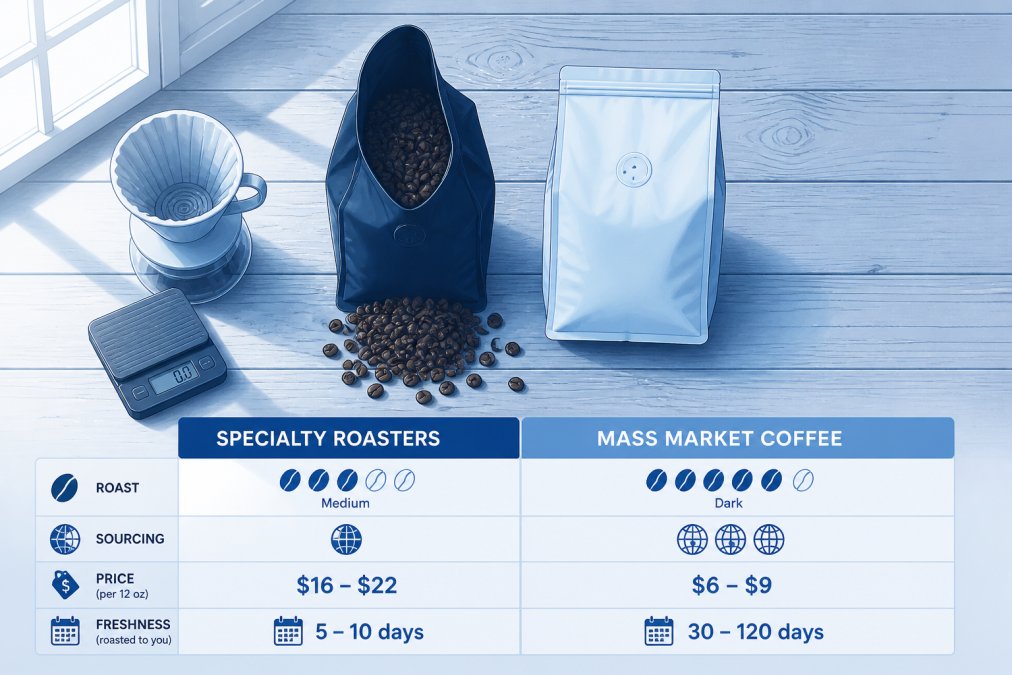
Quick Comparison: Roast, Sourcing, Price, and Freshness
Specialty roasters typically roast to order in small batches and print the roast date on the bag. Mass-market brands roast for consistency and shelf stability, which usually means darker profiles and longer time between roast and delivery.
| Factor | Mass-Market Model | Specialty Small-Batch Model |
|---|---|---|
| Roast level | Medium-dark to dark roast | Full range, often medium or med-light |
| Sourcing | Blended, origin rarely disclosed | Single-origin, farm-direct relationships |
| Batch size | Large, continuous production | Small-batch, thermal-mapped roasts |
| Freshness signal | "Best by" date | Roast date printed on bag |
| Price per ounce | Lower | Higher |
| Best for | Convenience, consistency | Flavor clarity, brewing control |
What Is Specialty Grade Coffee?
Specialty grade coffee is coffee that scores 80 points or higher on the 100-point scale used by licensed Q graders, with zero primary defects in the green sample (sca.coffee). That threshold separates it from commodity coffee, which trades on volume rather than cup quality.
The 80-Point Cupping Threshold and What It Filters Out
The 80-point line is not arbitrary. It filters out coffee with fermentation faults, mold damage, or inconsistent bean development. A clean cup, defined acidity, and a traceable aftertaste are baseline expectations above that line.
Here's what most guides miss: a roaster can source specialty-grade green coffee and still roast the character out of it. Grade sets the ceiling. Roast profile decides how much of that ceiling you actually taste. That distinction is why two bags of the same Colombian lot can taste nothing alike.
Benefits of Small Batch Coffee Roasting
Small-batch roasting gives the roaster tighter control over roast profile, which protects flavor clarity and limits the bitterness that comes from over-development. Smaller charges respond faster to heat adjustments, so the curve stays where the roaster intended.
Roast Profile, Bean Density, and Why Bitterness Happens
Bitterness in coffee usually traces to two things: over-extraction or over-roasting. High-density beans from highland-grown estates tolerate heat differently than low-density beans, so a single fixed profile applied to every lot produces uneven results. Precision thermal mapping lets a roaster adjust the curve to the bean in front of them rather than forcing the bean to fit a preset.
The practical payoff is a cup with complex sweetness instead of char. Iron Spur Coffee roasts to order in disciplined small batches with thermal mapping, which is how it targets that non-bitter profile rather than hoping for it.
How to Identify Fresh Roasted Coffee Before You Buy
Fresh roasted coffee is identified by a printed roast date, not a "best by" date. If the bag only carries an expiration window, you cannot know when the beans were roasted, and that is the single most useful piece of information on the label.
Roast Date, Oiliness, and the Bag Details That Matter
- Roast date printed as a specific day, not a month or season
- No visible surface oil on a medium roast (oiliness signals age or a very dark roast)
- One-way degassing valve on the bag
- Origin and processing method listed
- Whole bean option available
Oiliness deserves a note. Fresh medium roast beans look matte. Beans that glisten have either been roasted very dark or have sat long enough for oils to migrate to the surface. Both change what you taste.
Where Each Option Wins: Use Cases and Brewing Method Fit
Mass-market coffee wins on convenience and price predictability. Specialty small-batch coffee wins when the brewing method rewards clarity: pour-over, AeroPress, and espresso extraction all expose roast defects that a heavy dark roast can hide.
Brewing method compatibility matters more than most buyers expect. A med-light single-origin like Iron Spur Coffee's Ethiopia Natural, with its milk chocolate, fruity, and caramel notes, performs best as pour-over or AeroPress. A darker blend like the Italian Roast holds up in a moka pot or as a milk-based espresso drink where body and mouthfeel carry the cup. Match the roast to the method and both models improve.

The Technical Variables Most Comparisons Never Give You
This is the part the standard brand-versus-brand article skips: darker roasts and lighter specialty roasts do not brew the same way. If you use one recipe for both, you will blame the bean for a problem that lives in your grinder or kettle. Here is how to adjust.
Grind size. Darker roasts are more porous and soluble, so they extract faster. Go one or two clicks coarser than you would for a light roast on the same brewer. Lighter specialty roasts are denser and resist extraction, go finer, and expect to grind noticeably finer for espresso than you would for a dark blend.
Water temperature. A common starting range is 195-205°F (sca.coffee). For a dark, developed roast, stay at the lower end (around 195-200°F) to avoid pulling out the ashy, bitter compounds that are already close to the surface. For a light specialty roast, push toward 200-205°F to get full extraction from the denser bean.
Ratio. Start at 1:15 to 1:16 coffee-to-water by weight for drip and pour-over. Darker roasts often taste better slightly stronger (closer to 1:15); light roasts often open up at 1:16 or even 1:17. Weigh the coffee, volume scoops vary too much to be a reliable control.
Time and agitation. A dark roast can finish in a shorter window before it turns bitter. A light roast usually needs a longer contact time or a finer grind to reach the same extraction yield. If a light roast tastes sour or thin, you are under-extracting; if a dark roast tastes harsh or ashy, you are over-extracting.
Matching Roast to Method
| Brewing method | Best-fit roast | Key adjustment |
|---|---|---|
| Pour-over | Medium to med-light | Finer grind, 200-205°F, 1:16 |
| AeroPress | Medium to med-light | Finer grind, shorter steep, 1:15 |
| Drip | Medium | Medium grind, 195-200°F, 1:16 |
| Espresso | Medium to dark | Fine grind, 200°F, watch for channeling on light roasts |
| Moka pot | Medium-dark to dark | Medium-fine grind, preheat water, lower heat |
| French press | Any, but dark shines | Coarse grind, 4-minute steep, 195-200°F |
A darker blend like the Italian Roast is forgiving in a moka pot or as a milk-based espresso drink because body and mouthfeel carry the cup. A med-light single-origin rewards the adjustments above and punishes a lazy recipe. Match the roast to the method, then tune the variables, that is where the specialty model actually pays off.
Price Per Ounce, Sourcing Transparency, and Value
Price per ounce is the honest way to compare, because bag sizes vary and a lower sticker price often means less coffee. A 12-ounce bag at one price and a 2-pound bag at another are not comparable until you divide. Do that division before you decide which bag is the better deal.
How to Run the Per-Ounce Math
Three steps, in order:
- Divide the bag price by the net weight in ounces (the label lists net weight in grams on many specialty bags, divide grams by 28.35 to get ounces).
- Add shipping per bag if the roaster does not offer free shipping at your order size.
- Compare the result against the roast date and origin disclosure, not against the brand name.
A common pattern is that mass-market coffee lands in a lower per-ounce band while specialty small-batch coffee lands higher, and the gap widens once shipping is included on small orders. The value question is not whether specialty costs more. It is whether the roast date, origin detail, and cup quality justify the difference for how you brew.
What Transparency Actually Looks Like on a Label
Sourcing transparency is where the gap is widest. Farm-direct relationships and disclosed regions, altitudes, and varieties let you trace what you're drinking. Commodity blends rarely publish any of it. For buyers who care about where the money goes, that disclosure is part of the product.
A label that supports a real traceability claim usually names:
- The country and region (not just "South America")
- The altitude range in meters
- The processing method (washed, natural, honey, anaerobic)
- The variety or varietal group when known
- The grower, cooperative, or washing station
Iron Spur Coffee's single-origin lots list grower, region, altitude, and process on the product page. The High Plains Colombia, for example, is a medium roast from smallholder farmers in Medellín, Antioquia, at 1,300-1,500 meters, fully washed and dried in solar dryers. That level of detail is the practical difference between a brand promise and a paper trail.

The Certification Layer Most Comparisons Skip
This is the angle most side-by-side coffee comparisons leave out: third-party certifications. They are not the same as specialty grade, and they are not the same as farm-direct. Each answers a different question.
- Fair Trade (Fairtrade America in the U.S. market) focuses on minimum price floors and a social premium paid to cooperatives.
- USDA Organic certifies the growing and handling chain against the National Organic Program standards.
- Rainforest Alliance certifies against a combined environmental and social standard covering shade, water, and worker conditions.
- Bird Friendly (Smithsonian Migratory Bird Center) requires shade-grown criteria on top of organic.
A bag can be specialty grade and carry none of these. A bag can carry a certification and still score below the specialty threshold. Read them as separate signals: grade tells you about cup quality, certification tells you about production practices, and farm-direct tells you about the supply chain relationship. The strongest bags disclose all three.
Conclusion: Matching the Bag to the Job
The real decision is not which brand is better. It is which model fits how you actually drink coffee. If you want convenience and a familiar dark profile, the mass-market model delivers it. If you want flavor clarity, a roast date you can verify, and brewing variables you can control, specialty small-batch roasting is the better tool.
That is the standard Iron Spur Coffee builds to: specialty-grade beans from high-elevation estates, small-batch roasting with thermal mapping to cut bitterness, and roasting to order so the bag arrives fresh. Browse the single-origin lineup or the mushroom-infused roasts and match the bag to the job.
Frequently Asked Questions
Is Black Rifle Coffee considered high quality?
Black Rifle Coffee sells a range of roasts, but quality depends on how you measure it. Specialty grading is a specific standard: beans scoring 80 points or higher on the industry cupping scale, with traceable farm origins and a printed roast date. Mass-market and lifestyle brands often blend commodity coffee and skip origin detail, which is why flavor clarity and mouthfeel land flatter. If cupping notes, sourcing transparency, and roast date matter to you, check the bag label before you judge any brand.
What defines a specialty coffee roaster compared to a commercial brand?
A specialty roaster buys beans that meet the 80-point cupping threshold, names the farm or region, and roasts in small batches with a recorded roast profile. Commercial brands buy commodity coffee at scale, blend for consistency across millions of bags, and often sell coffee that was roasted months before it hits the shelf. The practical difference shows up in acidity, body, and aftertaste: specialty-grade coffee tends to taste cleaner and more distinct, while commodity coffee leans on roast intensity to mask defects.
How do I identify fresh roasted coffee on a bag label?
Look for three things. First, a printed roast date, not just a best-by date. Second, a roast level stated plainly, such as medium roast or dark roast. Third, origin detail: single-origin beans from a named region beat a vague blend. Whole beans stay fresh longer than pre-ground, and oiliness on the bean surface signals a darker roast or older stock. If a bag lists no roast date at all, assume it was roasted weeks or months ago.
Does roast-to-order coffee actually taste different from shelf coffee?
Yes, and the gap is largest in the first three weeks after roasting. Coffee releases carbon dioxide as it rests, and peak flavor usually lands between four and fourteen days post-roast. Supermarket bags may sit in a warehouse for months, so the aromatics fade before you open them. Roast-to-order coffee arrives closer to that window, which is why flavor clarity, sweetness, and aftertaste read stronger in the cup.
Why does thermal mapping matter in the coffee roasting process?
Thermal mapping records bean temperature through every stage of the roast, so the roaster can hit the same curve batch after batch. Without it, small changes in drum heat or airflow push a batch into over-roasting, which is where bitterness and a thin, ashy aftertaste come from. A controlled profile keeps extraction yield predictable, so a medium roast tastes like the tasting notes on the bag instead of a generic dark char.
Choosing between a brand you recognize and a roast you can trace is a daily decision, and the label rarely gives you enough to make it well. Iron Spur Coffee roasts to order in small batches, maps every roast profile to the bean, and prints the details that let you judge freshness for yourself. Start with the Ethiopia Natural for a bright, fruit-forward cup or the Italian Roast when you want depth and body. Discover Iron Spur Coffee today.