

What Direct Trade Coffee Sourcing Really Means
Last Updated: November 4, 2026
Quick Summary
Direct trade coffee sourcing is a model in which a roaster buys green coffee straight from a farm or producer cooperative, skipping most middlemen. The roaster often builds a long-term relationship, visits the origin, and negotiates quality and price directly with the producer. Unlike fair trade, it has no formal certification standard.
- Direct trade skips most middlemen between farmer and roaster.
- It is a private sourcing approach, not a certification with set rules.
- Fair trade guarantees a minimum price; direct trade prices vary by deal.
- Short supply chains do not guarantee fairness, since price still matters.
- Ask roasters for farm name, harvest year and price paid to verify claims.
Table of Contents
- What Direct Trade Coffee Sourcing Means in Practice
- Direct Trade vs Fair Trade Coffee: Key Differences
- How to Source Direct Trade Green Coffee Beans
- Direct Trade Coffee Benefits for Farmers
- Direct Trade Coffee Transparency and How to Verify Claims
- Risks and Measuring Outcomes for Your Next Coffee Order
- Frequently Asked Questions
Most coffee you buy has passed through a long chain before it reaches your grinder. Direct trade coffee sourcing is one way to shorten that chain, and at Iron Spur Coffee we think understanding the chain is the first step to choosing better beans.
In the traditional model, a farmer sells cherries or dried beans to a local collector. That collector sells to an exporter, who sells to an importer, who sells to a roaster. Each step adds a margin, and the farmer often sees only a small share of the final retail price.
- Farmers sell to local collectors or mills
- Exporters ship the coffee to consuming countries
- Importers sell lots to roasters and brokers
- Roasters buy, blend and roast before retail sale
The chain exists for good reasons. Small farms rarely have export licenses, shipping logistics or buyers' contacts, and intermediaries handle those tasks. The downside is that pricing is often set by commodity markets, and quality rewards may not reach the people who grew the crop.
Watch out: a short chain is not automatically a fair one. A roaster can buy direct and still pay a price that leaves the producer with little.
What Direct Trade Coffee Sourcing Means in Practice
Direct trade coffee sourcing means a roaster builds a long-term relationship with a specific farm or cooperative and buys its coffee without routing it through a broker. The roaster often visits the origin, agrees on quality standards with the producer, and pays a price negotiated between the two parties.
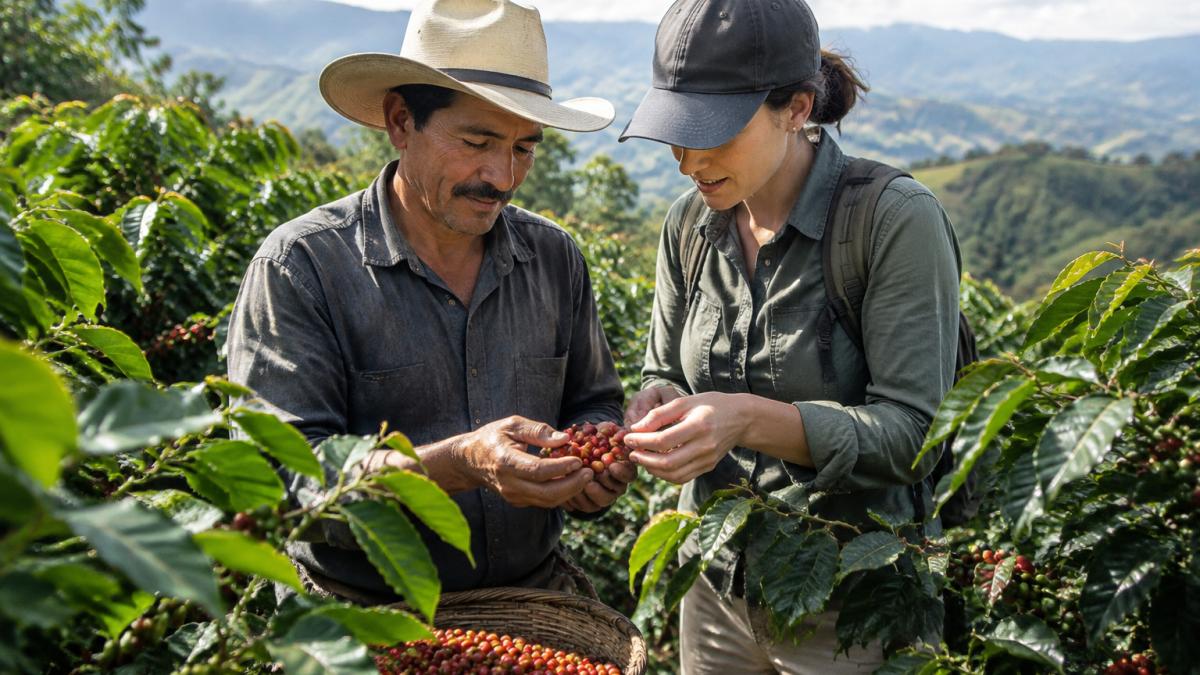
In practice, the relationship is the point. A roaster may request sample lots, give feedback on processing, and commit to buying the same farm's harvest for several years. Producers gain a buyer who understands their work, and roasters gain traceable, consistent coffee.
Direct trade is not a certification. For a side-by-side look at how Organic Fair Trade certification differs in its farmer impact, see Why Choose Organic Fair Trade Coffee Beans? No single independent body grants the label, so the claim depends on how transparent the roaster is about its supply relationships.
Direct Trade vs Fair Trade Coffee: Key Differences
Direct trade and fair trade are often confused, but they work differently. Fair trade is a certification system with set minimum prices and a community premium, governed by third-party organizations (Fair Trade Standards & Requirements). Direct trade is a private sourcing approach with no standard rules.
- Who sets terms: Fair trade sets terms through certification standards. Direct trade sets terms between the buyer and producer.
- Price: Fair trade guarantees a minimum price. Direct trade prices vary by deal.
- Verification: Fair trade is audited by third parties. Direct trade relies on the roaster's disclosures.
Many roasters use both models, and a coffee can carry a fair trade certification while also being sourced directly. The key is reading the label closely.
How to Source Direct Trade Green Coffee Beans
For a small roaster, direct sourcing is less a single transaction than a repeatable workflow. The steps below reflect how most practitioners structure a first direct relationship, and each one carries decisions that affect both coffee quality and producer income.
-
Define your buying profile before you look for farms. Decide the volume you can commit to per harvest, the flavor profiles and origins you want, your target landed cost per pound, and how much working capital you can tie up in inventory. A roaster who needs 1,500 pounds of a washed coffee for a year is shopping differently than one filling a single 37,500-pound container. Knowing your numbers first prevents wasted sample requests and unrealistic negotiations.
-
Find producers through credible channels. Common paths include exporter and importer partners, cooperative federations, coffee associations, trade shows, and referrals from other roasters. Many small roasters start with an importer who already has farm-level relationships and can consolidate lots, then move toward more direct contracts as volume grows. Ask each channel how they were introduced to the producer and how long they have worked together.
-
Request samples and cup systematically. Ask for a current-crop sample with the lot name, harvest date, altitude, variety, and processing method. Cup blind against your existing offerings, score for defects and consistency, and request a second sample from the same lot before committing. A single good cup can be a lucky roast; a repeatable profile across samples is what supports a multi-year contract.
-
Agree on quality, volume, and price in writing. A direct agreement typically specifies the lot, the harvest year, the volume in pounds or bags, the quality standard (often a cupping score range and defect limits), the price per pound, the payment schedule, and what happens if the delivered coffee fails to meet the agreed standard. Clarify whether the price is farm-gate, FOB origin, or delivered, because each term shifts freight and risk to a different party.
-
Confirm export, import, and logistics responsibilities. Small farms rarely hold export licenses, so the contract usually names an exporter or cooperative to handle milling, bagging, phytosanitary certificates, and customs paperwork. On the receiving side, an importer of record clears U.S. Customs and Border Protection, pays any applicable duties, and arranges delivery. Decide early who books freight, who insures the shipment, and who bears the cost if a container is delayed.
-
Structure payment to protect both sides. Direct deals commonly use a deposit at contract signing, a payment at shipment, and a final payment on arrival or approval of quality. Wire transfers are standard, and some buyers use letters of credit for larger volumes. Producers often need cash before harvest, so a schedule that pays part of the price early can matter more to a farm than a slightly higher total price paid months later.
-
Plan for the next harvest before this one ships. Repeat contracts are the clearest evidence that a direct relationship is real. Discuss expected volume and quality targets for the following year, and ask the producer what investments, drying beds, sorting equipment, worker training, would help them meet those targets.
Watch out: a first direct purchase can look cheaper per pound than a broker lot until freight, duties, insurance, warehousing, and the cost of a rejected lot are added in. Build a landed-cost model before signing, not after the container arrives.
Supply-Chain Costs and Payment Mechanics
Direct sourcing shifts costs rather than removing them. A roaster may pay the producer directly, but it also takes on freight, import duties, insurance, warehousing, and the risk of a bad lot. Export milling and bagging, ocean freight, port handling, customs brokerage, and inland trucking each add a line to the landed cost, and financing charges accrue while coffee sits in transit or in a warehouse. Payment is often made by wire transfer, sometimes in stages tied to shipment and arrival. For a small roaster buying a single container, these fixed costs can make the per-pound price higher than a broker lot, so the math needs to be checked before committing.
The article lays out seven steps for a first direct purchase, each with a decision that affects quality and producer income.
| Step | What to do | Key check |
|---|---|---|
| 1. Define buying profile | Set volume, origins, landed cost and working capital | Know your numbers first |
| 2. Find producers | Use importers, cooperatives, associations or referrals | Ask how the producer was introduced |
| 3. Request samples | Cup blind, score defects, get a second sample | Look for a repeatable profile |
| 4. Agree terms in writing | Specify lot, volume, quality standard, price and payment | State the pricing term clearly |
| 5. Confirm logistics | Name exporter for paperwork and importer for customs | Decide who bears delay costs |
| 6. Structure payment | Deposit at signing, payment at shipment, final on arrival | Early payment matters to farms |
| 7. Plan next harvest | Discuss next year's volume and quality targets | Repeat contracts show a real relationship |
Direct Trade Coffee Benefits for Farmers
A steady buyer can offer a price premium for high-scoring lots, and long-term contracts can reduce the risk of sudden price drops.
Direct buying does not guarantee better income, though. Premiums depend on the deal, and a farm with weak quality or poor record-keeping may struggle to capture higher prices. Expect outcomes to vary by farm.
Direct Trade Coffee Transparency and How to Verify Claims
Because direct trade has no formal standard, verification depends on the evidence a roaster is willing to show.
Identity and traceability. Ask for the farm or cooperative name, the region, the altitude range, the variety, the processing method, and the harvest year. For a cooperative lot, ask which washing station or member farms contributed.
Pricing records. Ask how the price was set and what it was relative to.
Relationship evidence. Direct trade is defined by repeat dealings, so ask how long the roaster has bought from this producer, how many consecutive harvests, and whether anyone from the company has visited the farm or cooperative.
Payment and contract terms. Ask when the producer was paid, at signing, at shipment, or on arrival, and whether payment was made in stages.
Producer-side outcomes. The strongest verification goes beyond the roaster's own narrative.
Ask your roaster for the farm name, the cooperative, the harvest year, and the price paid to the producer. A transparent roaster will usually share these details without hesitation.
Risks and Measuring Outcomes for Your Next Coffee Order
Direct sourcing has real risks. Crop failures, shipping delays and quality swings can all hit a small roaster hard. Measuring outcomes helps: track cup scores, on-time delivery, and whether the farm's pricing and quality terms were met.
When you shop, compare roasters by the details they publish, not just the words on the bag. Try a few single-origin options to learn which origins suit your taste. If you want a place to start, explore the single-origin coffees in our lineup, including the High Plains Colombia and the Forge Roast - Costa Rica, and see which farms and processes you prefer.


Frequently Asked Questions
What is direct trade in coffee?
Direct trade is a sourcing model in which a roaster buys green coffee straight from a producer, a farm or a producer cooperative, without relying on traditional intermediaries such as importers and exporters who handle most of the transaction. The relationship is ongoing rather than a one-time purchase, and it typically involves negotiated prices, shared quality goals and direct communication about harvests and lots. Iron Spur Coffee sources its specialty-grade beans from high-elevation estates, and buyers can see origin details such as the grower, region, altitude and processing method on each product listing.
Does direct trade coffee pay farmers more?
Direct trade often pays farmers more than the commodity market, because roasters negotiate prices with producers and frequently pay a quality premium above the market rate. However, direct trade is not a guarantee of higher pay. The amount depends on the agreement between the roaster and the producer, the quality of the lot and the costs involved. Buyers who want evidence should ask roasters for farm-gate price information or the specific premium paid for a given lot.
What are the key differences between direct trade and Fair Trade coffee?
Fair Trade is a certification system with set minimum prices and a community premium, verified by third-party auditors. Direct trade is a sourcing model defined by the direct relationship between roaster and producer, with pricing and terms negotiated case by case, and it often has no formal certification. Some coffees carry both claims. The most useful question for a buyer is whether the roaster can show who grew the coffee, what was paid and how the lot was selected.
How can you tell whether coffee is genuinely direct trade?
Look for specifics rather than general claims. A credible direct trade roaster names the farm or cooperative, the region and the altitude, and explains how the relationship works, including whether prices were negotiated and whether the buyer returns to the same producers year after year. Roasters that publish origin details on each product page, as Iron Spur Coffee does with its Bali Blue, Brazil Santos, High Plains Colombia and Forge Roast Costa Rica listings, make verification easier than roasters that only use the term.
