

Best Coffee Roasting Beans: 10 Single-Origin Picks
Table of Contents
- Quick Comparison: Best Coffee Roasting Beans
- How to Choose Coffee Beans for Roasting
- Best Green Coffee Beans for Home Roasting
- Coffee Roast Levels Explained
- Small-Batch Coffee Roasting: What It Means for Freshness
- Top Single-Origin Coffee Roasting Beans Reviewed
- Pricing and Value: What to Expect
- Verdict: Which Coffee Roasting Beans Should You Buy?
- Frequently Asked Questions
Last Updated: October 13, 2026
Quick Comparison: Best Coffee Roasting Beans
The best coffee roasting beans are single-origin green coffees chosen for a specific roast level, process, and origin character. At Iron Spur Coffee, we roast small batches to order, and we built this guide around the ten origins we know best, because the gap between a great green bean and a forgettable one comes down to origin, altitude, and how it was processed, not marketing copy.
Here is the short version before the detail:
| Origin | Roast Level | Tasting Profile | Best For | Price |
|---|---|---|---|---|
| Ethiopia Natural | Med-light | Milk chocolate, fruity, caramel | Bright, fruit-forward cups | $23.99 |
| Kenya | Light-medium | Orange, lemon, floral, effervescent | Pour-over and drip | $23.99 |
| Bali Blue | Med-dark | Dark chocolate, molasses, brown sugar | Espresso and French press | $23.99 |
| Brazil Santos | Medium | Smooth cup, cocoa notes | Everyday drip | $23.99 |
| Guatemala | Medium | Dark chocolate, bright fruit, butterscotch | Balanced all-rounder | $23.99 |
| Sumatra | Medium-dark | Syrupy body, dark chocolate, earthy | French press | $23.99 |
| Tanzania | Medium-light | Pear, floral, jasmine, strawberry | Pour-over | $23.99 |
| Papua New Guinea | Medium | Caramel, honey, fruit | Drip and cold brew | $23.99 |
| High Plains Colombia | Medium | Dried orange, berry, chocolate | Espresso and drip | $23.99 |
| Peru | Medium | Salted caramel, silky sweet, citrus | Drip and espresso | $23.99 |
If you only read one line: buy the origin that matches your brew method and your taste for acidity, not the one with the loudest label.

How to Choose Coffee Beans for Roasting
Choosing coffee beans for roasting starts with two decisions: the roast level you want to drink and the origin character you want to taste. Everything else, including price, packaging, and grind, follows from those two choices.
Start With Roast Level Goals
Decide what you want in the cup before you buy anything. A light roast preserves origin character: fruit, florals, and acidity. A dark roast trades that character for caramelized sugar and body. Most home roasters land somewhere in the middle, and medium roasts are the safest starting point because they forgive small mistakes in timing and temperature.
If you drink espresso, lean darker. If you drink pour-over, lean lighter. That single decision narrows your bean list faster than any review.
Check Origin, Altitude, and Process
Altitude and process shape flavor as much as roast level does. High-grown beans from estates above 1,200 meters tend to develop more sweetness and complexity. Process matters too: washed coffees taste clean and bright, while natural-process coffees taste fruitier and heavier.
- Washed process: clean, bright, defined acidity
- Natural process: fruity, sweet, heavier body
- Wet-hulled: earthy, syrupy, low acidity
Buy from sellers who publish the region, altitude, variety, and process. If a bag lists none of that, you are guessing.
Best Green Coffee Beans for Home Roasting
The best green coffee beans for home roasting are single-origin lots with clear origin data, consistent screen size, and enough density to survive a home roaster's heat curve. Density comes from altitude, so high-grown beans are the safer bet when you are still learning your machine.
Buy small quantities first. A one-pound bag lets you roast three or four batches and learn how the bean behaves before you commit to five pounds.
Coffee Roast Levels Explained
Coffee roast levels describe how far a roaster takes a bean past first crack, and they determine whether you taste the origin or the roast. Light, medium, and dark are the three broad categories, and each one changes acidity, body, and sweetness in predictable ways.
Light, Medium, and Dark Roast Flavor Profiles
- Light roast: bright acidity, floral and fruity notes, lighter body, more origin character
- Medium roast: balanced acidity and sweetness, caramel and chocolate notes, medium body
- Dark roast: low acidity, smoky and bittersweet notes, heavy body, roast flavor dominates
There is no single best roast level. There is only the roast level that suits how you brew and what you like to taste. A light-roasted Kenya in a French press can taste thin and sharp; the same bean at medium roast tastes rounder and sweeter.

Small-Batch Coffee Roasting: What It Means for Freshness
Small-batch coffee roasting means roasting in small quantities with close control over time and temperature, which lets a roaster adjust the profile batch by batch instead of running one setting for everything.
Freshness is the variable most buyers underestimate. Roasted coffee peaks in flavor within roughly the first two to four weeks after roasting, then slowly flattens.
Buy from roasters who print the roast date, not just a use-by date. If the date is missing, assume the coffee is older than you would like.
Top Single-Origin Coffee Roasting Beans Reviewed
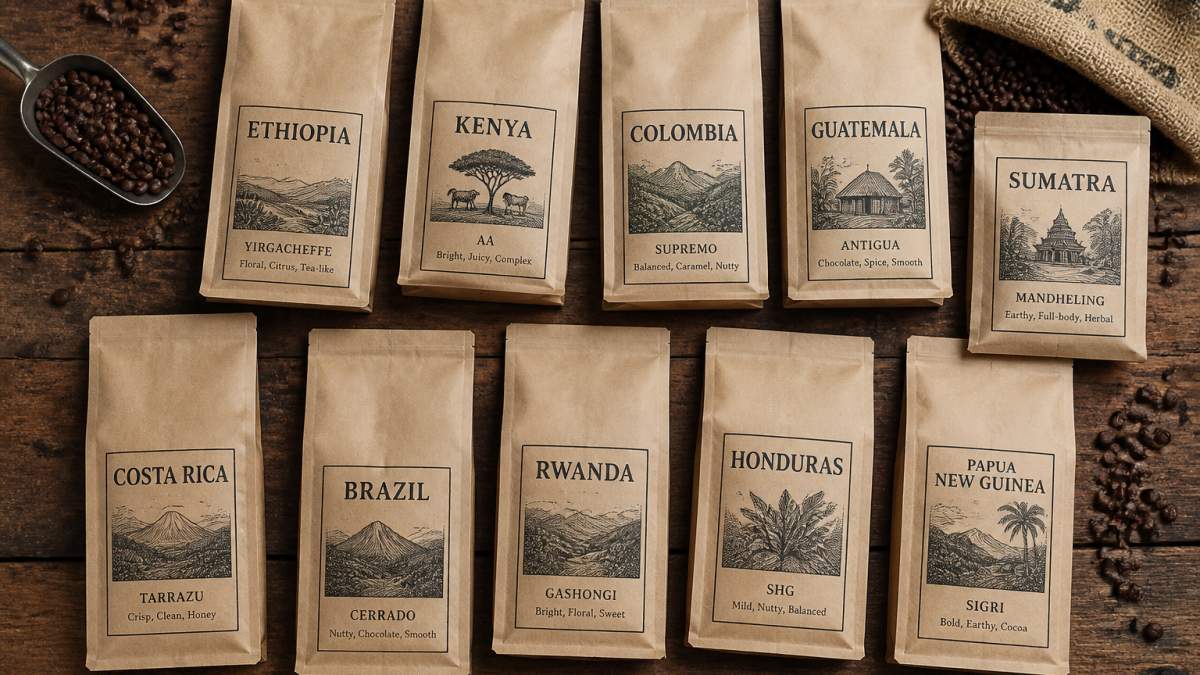
These ten origins cover the range from bright and floral to heavy and earthy. Each one lists the roast level, tasting profile, growing region, altitude, and process so you can match a bean to your brew method before you buy.
Ethiopia Natural
Our Ethiopia Natural is the fruit-forward pick. It comes from smallholder farmers in the Sidama zone, grown at 1,700 to 1,900 meters on nitisol soil, and processed as a full natural, hand-sorted and dried on raised beds. The cup shows milk chocolate, fruit, and caramel at a medium-light roast.
Best for pour-over and drip, where the fruit notes stay clear. If you like coffee that tastes like something other than coffee, start here.
Kenya
Kenya is the acidity benchmark in this lineup. Grown in Othaya, Nyeri County, at 1,700 to 1,890 meters, fully washed and dried on raised beds, with SL28, SL34, Ruiru 11, and Batian varieties. Expect bright acidity, orange, lemon, floral notes, and an effervescent finish.
This is a pour-over coffee. Brew it hot and fast, and keep the roast light to preserve the citrus.
Bali Blue
Bali Blue is the dark-roast option for people who want body without bitterness. Smallholder farmers in Kintamani grow it at 1,200 to 1,600 meters on volcanic loam, hand-picked, wet-hulled, and dried on raised beds. The profile is dark chocolate, molasses, and brown sugar at a medium-dark roast.
Best for espresso and French press. The molasses sweetness holds up against milk and sugar.
Brazil Santos
Brazil Santos is the smooth, low-drama cup. Grown by Fazenda Santa Barbara, Sao Francisco, and Santo Antonio in Parana and Sao Paulo at 750 to 1,050 meters, pulped natural and sun-dried, with Catuai and Mundo Novo varieties. The profile is elegant and smooth with cocoa notes at a medium roast.
Best for everyday drip and for anyone moving off grocery-store coffee.
Guatemala
Guatemala is the balanced all-rounder. Smallholder farmers in Antigua grow it at 1,200 to 1,616 meters on volcanic loam, fully washed and sun-dried, with Bourbon, Catuai, Caturra, and Typica varieties. The cup shows dark chocolate, bright fruit, and butterscotch at a medium roast.
Best for drip and espresso both.
Sumatra
Sumatra is the heavy, earthy cup. Grown in Aceh, Takengon, by the Koperasi Baitul Qiradh Baburrayyan cooperative at 1,100 to 1,600 meters, processed with giling basha wet-hulling, with Tim Tim, Typica, Ateng, Onan Ganjang, and Jember varieties. Notes are medium acidity, syrupy body, dark chocolate, dried fruit, and earth.
Best for French press, where the body has room to show.
Tanzania
Tanzania is the floral, delicate option. Small cooperative farmers in the Mbeya region grow it at 1,200 to 1,900 meters on clay-mineral soil, fully washed and dried on raised beds, with Bourbon and Kent varieties. The profile is pear, floral, jasmine, and strawberry at a medium-light roast.
Best for pour-over.
Papua New Guinea
Papua New Guinea sits between the bright and heavy ends of this list. Small agricultural cooperatives in Chimbu grow it at 1,350 meters on volcanic loam, fully washed and sun-dried, with Bourbon and Typica varieties. Caramel, honey, and fruit at a medium roast.
Best for drip and cold brew.
High Plains Colombia
High Plains Colombia is the crowd-pleaser. Smallholder farmers from Medellin grow it at 1,300 to 1,500 meters on volcanic loam, fully washed and dried in solar dryers to protect the coffee from rain, with Castillo, Caturra, Colombia, and Typica varieties. Dried orange, berry, and chocolate at a medium roast.
Best for espresso and drip.
Peru
Peru closes the list with the sweetest cup. The Cooperativa Agricola de Servicisios Norandino grows it in Piura and Amazonas at 1,100 to 1,700 meters on clay-mineral soil, gully washed and sun-dried, with Caturra, Bourpon, Catuai, Pache, and Catimor varieties. Salted caramel, silky sweetness, and citrus at a medium roast.
Best for drip and espresso.
Pricing and Value: What to Expect
Every origin in this guide is priced at $23.99 per bag, which keeps the comparison honest: you are choosing on flavor and roast level, not on price tier. That is deliberate on our part.
When you compare prices elsewhere, ask what the number includes.
The other value lever is waste. Buying beans matched to your brew method means fewer bags you drink out of obligation. That usually saves more than chasing a lower sticker price.
Verdict: Which Coffee Roasting Beans Should You Buy?
Buy the origin that matches your brew method and your taste for acidity, then buy it fresh. For pour-over, our picks are Ethiopia Natural, Kenya, and Tanzania. For espresso, go with Bali Blue, High Plains Colombia, or Peru.

We roast to order so the bag you open is close to its roast date, and we use precision thermal mapping in small batches to keep bitterness out of the cup. Start with one origin, log your brew, and adjust from there.
Frequently Asked Questions
Which roasted coffee beans are best?
The best roasted coffee beans depend on your brew method and flavor preference. For a balanced, sweet cup, medium roasts like Brazil Santos or Guatemala work well. If you prefer bright, fruity notes, try a medium-light roast such as Ethiopia Natural or Tanzania. Darker roasts like Bali Blue deliver bold, chocolatey flavors. All Iron Spur Coffee beans are roasted to order, so you get maximum freshness and a clear roast date on every bag.
What are the best green coffee beans for home roasting?
For home roasting, start with single-origin green beans that have consistent density and moisture. Ethiopian and Kenyan beans offer bright acidity and complex fruit notes, while Brazilian and Sumatran beans provide smoother, earthier profiles. Look for beans from high-elevation estates (1,200 to 1,900 meters) because they tend to roast more evenly. Always check the harvest date and store green beans in a cool, dry place.
How do you choose coffee beans for different roast levels?
Match the bean's origin and processing method to your target roast level. Light roasts preserve origin character, so use high-grown washed beans like Kenya or Tanzania. Medium roasts suit balanced beans like Colombia or Peru. Dark roasts work best with naturally processed or wet-hulled beans such as Sumatra or Bali Blue, which hold up to longer roasting without turning bitter. Buy from a roaster that lists altitude, variety, and process on the bag.
What are the four types of coffee roasts?
The four main coffee roast levels are light, medium-light, medium, and dark. Light roasts have bright acidity and floral notes. Medium-light roasts balance acidity with sweetness. Medium roasts offer a rounded flavor with caramel or chocolate tones. Dark roasts feature bold, smoky, or bittersweet flavors with low acidity. Iron Spur Coffee offers roasts across this spectrum, from the medium-light Ethiopia Natural to the medium-dark Bali Blue.
Does small-batch roasting make a difference in flavor?
Small-batch roasting gives the roaster more control over temperature and timing, which reduces the risk of bitterness and uneven development. Iron Spur Coffee uses precision thermal mapping during small-batch roasting to eliminate bitter notes and highlight each bean's natural sweetness. Because beans are roasted to order, they arrive fresher than grocery store bags that may sit on shelves for months. Freshness directly affects aroma, flavor, and extraction quality.
The hardest part of buying coffee roasting beans is not finding options. It is knowing which origin suits your brew method before you spend money. At Iron Spur Coffee, we source specialty-grade, high-elevation beans and roast them in disciplined small batches with precision thermal mapping to eliminate bitterness, then ship fast so the coffee reaches you near its roast date. Try one origin, taste it against your usual bag, and see the difference freshness makes. Discover Iron Spur Coffee today.